






Ahmedabad
(Head Office)Address : 506, 3rd EYE THREE (III), Opp. Induben Khakhrawala, Girish Cold Drink Cross Road, CG Road, Navrangpura, Ahmedabad, 380009.
Mobile : 8469231587 / 9586028957
Telephone : 079-40098991
E-mail: dics.upsc@gmail.com

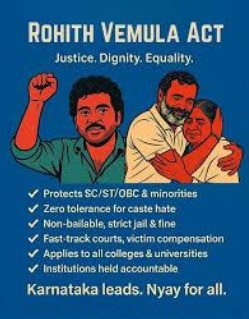
The Karnataka government has introduced the \'Karnataka Freedom of Choice in Marriage and Prevention and Prohibition of Crimes in the Name of Honour and Tradition (Eva Nammava, Eva Nammava) Bill, 2026.\' This landmark legislation seeks to provide a specialized legal shield for consenting adults opting for inter-caste marriages, directly addressing the persistence of caste-based violence and social exclusion in the state. • Protection of Marital Autonomy: The Bill explicitly guarantees the right of consenting adults to choose their life partners without coercion from family, community, or traditional institutions, treating such interference as a violation of fundamental dignity. • Stringent Penal Provisions: It proposes a minimum of five years\' imprisonment for killings committed in the name of \'honour.\' For cases involving injury, the Bill mandates at least two years of jail time and a fine of Rs 2 lakh, ensuring that the cost of communal interference is high. • Curbing Illegal Assemblies: A significant clause prohibits the assembly of five or more persons gathered with the intent to condemn or oppose a marriage based on caste, tribe, or tradition, thereby targeting the \'Khap-style\' community adjudications. • Institutional Support (Eva Nammava Vedike): The Bill mandates the creation of \'Eva Nammava, Eva Nammava\' (He/She is ours) Vedikes at the district level. These forums are designed to solemnize intercaste unions and provide a formal support system for vulnerable couples. • Addressing Systemic Discrimination: The legislation acknowledges that caste-based discrimination remains a reality and aims to transform social mindsets by promoting the \'Eva Nammava\' philosophy, which emphasizes inclusivity and human rights over regressive traditions. Key Definitions • Honour Killing: A homicide committed by family members or community members against a relative (usually a couple) who is perceived to have brought dishonour upon the family or community by breaking social norms, particularly through inter-caste or inter-religious relationships. • Eva Nammava, Eva Nammava: A Kannada phrase meaning \'He is ours, She is ours.\' Derived from the teachings of the 12th-century social reformer Basavanna, it promotes a sense of universal brotherhood and the rejection of \'othering\' based on caste. • Consenting Adult: A person who has attained the legal age of marriage (18 for women, 21 for men) and possesses the mental capacity to make a free and informed decision regarding their union. Constitutional & Legal Provisions • Article 21 (Right to Life and Liberty): The Supreme Court in the Shakti Vahini v. Union of India (2018) case ruled that the right to choose a life partner is a fundamental facet of Article 21. • Article 14 & 15: The Bill upholds Equality before Law and the Prohibition of Discrimination on grounds of religion, race, caste, sex, or place of birth. • Article 17 (Abolition of Untouchability): By protecting inter-caste marriages, the Bill indirectly strikes at the roots of endogamy, which is a primary pillar of the caste system and untouchability. • Special Marriage Act, 1954: This existing Central legislation provides a civil form of marriage for residents of India irrespective of the religion or caste followed by either party. Conclusion The \'Eva Nammava\' Bill marks a proactive shift from reactive policing to preventive legislation. By criminalizing community interference and providing district-level support structures, Karnataka is attempting to bridge the gap between constitutional morality and social practice. It reinforces the principle that \'tradition\' cannot override the \'sovereignty of the individual\' in a democratic republic. UPSC Relevance • GS Paper I: Social Issues (Casteism, Communalism, and Secularism; Role of women and women’s organization). • GS Paper II: Governance and Polity (Statutory, regulatory and various quasi-judicial bodies; Mechanisms, laws, institutions and Bodies constituted for the protection and betterment of vulnerable sections). • GS Paper IV: Ethics and Human Interface (Social influence and persuasion; Ethical concerns in private and public relationships). • Mains Perspective: Discuss the efficacy of legislative measures vs. social reform movements in tackling deep-rooted social evils like honour killings.


Address : 506, 3rd EYE THREE (III), Opp. Induben Khakhrawala, Girish Cold Drink Cross Road, CG Road, Navrangpura, Ahmedabad, 380009.
Mobile : 8469231587 / 9586028957
Telephone : 079-40098991
E-mail: dics.upsc@gmail.com
Address: A-306, The Landmark, Urjanagar-1, Opp. Spicy Street, Kudasan – Por Road, Kudasan, Gandhinagar – 382421
Mobile : 9723832444 / 9723932444
E-mail: dics.gnagar@gmail.com
Address: 2nd Floor, 9 Shivali Society, L&T Circle, opp. Ratri Bazar, Karelibaugh, Vadodara, 390018
Mobile : 9725692037 / 9725692054
E-mail: dics.vadodara@gmail.com
Address: 403, Raj Victoria, Opp. Pal Walkway, Near Galaxy Circle, Pal, Surat-394510
Mobile : 8401031583 / 8401031587
E-mail: dics.surat@gmail.com
Address: 303,305 K 158 Complex Above Magson, Sindhubhavan Road Ahmedabad-380059
Mobile : 9974751177 / 8469231587
E-mail: dicssbr@gmail.com
Address: 57/17, 2nd Floor, Old Rajinder Nagar Market, Bada Bazaar Marg, Delhi-60
Mobile : 9104830862 / 9104830865
E-mail: dics.newdelhi@gmail.com