





Ahmedabad
(Head Office)Address : 506, 3rd EYE THREE (III), Opp. Induben Khakhrawala, Girish Cold Drink Cross Road, CG Road, Navrangpura, Ahmedabad, 380009.
Mobile : 8469231587 / 9586028957
Telephone : 079-40098991
E-mail: dics.upsc@gmail.com


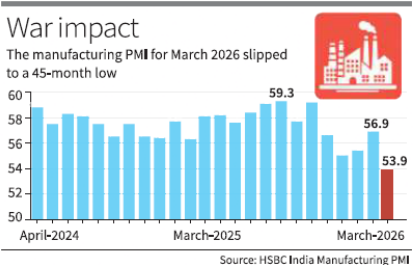
Context: India’s services sector, a critical pillar of its GDP, experienced a 14-month growth low in March 2026. Data from the HSBC India Services Purchasing Managers’ Index (PMI) indicates that while the sector remains in expansion mode, the ongoing conflict in West Asia has begun to dampen domestic demand and escalate operational costs. Analysis of Services Sector Performance • PMI Growth Deceleration: The Services PMI moderated to 57.5 in March from 58.1 in February. Although this represents the weakest expansion since early 2025, the figure remains significantly above the long-term average of 54.4, signaling continued resilience despite external shocks. • Dual Impact of Conflict: The West Asia war has acted as a double-edged sword; it has constrained domestic demand and tourism due to market uncertainty, while simultaneously driving input cost inflation to its highest level since mid-2022 due to surging fuel and logistics expenses. • Divergence in Demand: A notable \'de-coupling\' was observed between domestic and international markets. While domestic new business intakes slowed, export orders approached a series peak, with robust demand surfacing from regions including Africa, Europe, and the Americas. • Sectoral Vulnerability: Three out of four broad service areas—Finance & Insurance, Real Estate, and Transport/Information & Communication—reported softer sales. Consumer services, however, faced the brunt of the quickest increases in input costs. • Employment and Optimism: Despite the slowdown, job creation reached its strongest pace since mid2025. Business confidence remains at a 12-year high, underpinned by aggressive advertising and expectations of long-term demand recovery once geopolitical tensions subside. Key Definitions • Purchasing Managers’ Index (PMI): An economic indicator derived from monthly surveys of private sector companies. A reading above 50 indicates expansion, while below 50 indicates contraction. It is a \'lead indicator\' that predicts economic trends before official GDP data is released. • Input Cost Inflation: The rise in the price of raw materials and services (like fuel, electricity, and labor) used by a company to produce its final output. • Composite PMI Output Index: A weighted average of the Manufacturing and Services PMI, providing a holistic view of the private sector\'s health. Constitutional and Legal Provisions • Article 301: Guarantees Freedom of Trade, Commerce, and Intercourse throughout the territory of India, which is essential for the seamless operation of the transport and communication services sectors during crises. • Entry 92C of Union List (List I): Provides the Union government the power to levy taxes on services. The health of the services sector directly impacts the Integrated Goods and Services Tax (IGST) and Central GST (CGST) collections. • Consumer Protection Act, 2019: Relevant as consumer services face high output charges; it ensures that inflationary pricing does not lead to unfair trade practices or exploitation of domestic consumers. Conclusion The cooling of the services sector highlights India’s sensitivity to global supply chain disruptions and energy price volatility. While record-high export orders and strong employment figures provide a safety net, the sustained rise in input costs poses a risk of \'cost-push inflation.\' Maintaining growth momentum will require a delicate balance of monetary policy by the RBI to manage inflation without stifling the nascent recovery in domestic business sentiment. UPSC Relevance • GS Paper III (Economy): Role of the services sector in Indian economy; lead indicators like PMI vs. lag indicators like GDP; impact of global supply chains on domestic inflation. • GS Paper II (International Relations): Impact of West Asian instability on India’s \'Extended Neighborhood\' policy and its economic fallout on the domestic service industry and tourism. • Prelims: Definition and calculation of PMI, components of the services sector (finance, insurance, real estate), and the difference between headline and core inflation in the context of input costs.


Address : 506, 3rd EYE THREE (III), Opp. Induben Khakhrawala, Girish Cold Drink Cross Road, CG Road, Navrangpura, Ahmedabad, 380009.
Mobile : 8469231587 / 9586028957
Telephone : 079-40098991
E-mail: dics.upsc@gmail.com
Address: A-306, The Landmark, Urjanagar-1, Opp. Spicy Street, Kudasan – Por Road, Kudasan, Gandhinagar – 382421
Mobile : 9723832444 / 9723932444
E-mail: dics.gnagar@gmail.com
Address: 2nd Floor, 9 Shivali Society, L&T Circle, opp. Ratri Bazar, Karelibaugh, Vadodara, 390018
Mobile : 9725692037 / 9725692054
E-mail: dics.vadodara@gmail.com
Address: 403, Raj Victoria, Opp. Pal Walkway, Near Galaxy Circle, Pal, Surat-394510
Mobile : 8401031583 / 8401031587
E-mail: dics.surat@gmail.com
Address: 303,305 K 158 Complex Above Magson, Sindhubhavan Road Ahmedabad-380059
Mobile : 9974751177 / 8469231587
E-mail: dicssbr@gmail.com
Address: 57/17, 2nd Floor, Old Rajinder Nagar Market, Bada Bazaar Marg, Delhi-60
Mobile : 9104830862 / 9104830865
E-mail: dics.newdelhi@gmail.com