


Ahmedabad
(Head Office)Address : 506, 3rd EYE THREE (III), Opp. Induben Khakhrawala, Girish Cold Drink Cross Road, CG Road, Navrangpura, Ahmedabad, 380009.
Mobile : 8469231587 / 9586028957
Telephone : 079-40098991
E-mail: dics.upsc@gmail.com

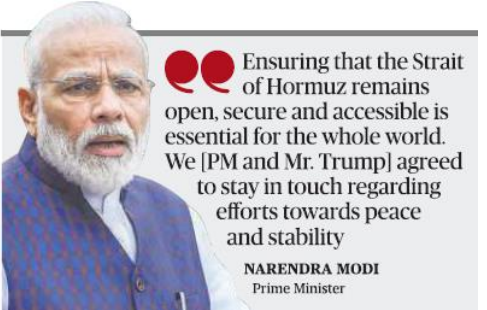
• Prime Minister Narendra Modi and US President Donald Trump held high-level discussions focusing on the escalating conflict in West Asia and its repercussions on regional stability. • A primary concern identified was the protection of the Strait of Hormuz, a critical maritime chokepoint through which a significant portion of the world\'s liquefied natural gas and oil exports pass. • India emphasized the necessity of de-escalation and the restoration of peace, citing the direct impact on the safety of the Indian diaspora, with reports confirming at least six Indian casualties in the region. • The US administration highlighted the military situation, including the deployment of additional Marines to the Gulf, amid ongoing airstrikes between Iran and Israel. • The dialogue underscores India’s growing role as a stakeholder in West Asian security, balancing its strategic autonomy while coordinating with global powers to ensure maritime freedom. • Both leaders agreed that keeping the Strait open and accessible is essential not just for regional actors but for the global economy to prevent a systemic energy shock. Key Concepts and Definitions Strait of Hormuz: A narrow waterway connecting the Persian Gulf with the Gulf of Oman and the Arabian Sea; it is the world’s most important oil transit chokepoint. Maritime Chokepoint: A strategic narrow passage that can be easily blocked to disrupt international trade or military movement. De-escalation: The reduction of the intensity of a conflict or a potentially violent situation through diplomatic or tactical maneuvers. Strategic and Legal Framework Article 51 of the Indian Constitution: Directs the State to promote international peace and security and maintain just and honorable relations between nations. UNCLOS (United Nations Convention on the Law of the Sea): Provides the legal framework for \'transit passage\' through international straits, ensuring that vessels have the right to navigate through chokepoints like Hormuz. Energy Security: India imports nearly 80% of its crude oil, with a massive share originating from the Persian Gulf, making the security of the Strait of Hormuz a non-negotiable national interest. Operation Sankalp: The Indian Navy’s maritime security operation launched to ensure the safe passage of Indian-flagged vessels through the Strait of Hormuz amidst regional tensions. Additional Key Points • The conflict has transitioned from localized skirmishes to direct exchanges between Iran and Israel, significantly raising the risk of a wider regional war. • India’s \'Link West\' policy faces a severe test as it navigates relations with the US, Israel, and Iran simultaneously. • Economic volatility: Any closure of the Strait could lead to a 20-30% spike in global oil prices, impacting India’s fiscal deficit and inflation targets. Conclusion and UPSC Relevance The telephonic conversation between the two leaders highlights the gravity of the West Asian situation and the shared interest in maritime security. For India, the stability of this region is inextricably linked to energy security and the welfare of millions of expatriates. From a UPSC perspective, this topic is critical for GS Paper II (International Relations), specifically the \'Effect of policies and politics of developed and developing countries on India’s interests\' and GS Paper III (Internal Security & Economy) regarding energy security and maritime threats. It also provides relevant content for essays concerning global geopolitics and India\'s strategic autonomy.


Address : 506, 3rd EYE THREE (III), Opp. Induben Khakhrawala, Girish Cold Drink Cross Road, CG Road, Navrangpura, Ahmedabad, 380009.
Mobile : 8469231587 / 9586028957
Telephone : 079-40098991
E-mail: dics.upsc@gmail.com
Address: A-306, The Landmark, Urjanagar-1, Opp. Spicy Street, Kudasan – Por Road, Kudasan, Gandhinagar – 382421
Mobile : 9723832444 / 9723932444
E-mail: dics.gnagar@gmail.com
Address: 2nd Floor, 9 Shivali Society, L&T Circle, opp. Ratri Bazar, Karelibaugh, Vadodara, 390018
Mobile : 9725692037 / 9725692054
E-mail: dics.vadodara@gmail.com
Address: 403, Raj Victoria, Opp. Pal Walkway, Near Galaxy Circle, Pal, Surat-394510
Mobile : 8401031583 / 8401031587
E-mail: dics.surat@gmail.com
Address: 303,305 K 158 Complex Above Magson, Sindhubhavan Road Ahmedabad-380059
Mobile : 9974751177 / 8469231587
E-mail: dicssbr@gmail.com
Address: 57/17, 2nd Floor, Old Rajinder Nagar Market, Bada Bazaar Marg, Delhi-60
Mobile : 9104830862 / 9104830865
E-mail: dics.newdelhi@gmail.com