






Ahmedabad
(Head Office)Address : 506, 3rd EYE THREE (III), Opp. Induben Khakhrawala, Girish Cold Drink Cross Road, CG Road, Navrangpura, Ahmedabad, 380009.
Mobile : 8469231587 / 9586028957
Telephone : 079-40098991
E-mail: dics.upsc@gmail.com

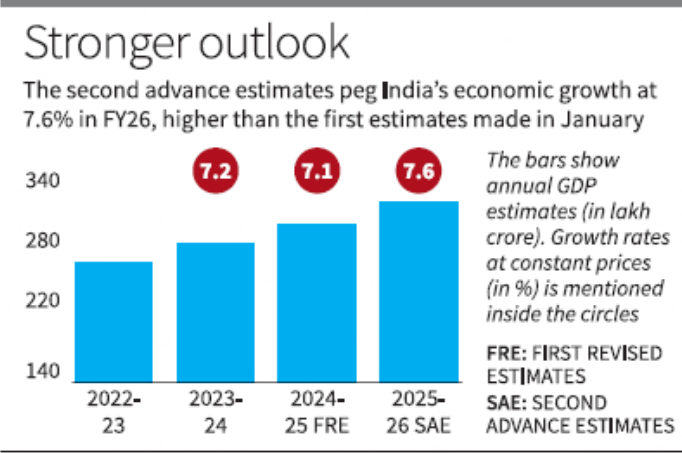
The Ministry of Statistics and Programme Implementation (MoSPI) has released the second advance estimates for FY26, incorporating a foundational shift in India’s Gross Domestic Product (GDP) calculation through a new data series. Core Summary of the New GDP Series • Growth Projection Upgrade: India’s real GDP growth for FY26 is now estimated at 7.6% under the new series, an upward revision from the 7.4% projected in the January advance estimates. • Base Year Revision: The government has updated the base year for national accounts from 2011-12 to 2022-23 to better reflect the structural changes, consumption patterns, and technological shifts in the modern economy. • Data Granularity: The new series integrates several fresh datasets and improved methodologies to enhance representativeness, aiming for a more accurate capture of the unorganized sector and digital economy. • Historical Revisions: The growth rate for FY24 was revised downward to 7.2% (from 9.2%), while FY25 saw an upward revision to 7.1% (from 6.5%), indicating a recalibration of the post-pandemic recovery trajectory. • Nominal GDP Impact: The absolute size of the nominal GDP has been revised downward for the 2023- 26 period, which creates a mathematical \'denominator effect\' on key macroeconomic indicators. • Fiscal Implications: A lower nominal GDP base implies that ratios such as the Fiscal Deficit-to-GDP and Debt-to-GDP will appear higher, potentially challenging the government\'s fiscal consolidation targets despite robust real growth. Key Definitions • Base Year: A representative year used as a benchmark for calculating real growth by eliminating the effects of inflation. Updating it prevents the \'base effect\' from distorting current economic reality. • Real vs. Nominal GDP: Real GDP is inflation-adjusted, measuring actual production volume, while Nominal GDP is calculated at current market prices without adjusting for inflation. • Denominator Effect: A phenomenon where a ratio (like Debt/GDP) increases not because the numerator (Debt) grew, but because the denominator (GDP) was revised downward. Constitutional and Legal Provisions • Article 112: Relates to the Annual Financial Statement (Budget). Accurate GDP data is vital for the constitutional requirement of presenting a transparent account of the nation\'s finances. • FRBM Act, 2003: The Fiscal Responsibility and Budget Management Act mandates specific targets for fiscal deficit as a percentage of GDP. Changes in GDP calculation directly impact compliance with this legal framework. • Collection of Statistics Act, 2008: Provides the legal backing for MoSPI and the National Statistical Office (NSO) to collect data from industrial and household units for national accounting. Additional Key Points • Sectors Impacted: The revision usually incorporates newer sectors like gig-work and digital services that were underrepresented in the 2011-12 series. • Global Alignment: Periodic rebasing is a standard practice recommended by the United Nations System of National Accounts (SNA) to ensure international comparability of economic data. • Policy Calibration: The Chief Economic Adviser (CEA) noted that while the new series shows faster current growth, the lower nominal base requires cautious fiscal planning for the upcoming budget cycles. Conclusion: The transition to the 2022-23 base year aligns India\'s statistical architecture with its current economic profile. While the surge in real growth to 7.6% signals strong momentum, the downward revision of the nominal base necessitates a tighter grip on fiscal management to maintain investor confidence and debt sustainability. UPSC Relevance: • GS Paper III: Indian Economy and issues relating to planning, mobilization of resources, growth, development, and employment. • Prelims: Concepts of GDP, GVA, Base Year effects, and the roles of NSO and MoSPI. • Economic Survey/Budget: These estimates form the bedrock of the projections found in the annual Economic Survey.


Address : 506, 3rd EYE THREE (III), Opp. Induben Khakhrawala, Girish Cold Drink Cross Road, CG Road, Navrangpura, Ahmedabad, 380009.
Mobile : 8469231587 / 9586028957
Telephone : 079-40098991
E-mail: dics.upsc@gmail.com
Address: A-306, The Landmark, Urjanagar-1, Opp. Spicy Street, Kudasan – Por Road, Kudasan, Gandhinagar – 382421
Mobile : 9723832444 / 9723932444
E-mail: dics.gnagar@gmail.com
Address: 2nd Floor, 9 Shivali Society, L&T Circle, opp. Ratri Bazar, Karelibaugh, Vadodara, 390018
Mobile : 9725692037 / 9725692054
E-mail: dics.vadodara@gmail.com
Address: 403, Raj Victoria, Opp. Pal Walkway, Near Galaxy Circle, Pal, Surat-394510
Mobile : 8401031583 / 8401031587
E-mail: dics.surat@gmail.com
Address: 303,305 K 158 Complex Above Magson, Sindhubhavan Road Ahmedabad-380059
Mobile : 9974751177 / 8469231587
E-mail: dicssbr@gmail.com
Address: 57/17, 2nd Floor, Old Rajinder Nagar Market, Bada Bazaar Marg, Delhi-60
Mobile : 9104830862 / 9104830865
E-mail: dics.newdelhi@gmail.com