





Ahmedabad
(Head Office)Address : 506, 3rd EYE THREE (III), Opp. Induben Khakhrawala, Girish Cold Drink Cross Road, CG Road, Navrangpura, Ahmedabad, 380009.
Mobile : 8469231587 / 9586028957
Telephone : 079-40098991
E-mail: dics.upsc@gmail.com

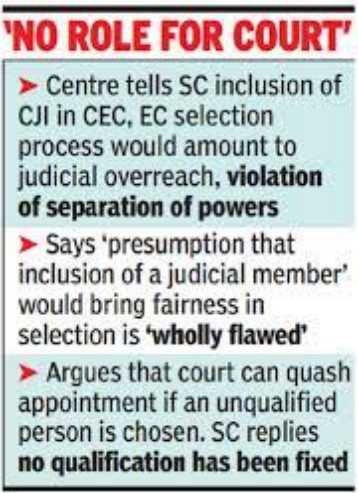
Summary of Key Developments • Recusal of the CJI: Chief Justice of India (CJI) Surya Kant has shifted petitions challenging the Chief Election Commissioner and Other Election Commissioners (Appointment, Conditions of Service and Term of Office) Act, 2023 to a different Bench to avoid potential \'conflict of interest.\' • Avoidance of Bias: The CJI noted that since the law directly concerns the inclusion or exclusion of the CJI’s office from the selection panel, any ruling by a Bench he heads could invite criticism; he further suggested the case be heard by judges not in line to become future CJIs. • Dilution of Anoop Baranwal Ruling: Petitioners, including the Association for Democratic Reforms (ADR), argue that the 2023 Act deliberately dilutes the Supreme Court’s 2023 verdict in Anoop Baranwal vs Union of India, which had mandated the CJI’s presence in the selection committee. • Composition of the Selection Panel: The contentious Section 7(1) of the new Act replaces the CJI with a Union Cabinet Minister, creating a panel consisting of the Prime Minister, the Leader of Opposition (or leader of the largest opposition party), and a Cabinet Minister. • Executive Preponderance: The primary legal challenge rests on the shift from a balanced panel to one where the executive (PM and a nominated Minister) holds a 2:1 majority, potentially undermining the independence of the Election Commission. • Scheduled Hearing: Acknowledging the sensitivity of the matter, the Bench has listed the case for April 7 before an appropriate Bench that excludes the prospective CJI to ensure perceived and actual impartiality. Key Definitions • Recusal: The act of a judge abstaining from participating in a legal proceeding due to a conflict of interest or lack of impartiality. • Conflict of Interest: A situation where an individual\'s personal or professional interests could compromise their judgment, decisions, or actions in an official capacity. • Executive Preponderance: A state where the executive branch of government holds dominant power or influence over other branches or independent bodies. Constitutional & Legal Provisions • Article 324(2): Provides that the appointment of the CEC and ECs shall be made by the President, subject to the provisions of any law made by Parliament. • Independence of the EC: Though not explicitly mentioned as a \'Basic Structure\' element in isolation, the Supreme Court has held that \'free and fair elections\' are part of the Basic Structure, which necessitates an independent Election Commission. • Section 7 of the 2023 Act: Specifies the Appointment Committee\'s composition; this is the specific provision currently under judicial scrutiny for allegedly bypassing the Anoop Baranwal guidelines. • Doctrine of Separation of Powers: A constitutional principle where the Executive, Legislature, and Judiciary function in their own domains; petitioners argue the new law encroaches upon judicial oversight of democratic purity. Additional Important Keypoints • The Anoop Baranwal Precedent: In March 2023, a Constitution Bench ruled that until Parliament makes a law, the selection committee should consist of the PM, LoP, and the CJI to ensure a \'fair and transparent\' process. • Legislative Overruling: While Parliament has the power to vacate a judicial vacuum by passing a law, the judiciary can still test that law against the touchstone of the Constitution and the principle of institutional independence. • Nemo Judex in Causa Sua: This Latin maxim means \'no one should be a judge in their own cause.\' The CJI’s decision to shift the Bench aligns with this fundamental principle of natural justice. Conclusion and UPSC Relevance The transition of the selection process from a judicially-integrated panel to an executive-dominated one marks a significant friction point between the judiciary and the legislature. The CJI\'s move to ensure the case is heard by a \'neutral\' Bench highlights the Supreme Court\'s commitment to procedural propriety. For the UPSC aspirant, this topic is critical as it intersects with the independence of constitutional bodies, judicial ethics (recusal), and the evolving nature of the \'Separation of Powers\' in Indian democracy. UPSC Relevance: • General Studies II: Appointment to various Constitutional posts, powers, functions and responsibilities of various Constitutional Bodies; Judiciary (Recusal, Doctrine of Bias); Statutory, regulatory and various quasi-judicial bodies. • Ethics (GS IV): Conflict of Interest and the principle of \'Nemo Judex in Causa Sua.\'


Address : 506, 3rd EYE THREE (III), Opp. Induben Khakhrawala, Girish Cold Drink Cross Road, CG Road, Navrangpura, Ahmedabad, 380009.
Mobile : 8469231587 / 9586028957
Telephone : 079-40098991
E-mail: dics.upsc@gmail.com
Address: A-306, The Landmark, Urjanagar-1, Opp. Spicy Street, Kudasan – Por Road, Kudasan, Gandhinagar – 382421
Mobile : 9723832444 / 9723932444
E-mail: dics.gnagar@gmail.com
Address: 2nd Floor, 9 Shivali Society, L&T Circle, opp. Ratri Bazar, Karelibaugh, Vadodara, 390018
Mobile : 9725692037 / 9725692054
E-mail: dics.vadodara@gmail.com
Address: 403, Raj Victoria, Opp. Pal Walkway, Near Galaxy Circle, Pal, Surat-394510
Mobile : 8401031583 / 8401031587
E-mail: dics.surat@gmail.com
Address: 303,305 K 158 Complex Above Magson, Sindhubhavan Road Ahmedabad-380059
Mobile : 9974751177 / 8469231587
E-mail: dicssbr@gmail.com
Address: 57/17, 2nd Floor, Old Rajinder Nagar Market, Bada Bazaar Marg, Delhi-60
Mobile : 9104830862 / 9104830865
E-mail: dics.newdelhi@gmail.com