






Ahmedabad
(Head Office)Address : 506, 3rd EYE THREE (III), Opp. Induben Khakhrawala, Girish Cold Drink Cross Road, CG Road, Navrangpura, Ahmedabad, 380009.
Mobile : 8469231587 / 9586028957
Telephone : 079-40098991
E-mail: dics.upsc@gmail.com

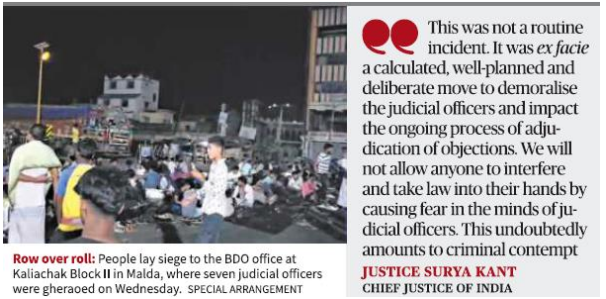
The Supreme Court has taken a stern view of the \'mob gherao\' of seven judicial officers in Malda, West Bengal, who were confined without basic necessities for over nine hours. Deployed as Election Registration Officers (EROs) under Supreme Court orders, these officers were targeted during the Special Intensive Revision (SIR) of electoral rolls. The Court characterized the incident as a calculated attempt to demoralize the judiciary and an act of criminal contempt that reflects a breakdown of the state\'s administrative machinery. Core Summary of the Supreme Court\'s Observations • Assault on Judicial Integrity: The CJI termed the confinement of judicial officers (including three women) as a \'brazen attempt\' to browbeat the judiciary and a direct challenge to the authority of the Supreme Court. • Calculated Interference: The Court observed that the violence was not spontaneous but a \'wellplanned and deliberate move\' designed to influence the ongoing adjudication of voter objections ahead of the Assembly elections. • Administrative Failure: The Bench noted a \'complete failure\' of the civil and police administration in West Bengal for failing to prevent the nine-hour captivity and the subsequent stone-pelted rescue of the officers. • Political Polarization: Chief Justice Surya Kant highlighted the extreme political polarization in the state, noting that the environment has become one where administrative and political actors often speak a \'political language\' rather than a constitutional one. • Criminal Contempt Warning: The Court clarified that any attempt to interfere with judicial officers performing duties mandated by the top court \'undoubtedly amounts to criminal contempt\' and will not be tolerated. Key Definitions • Gherao: A form of protest involving the encirclement of a target (usually a person in authority) to prevent them from leaving until certain demands are met. • Special Intensive Revision (SIR): A rigorous process of updating electoral rolls to ensure accuracy, often involving judicial officers to adjudicate claims and objections regarding voter exclusion. • Criminal Contempt: Under the Contempt of Courts Act, 1971, it includes any act that scandalizes the court, prejudices judicial proceedings, or interferes with the administration of justice. Constitutional & Legal Provisions • Article 129: Grants the Supreme Court the power to punish for contempt of itself, acting as a \'Court of Record\' to maintain judicial dignity. • Article 144: Mandates that all authorities, civil and judicial, in the territory of India shall act in aid of the Supreme Court. The failure of the Malda administration is a direct violation of this mandate. • Article 324: Relates to the superintendence, direction, and control of elections. The judicial officers were acting in a quasi-judicial capacity to ensure the integrity of the electoral process under this framework. • Independence of the Judiciary: A \'Basic Structure\' doctrine component which requires that judicial officers be free from executive or mob pressure to perform their legal duties. Important Keypoints for Analysis • Security of the Subordinate Judiciary: The incident raises critical questions about the physical security provided to judicial officers when they are assigned executive or election-related duties. • Rule of Law vs. Mobocracy: The transition from legal protest to physical confinement (Gherao) signals a dangerous shift where mob pressure seeks to bypass established legal adjudication processes. • Neutrality of State Machinery: The CJI\'s remarks on polarization underscore the need for an impartial bureaucracy and police force that remains insulated from partisan politics during election cycles. Conclusion The Supreme Court\'s intervention underscores that the safety of judicial officers is non-negotiable for the survival of the Rule of Law. By equating the Malda incident with criminal contempt, the Court has sent a clear message: administrative negligence in protecting the judiciary will be viewed as a constitutional lapse. Ensuring a fear-free environment for those adjudicating electoral disputes is essential for the conduct of \'free and fair elections,\' which is a cornerstone of Indian democracy. UPSC Relevance • GS Paper II (Polity): Essential for topics such as the Independence of the Judiciary, the Role of the Governor/State Executive in maintaining Law and Order, and the conduct of Elections. • Governance: Highlights the challenges of administrative neutrality in \'politically polarized\' environments and the implementation of Article 144.


Address : 506, 3rd EYE THREE (III), Opp. Induben Khakhrawala, Girish Cold Drink Cross Road, CG Road, Navrangpura, Ahmedabad, 380009.
Mobile : 8469231587 / 9586028957
Telephone : 079-40098991
E-mail: dics.upsc@gmail.com
Address: A-306, The Landmark, Urjanagar-1, Opp. Spicy Street, Kudasan – Por Road, Kudasan, Gandhinagar – 382421
Mobile : 9723832444 / 9723932444
E-mail: dics.gnagar@gmail.com
Address: 2nd Floor, 9 Shivali Society, L&T Circle, opp. Ratri Bazar, Karelibaugh, Vadodara, 390018
Mobile : 9725692037 / 9725692054
E-mail: dics.vadodara@gmail.com
Address: 403, Raj Victoria, Opp. Pal Walkway, Near Galaxy Circle, Pal, Surat-394510
Mobile : 8401031583 / 8401031587
E-mail: dics.surat@gmail.com
Address: 303,305 K 158 Complex Above Magson, Sindhubhavan Road Ahmedabad-380059
Mobile : 9974751177 / 8469231587
E-mail: dicssbr@gmail.com
Address: 57/17, 2nd Floor, Old Rajinder Nagar Market, Bada Bazaar Marg, Delhi-60
Mobile : 9104830862 / 9104830865
E-mail: dics.newdelhi@gmail.com