


Ahmedabad
(Head Office)Address : 506, 3rd EYE THREE (III), Opp. Induben Khakhrawala, Girish Cold Drink Cross Road, CG Road, Navrangpura, Ahmedabad, 380009.
Mobile : 8469231587 / 9586028957
Telephone : 079-40098991
E-mail: dics.upsc@gmail.com

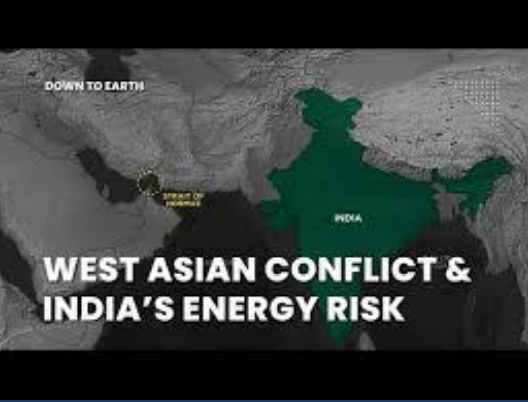
• Strategic Shift in Priority: Amidst the Iran-Israel conflict and Brent crude crossing $100 per barrel, the Indian government has pivoted its focus from price stability to supply security, prioritizing the continuous physical availability of crude oil and LNG over inflationary concerns. • Vulnerability of the Strait of Hormuz: As a critical maritime chokepoint handling 20% of global liquid petroleum and LNG, the effective suspension of tanker movements through the Strait puts nearly half of India\'s oil imports (primarily from Iraq, Saudi Arabia, and UAE) at structural risk. • Macroeconomic Implications: With an oil import dependency exceeding 88%, every $1/barrel increase in crude prices raises India’s annual import bill by approximately $2 billion, potentially widening the Current Account Deficit (CAD) by 0.4% of GDP for every 10% price hike. • Diversification Strategy: Indian refiners are mitigating risks by ramping up purchases from non-Hormuz regions (currently 60% of imports) and leveraging Russian crude \'on water\' to maintain a 6-to-8 week buffer of crude and fuel stocks. • Emergency Regulatory Measures: The government has invoked the Essential Commodities Act to mandate that refiners maximize LPG production for domestic households, prioritizing it over petrochemical use, as 80% of LPG imports transit through the conflict zone. • Sectoral Gas Reprioritization: Anticipating a squeeze in LNG deliveries (50% of which pass through Hormuz), the government is preparing to reallocate domestic natural gas to critical sectors like fertilizers and power while encouraging others to switch to alternative fuels. Key Definitions • Strait of Hormuz: A narrow waterway connecting the Persian Gulf with the Gulf of Oman; it is the world’s most important oil transit chokepoint. • Current Account Deficit (CAD): A measurement of a country’s trade where the value of the goods and services it imports exceeds the value of the products it exports. • Strategic Petroleum Reserves (SPR): Emergency fuel storage of crude oil maintained by a country to safeguard against supply disruptions. Constitutional & Legal Provisions • Essential Commodities Act, 1955: Provides the central government powers to control the production, supply, and distribution of specific commodities (like petroleum and its products) to ensure availability at fair prices. • Article 73: Extends the executive power of the Union to matters with respect to which Parliament has power to make laws, including international relations and energy security. • National Policy on Biofuels, 2018: While not a direct legal provision for the crisis, it serves as the longterm legal framework to reduce import dependency through 20% ethanol blending. Additional Important Keypoints • Import Dependency: India\'s reliance on foreign oil has climbed to 88%, making it one of the top three most vulnerable Asian economies (alongside Thailand and South Korea). • Price Freeze Policy: Public Sector Undertaking (PSU) oil retailers are maintaining stable pump prices to blunt immediate \'imported inflation,\' absorbing losses during global spikes to protect the domestic consumer base. • Global Coordination: G7 countries are considering a coordinated release of 400 million barrels from global SPRs to stabilize the $120/barrel peak seen during the onset of the escalation. Conclusion The escalating conflict in West Asia underscores the fragility of India’s energy matrix. While short-term measures like diversification and the invocation of emergency acts can manage immediate shortages, the crisis highlights the urgent need for India to accelerate its transition toward renewable energy and enhance its domestic Strategic Petroleum Reserves to ensure long-term economic resilience against geopolitical shocks. UPSC Relevance • GS Paper II: Effect of policies and politics of developed and developing countries on India’s interests (West Asia conflict impact). • GS Paper III: Energy security, Infrastructure, and Indian Economy (Inflation, CAD, and import dependency). • Prelims: Location-based geography (Strait of Hormuz, Persian Gulf), Essential Commodities Act, and Macroeconomic indicators (CAD/GDP ratios).


Address : 506, 3rd EYE THREE (III), Opp. Induben Khakhrawala, Girish Cold Drink Cross Road, CG Road, Navrangpura, Ahmedabad, 380009.
Mobile : 8469231587 / 9586028957
Telephone : 079-40098991
E-mail: dics.upsc@gmail.com
Address: A-306, The Landmark, Urjanagar-1, Opp. Spicy Street, Kudasan – Por Road, Kudasan, Gandhinagar – 382421
Mobile : 9723832444 / 9723932444
E-mail: dics.gnagar@gmail.com
Address: 2nd Floor, 9 Shivali Society, L&T Circle, opp. Ratri Bazar, Karelibaugh, Vadodara, 390018
Mobile : 9725692037 / 9725692054
E-mail: dics.vadodara@gmail.com
Address: 403, Raj Victoria, Opp. Pal Walkway, Near Galaxy Circle, Pal, Surat-394510
Mobile : 8401031583 / 8401031587
E-mail: dics.surat@gmail.com
Address: 303,305 K 158 Complex Above Magson, Sindhubhavan Road Ahmedabad-380059
Mobile : 9974751177 / 8469231587
E-mail: dicssbr@gmail.com
Address: 57/17, 2nd Floor, Old Rajinder Nagar Market, Bada Bazaar Marg, Delhi-60
Mobile : 9104830862 / 9104830865
E-mail: dics.newdelhi@gmail.com