



Ahmedabad
(Head Office)Address : 506, 3rd EYE THREE (III), Opp. Induben Khakhrawala, Girish Cold Drink Cross Road, CG Road, Navrangpura, Ahmedabad, 380009.
Mobile : 8469231587 / 9586028957
Telephone : 079-40098991
E-mail: dics.upsc@gmail.com

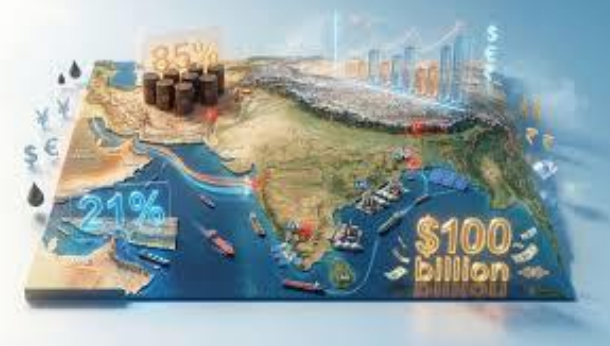
The targeting of Qatar’s energy infrastructure amid the Iran-Israel conflict marks a transition from supply \'disruption\' to \'destruction.\' With 17% of Qatar’s LNG capacity offline, the global energy market faces longterm structural deficits. For India, which relies heavily on Qatari LNG for its fertilizer and power sectors, this represents a major challenge to energy security and fiscal stability. • Infrastructure Paralysis: Strategic strikes on Qatar’s Ras Laffan hub have damaged two of its 14 LNG trains and one Gas-to-Liquids (GTL) facility, resulting in a loss of 12.8 million tonnes (mt) of annual capacity for an estimated 3 to 5 years. • Revenue and Market Shock: The damage translates to an annual revenue loss of $20 billion for Qatar and has forced QatarEnergy to declare Force Majeure on long-term contracts with key economies including Italy, Belgium, South Korea, and China. • Product Diversification Impact: Beyond LNG, the regional conflict has triggered a significant drop in associated exports: Condensate (24%), LPG (13%), Helium (14%), and Naphtha/Sulphur (6%), affecting global chemical and medical supply chains. • Investment Risks: Major global players like ExxonMobil (holding 30-34% stakes in damaged trains) face massive asset impairments, highlighting the vulnerability of foreign direct investment in conflictprone energy corridors. • Regional Geopolitical Shift: The unprecedented nature of the attacks—targeting a fellow Gulf nation during the month of Ramadan—signals a breakdown of regional diplomatic norms, complicating future mediation efforts in the Middle East. • Hostility Cessation Prerequisite: QatarEnergy has explicitly stated that production cannot restart until active hostilities cease, implying that global energy prices will remain elevated and volatile for the foreseeable future. Key Definitions • LNG Train: A specialized facility used to purify and condense natural gas into a liquid state (at approximately -162°C) for easier transport via cryogenic tankers. • Force Majeure: A legal clause in contracts that frees both parties from liability or obligation when an extraordinary event or circumstance beyond their control (e.g., war, strike, or \'Act of God\') occurs. • Gas-to-Liquids (GTL): A refinery process that converts natural gas into high-quality liquid hydrocarbons, such as gasoline or diesel fuel. • Condensate: A low-density mixture of hydrocarbon liquids that are present as gaseous components in raw natural gas and separate out when the temperature is reduced. Constitutional & Legal Provisions • Essential Commodities Act, 1955: Empowers the Indian government to regulate the price and distribution of petroleum and its products (including LNG) to prevent hoarding and ensure availability during supply shocks. • Article 297: The Constitution of India vests the Union with all lands, minerals, and other things of value underlying the ocean within the territorial waters, the continental shelf, or the exclusive economic zone, underscoring the Union\'s role in offshore energy security. • PNGRB Act, 2006: The Petroleum and Natural Gas Regulatory Board (PNGRB) is the statutory body that regulates the refining, processing, storage, transportation, and distribution of natural gas to ensure competitive markets. Additional Strategic Keypoints • Strategic Petroleum Reserves (SPR): India maintains strategic underground caverns (Visakhapatnam, Mangaluru, Padur) to provide approximately 9.5 days of crude oil cover, though LNG storage remains primarily commercial. • Import Dependency: India imports nearly 45-50% of its natural gas requirements, with Qatar historically being the largest supplier under long-term contracts. • Economic Inflationary Pressure: A rise in LNG prices directly increases the cost of Urea production (fertilizer subsidy) and power generation, potentially widening the fiscal deficit. Conclusion The destruction of Qatari LNG infrastructure is not merely a regional setback but a global economic shock. For India, this necessitates an urgent diversification of energy sources and a faster transition toward renewables to mitigate the risks associated with the Strait of Hormuz. The long repair timeline (3- 5 years) suggests that the era of \'cheap gas\' is effectively over, requiring a rethink of India\'s gas-based economy goals. UPSC Relevance • GS Paper II: International Relations (Bilateral, regional, and global groupings involving India and affecting India’s interests; Effect of policies and politics of developed and developing countries on India\'s interests). • GS Paper III: Economic Development (Infrastructure: Energy; Security of critical infrastructure; Indian Economy and issues relating to planning and mobilization of resources). • Prelims: Mapping (Persian Gulf, Strait of Hormuz, Ras Laffan), International Energy Agency (IEA) mandates, and Petroleum/Gas regulatory frameworks in India.


Address : 506, 3rd EYE THREE (III), Opp. Induben Khakhrawala, Girish Cold Drink Cross Road, CG Road, Navrangpura, Ahmedabad, 380009.
Mobile : 8469231587 / 9586028957
Telephone : 079-40098991
E-mail: dics.upsc@gmail.com
Address: A-306, The Landmark, Urjanagar-1, Opp. Spicy Street, Kudasan – Por Road, Kudasan, Gandhinagar – 382421
Mobile : 9723832444 / 9723932444
E-mail: dics.gnagar@gmail.com
Address: 2nd Floor, 9 Shivali Society, L&T Circle, opp. Ratri Bazar, Karelibaugh, Vadodara, 390018
Mobile : 9725692037 / 9725692054
E-mail: dics.vadodara@gmail.com
Address: 403, Raj Victoria, Opp. Pal Walkway, Near Galaxy Circle, Pal, Surat-394510
Mobile : 8401031583 / 8401031587
E-mail: dics.surat@gmail.com
Address: 303,305 K 158 Complex Above Magson, Sindhubhavan Road Ahmedabad-380059
Mobile : 9974751177 / 8469231587
E-mail: dicssbr@gmail.com
Address: 57/17, 2nd Floor, Old Rajinder Nagar Market, Bada Bazaar Marg, Delhi-60
Mobile : 9104830862 / 9104830865
E-mail: dics.newdelhi@gmail.com