





Ahmedabad
(Head Office)Address : 506, 3rd EYE THREE (III), Opp. Induben Khakhrawala, Girish Cold Drink Cross Road, CG Road, Navrangpura, Ahmedabad, 380009.
Mobile : 8469231587 / 9586028957
Telephone : 079-40098991
E-mail: dics.upsc@gmail.com

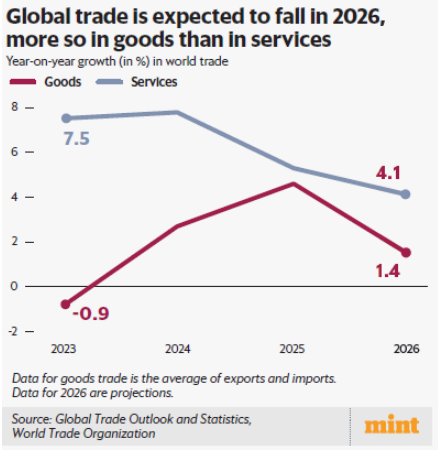
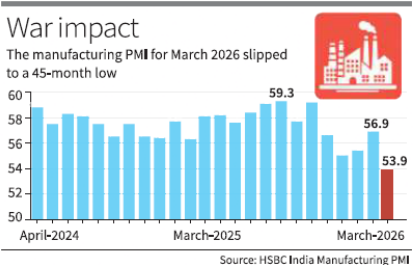
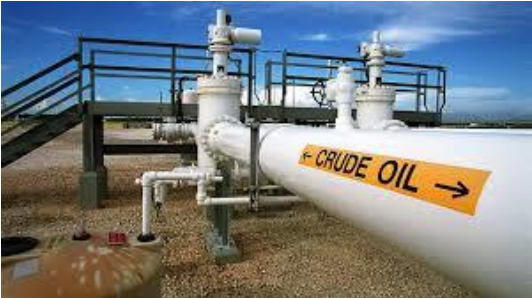
• Global Growth Contractions: The escalation of conflict in West Asia has disrupted the earlier \'oil glut\' forecast for 2026, with energy infrastructure damage threatening a long-term supply crunch. High energy costs are expected to shave 0.3 percentage points off global GDP growth, directly dampening consumer demand for non-essential discretionary goods. • Impact on India’s Macro-Stability: India’s GDP growth is highly sensitive to the \'India Basket\' crude prices. While a baseline of $85/barrel supports 6.5% growth, a surge to $125/barrel could plummet growth to 5.0% due to squeezed corporate margins and inflationary pressures on household consumption. • Services Sector as a Strategic Buffer: Despite the gloom in goods trade, \'digitally delivered services\' (financial, computer, and professional services) remain resilient. India, as the world’s fourth-largest exporter in this domain ($328 billion in 2025), is poised to outpace global growth trends, provided it navigates the transition to AI-integrated delivery. • Shifting Global Trade Dynamics: Net oil importers like Asia and Europe are facing slowing import growth, while oil-exporting regions (CIS, Africa, Middle East) are seeing increased revenues. Russia, in particular, has seen a \'de-facto de-sanctioning\' as global markets prioritize energy availability over geopolitical restrictions. • Post-War Reconstruction Opportunities: A potential \'silver lining\' exists in the post-conflict phase; rebuilding energy and urban infrastructure in West Asia will likely trigger a surge in demand for engineering equipment, technical manpower, and labor, potentially boosting Indian remittances and project exports. Key Definitions • Digitally Delivered Services: Services provided remotely through cross-border computer networks, encompassing telecommunications, computer and information services, and other business services. • India Basket Crude: A weighted average of Oman, Dubai (sour), and Brent (sweet) crude oil prices, representing the specific quality of oil typically processed by Indian refineries. • Discretionary Spending: Household expenditure on non-essential items (luxury goods, vacations, electronics) that can be easily deferred or cancelled during economic downturns. Constitutional and Legal Provisions • Article 297 of the Constitution: Vests all lands, minerals, and other things of value underlying the ocean within the territorial waters, the continental shelf, or the exclusive economic zone (EEZ) of India in the Union, highlighting the importance of domestic energy security. • Foreign Trade Policy (FTP) 2023: Aims to increase India’s exports to $2 trillion by 2030, emphasizing the digitalization of trade and the promotion of \'Services Exports from India Scheme\' equivalents to mitigate external shocks. • Essential Commodities Act, 1955: Empowers the government to regulate the supply and price of petroleum and its products to protect the domestic economy from global price volatility. Additional Key Points • AI Wildcard: While Indian IT firms have historically outpaced global growth (3.5 times since 2008), rapid AI adoption creates a \'retooling\' challenge that could disrupt traditional employment models. • Trade Deceleration: World goods trade growth is projected to drop from 4.6% in 2025 to 1.4% in 2026 if energy prices remain elevated, indicating a sharp slowdown in global manufacturing. • Remittance Resilience: India remains the top global recipient of remittances; stability in West Asia is crucial for the 8.5 million-strong Indian diaspora whose earnings support India\'s Current Account Balance. Conclusion The West Asia conflict underscores India\'s dual-track economic reality: a high vulnerability to commodity price shocks (oil) balanced by a robust, high-growth services export engine. While the immediate outlook for 2026 suggests a slowdown in GDP and goods trade, India’s strategic pivot toward digital services and potential role in regional reconstruction offer paths for economic resilience. Navigating this period requires a cautious fiscal approach and accelerated AI adoption within the tech sector. UPSC Relevance • GS Paper II: India and its neighborhood-relations; Effect of policies and politics of developed and developing countries on India’s interests and Indian diaspora. • GS Paper III: Indian Economy and issues relating to planning, mobilization of resources, growth, development, and employment; Energy security and infrastructure. • Economic Survey/Prelims: Understanding the \'India Basket\' of crude, WTO trade projections, and the composition of India’s Balance of Payments (BoP).


Address : 506, 3rd EYE THREE (III), Opp. Induben Khakhrawala, Girish Cold Drink Cross Road, CG Road, Navrangpura, Ahmedabad, 380009.
Mobile : 8469231587 / 9586028957
Telephone : 079-40098991
E-mail: dics.upsc@gmail.com
Address: A-306, The Landmark, Urjanagar-1, Opp. Spicy Street, Kudasan – Por Road, Kudasan, Gandhinagar – 382421
Mobile : 9723832444 / 9723932444
E-mail: dics.gnagar@gmail.com
Address: 2nd Floor, 9 Shivali Society, L&T Circle, opp. Ratri Bazar, Karelibaugh, Vadodara, 390018
Mobile : 9725692037 / 9725692054
E-mail: dics.vadodara@gmail.com
Address: 403, Raj Victoria, Opp. Pal Walkway, Near Galaxy Circle, Pal, Surat-394510
Mobile : 8401031583 / 8401031587
E-mail: dics.surat@gmail.com
Address: 303,305 K 158 Complex Above Magson, Sindhubhavan Road Ahmedabad-380059
Mobile : 9974751177 / 8469231587
E-mail: dicssbr@gmail.com
Address: 57/17, 2nd Floor, Old Rajinder Nagar Market, Bada Bazaar Marg, Delhi-60
Mobile : 9104830862 / 9104830865
E-mail: dics.newdelhi@gmail.com