

Ahmedabad
(Head Office)Address : 506, 3rd EYE THREE (III), Opp. Induben Khakhrawala, Girish Cold Drink Cross Road, CG Road, Navrangpura, Ahmedabad, 380009.
Mobile : 8469231587 / 9586028957
Telephone : 079-40098991
E-mail: dics.upsc@gmail.com

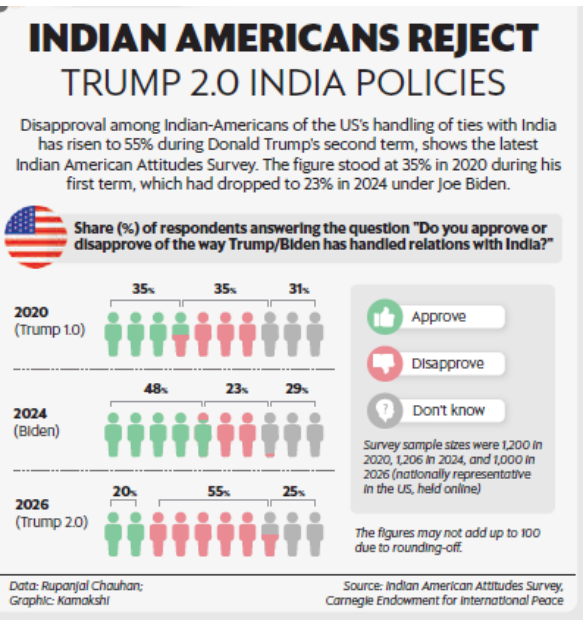
A recent survey by the Carnegie Endowment for International Peace highlights a significant shift in how the Indian-American community views the current U.S. administration\'s handling of bilateral ties. One year into Donald Trump’s second term, disapproval has surged to record levels, reflecting growing anxieties over trade, immigration, and strategic cooperation. Key Highlights and Summary • Rising Disapproval Rates: Disapproval among Indian-Americans regarding the U.S. handling of ties with India has climbed to 55% in 2026. This is a sharp increase from 35% during Trump’s first term and 23% under the Biden administration. • Shift in Strategic Perception: The community’s dissatisfaction is rooted in what the survey describes as a \'crisis\' in bilateral relations, marked by tensions in technology transfers, trade tariffs, and a perceived strain on the Quad alliance goals. • Political Realignment and Ambivalence: While the community remains predominantly Democratic (46%), there is a visible erosion of high-intensity loyalty. The share of Independents has risen to 29%, as voters feel increasingly alienated by the platforms of both major U.S. parties. • Impact of Domestic Policy: Beyond foreign policy, a staggering 71% of Indian-Americans disapprove of Trump’s overall job performance, with specific concerns regarding immigration curbs (64% disapproval) and international economic policies (70% disapproval). • Demographic Variance: The survey notes that younger Indian-Americans (ages 18–29) are shifting back toward the Democratic fold, while certain subgroups, like Indian-American Christians, have shown a modest increase in Republican affinity. • Discrimination and Safety: Nearly half of the respondents reported frequent encounters with online anti-Indian racism, leading many to modify their public behavior, such as avoiding political discussions or wearing traditional attire in public. Constitutional and Legal Provisions • Article 5 to 11 (Indian Constitution): These articles deal with citizenship. While India does not allow dual citizenship, the OCI (Overseas Citizen of India) scheme provides a lifelong visa for the diaspora, making their political standing in the US crucial for Indian soft power. • 14th Amendment (US Constitution): Guarantees \'equal protection of the laws.\' The survey’s findings on discrimination highlight concerns regarding the enforcement of civil rights for minority communities in the US. • The Logan Act (US): A federal law that forbids unauthorized citizens from negotiating with foreign governments having a dispute with the US, often cited in discussions about diaspora lobbying. • H-1B Visa Regulations: Under U.S. immigration law (INA), the administration has the power to adjust visa fees and quotas—a major point of contention for the Indian IT sector and diaspora families. Key Definitions • Diaspora: A scattered population whose origin lies in a separate geographic locale. The Indian diaspora is the largest in the world, serving as a bridge for \'Track II Diplomacy.\' • Soft Power: The ability to influence others through culture, political values, and foreign policies rather than coercion. The Indian-American community is a primary pillar of India’s soft power in the West. • Strategic Stress: A term used in the 2026 survey to describe the shift from \'Strategic Partnership\' to a relationship burdened by tariffs, sanctions, and misaligned regional goals. Conclusion The 2026 Indian American Attitudes Survey underscores a \'time of turbulence\' for one of the most successful immigrant groups in the US. The transition from 2020 to 2026 shows that while the diaspora\'s economic stakes in the US remain high, their faith in the political management of their home-country ties is wavering. This growing \'political ambivalence\' suggests that the diaspora can no longer be viewed as a monolithic voting bloc or a guaranteed advocate for U.S. foreign policy in South Asia. UPSC Relevance • GS Paper II: Bilateral, regional, and global groupings involving India (Quad, I2U2); Effect of policies and politics of developed countries on India\'s interests; Indian Diaspora. • GS Paper III: Impact of US trade policies (tariffs/sanctions) on the Indian economy; Technology transfers (iCET). • International Relations: The role of the \'Great Indian Diaspora\' as a pressure group in Western democracies and its impact on India’s \'National Interest.\'


Address : 506, 3rd EYE THREE (III), Opp. Induben Khakhrawala, Girish Cold Drink Cross Road, CG Road, Navrangpura, Ahmedabad, 380009.
Mobile : 8469231587 / 9586028957
Telephone : 079-40098991
E-mail: dics.upsc@gmail.com
Address: A-306, The Landmark, Urjanagar-1, Opp. Spicy Street, Kudasan – Por Road, Kudasan, Gandhinagar – 382421
Mobile : 9723832444 / 9723932444
E-mail: dics.gnagar@gmail.com
Address: 2nd Floor, 9 Shivali Society, L&T Circle, opp. Ratri Bazar, Karelibaugh, Vadodara, 390018
Mobile : 9725692037 / 9725692054
E-mail: dics.vadodara@gmail.com
Address: 403, Raj Victoria, Opp. Pal Walkway, Near Galaxy Circle, Pal, Surat-394510
Mobile : 8401031583 / 8401031587
E-mail: dics.surat@gmail.com
Address: 303,305 K 158 Complex Above Magson, Sindhubhavan Road Ahmedabad-380059
Mobile : 9974751177 / 8469231587
E-mail: dicssbr@gmail.com
Address: 57/17, 2nd Floor, Old Rajinder Nagar Market, Bada Bazaar Marg, Delhi-60
Mobile : 9104830862 / 9104830865
E-mail: dics.newdelhi@gmail.com