


Ahmedabad
(Head Office)Address : 506, 3rd EYE THREE (III), Opp. Induben Khakhrawala, Girish Cold Drink Cross Road, CG Road, Navrangpura, Ahmedabad, 380009.
Mobile : 8469231587 / 9586028957
E-mail: dics.upsc@gmail.com

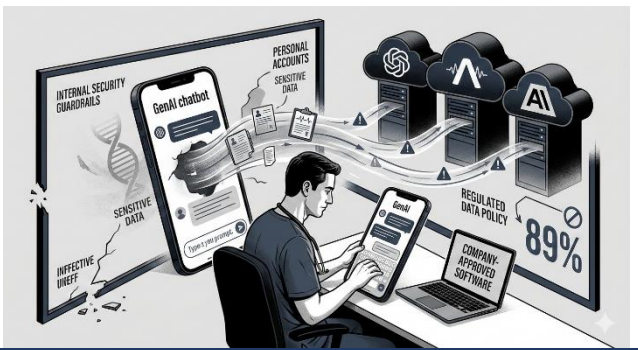
• Disproportionate Risk Profile: A recent report by Netskope Threat Labs reveals that 89% of data policy violations in healthcare involve regulated patient data, nearly triple the cross-industry average of 31%, highlighting an acute vulnerability in the sector. • Internal Security Gaps: Despite the acceleration of internal AI tool deployment, 43% of healthcare workers continue to use personal GenAI accounts for professional tasks, creating \'shadow IT\' environments where security systems cannot detect or prevent data leaks. • Leakage via Prompts: Sensitive medical information and patient records are frequently exposed through prompts and document uploads on public AI platforms like OpenAI, AssemblyAI, and Anthropic, often without proper de-identification. • Cloud Storage Vulnerabilities: Nearly 56% of healthcare organizations have had to block file uploads to personal Google Drive, Gmail, and OneDrive accounts to prevent unauthorized data exposure and malware distribution through trusted cloud interfaces. • Shift toward Managed AI: To mitigate risks, there is a growing trend of organizations deploying proprietary, managed GenAI applications that offer full visibility and control over data movements, outpacing similar transitions in other industries. • Regulatory Urgency: The report emphasizes that while external cyber threats remain a priority, addressing \'internal risk\' through stringent security guardrails and behavioral modification is essential for compliance in the highly regulated healthcare landscape. Key Definitions • Generative AI (GenAI): Artificial intelligence capable of generating text, images, or other media in response to prompts, often using Large Language Models (LLMs) that may store user input for training. • Shadow IT: The use of information technology systems, devices, software, applications, and services without explicit IT department approval within an organization. • Application Programming Interface (API): A set of rules that allows different software entities to communicate. In this context, it refers to the traffic between healthcare systems and AI models. Constitutional & Legal Provisions • Article 21: The Right to Privacy is a fundamental right under the Right to Life and Personal Liberty, as affirmed by the Supreme Court in the Justice K.S. Puttaswamy case (2017), which extends to sensitive health data. • Digital Personal Data Protection (DPDP) Act, 2023: Specifically classifies health data as a form of personal data that requires explicit consent for processing and mandates strict \'data fiduciary\' obligations on healthcare providers. • Information Technology (Reasonable Security Practices and Procedures and Sensitive Personal Data or Information) Rules, 2011: Requires body corporates to implement documented security programs to protect sensitive personal data like medical records. • Digital Information Security in Healthcare Act (DISHA): A proposed legal framework in India specifically designed to regulate the generation, storage, and transmission of digital health data while ensuring privacy and security. Additional Key Points • Malware Distribution: Cyber attackers are increasingly exploiting the \'inherent trust\' employees place in personal cloud applications to distribute malware within hospital networks. • Behavioral Modification: Institutions are focusing on training staff to use approved proprietary software instead of free public chatbots to ensure prompts do not become part of public training sets. • API Traffic Monitoring: 63% of healthcare organizations now detect significant API traffic to AI service providers, indicating that AI integration is happening faster than security policy updates. Conclusion The rapid adoption of GenAI in healthcare has outpaced the implementation of necessary security guardrails, leading to a significant \'privacy debt.\' While AI offers transformative potential for diagnostics and administrative efficiency, the current reliance on personal accounts and public prompts poses a catastrophic risk to patient confidentiality. Sustainable integration requires a transition to \'private-by-design\' AI architectures and a robust legal enforcement of data fiduciary responsibilities to ensure that technological progress does not come at the cost of fundamental privacy rights. UPSC Relevance • GS Paper II: Government policies and interventions for development in various sectors and issues arising out of their design and implementation (Health & IT); Important aspects of governance, transparency, and accountability. • GS Paper III: Challenges to internal security through communication networks; Role of media and social networking sites in internal security challenges; Basics of cyber security; Awareness in the fields of IT, Space, Computers, Robotics, and AI. • Mains Perspective: \'Analyze the ethical and legal challenges of integrating Generative AI in the healthcare sector with special reference to the DPDP Act, 2023.\'


Address : 506, 3rd EYE THREE (III), Opp. Induben Khakhrawala, Girish Cold Drink Cross Road, CG Road, Navrangpura, Ahmedabad, 380009.
Mobile : 8469231587 / 9586028957
E-mail: dics.upsc@gmail.com
Address: A-306, The Landmark, Urjanagar-1, Opp. Spicy Street, Kudasan – Por Road, Kudasan, Gandhinagar – 382421
Mobile : 9723832444 / 9723932444
E-mail: dics.gnagar@gmail.com
Address: Tithi Commercial Complex, 401/402 Productivity Road, Opp. Productivity House, Alkapuri, Vadodara, Gujarat – 390007
Mobile : 9725692037 / 9725692054
E-mail: dics.vadodara@gmail.com
Address: 403, Raj Victoria, Opp. Pal Walkway, Near Galaxy Circle, Pal, Surat-394510
Mobile : 8401031583 / 8401031587
E-mail: dics.surat@gmail.com
Address: 303,305 K 158 Complex Above Magson, Sindhubhavan Road Ahmedabad-380059
Mobile : 9974751177 / 8469231587
E-mail: dicssbr@gmail.com
Address: 57/17, 2nd Floor, Old Rajinder Nagar Market, Bada Bazaar Marg, Delhi-60
Mobile : 9104830862 / 9104830865
E-mail: dics.newdelhi@gmail.com