






Ahmedabad
(Head Office)Address : 506, 3rd EYE THREE (III), Opp. Induben Khakhrawala, Girish Cold Drink Cross Road, CG Road, Navrangpura, Ahmedabad, 380009.
Mobile : 8469231587 / 9586028957
Telephone : 079-40098991
E-mail: dics.upsc@gmail.com

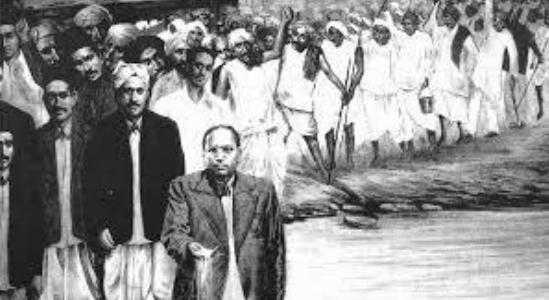
The Mahad Satyagraha, led by Dr. B.R. Ambedkar on March 20, 1927, remains one of the most significant civil rights movements in Indian history. As the nation enters the 99th year of this event (leading to the centenary on March 20, 2027), it serves as a crucial reminder of the struggle for social equality and human dignity. Unlike movements directed against colonial rule, Mahad was an internal reckoning—a demand for the recognition of the fundamental humanity of the \'Depressed Classes\' against age-old social exclusion. Key Highlights of the Mahad Satyagraha • The Chavdar Tale Act: On March 20, 1927, thousands led by Ambedkar marched to the Chavdar tank in Mahad (Maharashtra) to drink water, asserting a legal right granted by the Bole Resolution (1923) but denied by social custom. • Assertion of Human Rights: This was not a religious quest but a claim to a basic survival resource. It transitioned the Dalit movement from petitioning the government to direct mass action for civil rights. • Symbolic Resistance (Manusmriti Dahan): During the second conference in December 1927, Ambedkar publicly burned the Manusmriti, symbolizing a rejection of the religious codification of caste-based inequality and \'graded inequality.\' • Constitutional Methodism: Despite facing an immediate court injunction by upper castes, Ambedkar chose to respect the judicial process, demonstrating his lifelong faith in constitutional and legal means over lawlessness. • The Decade-Long Legal Battle: The struggle moved from the streets to the courts. In 1937, the Bombay High Court finally vindicated the satyagrahis in Narhari Damodar Vaidya v. B.R. Ambedkar, ruling that public tanks are open to all citizens regardless of caste. • Foundational Influence: The humiliations faced at Mahad provided the \'grammar of equality\' for the Indian Constitution. The denial of water at a public tank became the specific catalyst for the antidiscrimination framework in Part III. Key Definitions • Satyagraha: Literally \'truth-force\'; a method of nonviolent resistance. While Gandhi used it against the British (Salt Satyagraha), Ambedkar applied it against internal social tyranny (Water Satyagraha). • Bole Resolution (1923): A resolution passed by the Bombay Legislative Council allowing the Depressed Classes access to public watering places, wells, and dharamshalas. • Chavdar Tale: Meaning \'Tasty Tank,\' it was the specific site in Mahad where the symbolic act of drinking water occurred. • Graded Inequality: A term coined by Ambedkar to describe the caste system, where there is no horizontal equality; instead, every caste is superior to some and inferior to others, preventing a unified front against oppression. Constitutional & Legal Provisions • Article 15(2): Specifically prohibits discrimination regarding access to shops, public restaurants, hotels, and the use of wells, tanks, bathing ghats, and places of public resort. This is a direct constitutional legacy of Mahad. • Article 17: Abolishes \'Untouchability\' and forbids its practice in any form. The enforcement of any disability arising out of Untouchability is a punishable offense under the Protection of Civil Rights Act, 1955. • Article 21: The Right to Life and Personal Liberty has been interpreted by the Judiciary to include the Right to Dignity and the Right to Clean Drinking Water. • Directive Principles (Article 38): Mandates the State to secure a social order for the promotion of the welfare of the people and to minimize inequalities in status and opportunity. Additional Strategic Keypoints: Salt vs. Water • Target of Protest: The Salt Satyagraha (1930) targeted an external colonial tax (the British). The Mahad Satyagraha (1927) targeted an internal social \'sickness\' (untouchability). • Nature of Change: Political independence (Swaraj) could be achieved through a change in government; social equality required a fundamental \'change of heart\' and custom within Indian civilization. • The \'No Peon, No Water\' Principle: Ambedkar’s autobiographical reflections highlight that for a Dalit child, the absence of a \'touchable\' intermediary meant the denial of thirst-quenching, a reality the Constitution sought to erase. Conclusion The Mahad Satyagraha is the \'foundational moment\' of Indian constitutionalism. It established that the right to drink from a common pool of water is the most basic marker of citizenship. As the centenary approaches, the republic must move beyond ceremonial drinking of water to an honest reckoning with modern forms of exclusion, such as manual scavenging and digital-caste divides, ensuring the \'constitutional promise\' becomes a \'lived reality.\' UPSC Relevance • GS Paper I: Modern Indian History (Social Reform Movements, Role of Dr. Ambedkar); Social Issues (Casteism, Untouchability, and Social Empowerment). • GS Paper II: Indian Constitution (Fundamental Rights—Articles 14, 15, 17, 21; Preamble—Justice, Equality, Dignity). • GS Paper IV (Ethics): Human Values and Social Justice; Ethical concerns in the practice of \'Graded Inequality.\' • Prelims: Chronology of Ambedkar\'s movements (Mahad, Kalaram Temple, Poona Pact), landmark judgements like the 1937 Bombay HC ruling, and specific details of the Bole Resolution.


Address : 506, 3rd EYE THREE (III), Opp. Induben Khakhrawala, Girish Cold Drink Cross Road, CG Road, Navrangpura, Ahmedabad, 380009.
Mobile : 8469231587 / 9586028957
Telephone : 079-40098991
E-mail: dics.upsc@gmail.com
Address: A-306, The Landmark, Urjanagar-1, Opp. Spicy Street, Kudasan – Por Road, Kudasan, Gandhinagar – 382421
Mobile : 9723832444 / 9723932444
E-mail: dics.gnagar@gmail.com
Address: 2nd Floor, 9 Shivali Society, L&T Circle, opp. Ratri Bazar, Karelibaugh, Vadodara, 390018
Mobile : 9725692037 / 9725692054
E-mail: dics.vadodara@gmail.com
Address: 403, Raj Victoria, Opp. Pal Walkway, Near Galaxy Circle, Pal, Surat-394510
Mobile : 8401031583 / 8401031587
E-mail: dics.surat@gmail.com
Address: 303,305 K 158 Complex Above Magson, Sindhubhavan Road Ahmedabad-380059
Mobile : 9974751177 / 8469231587
E-mail: dicssbr@gmail.com
Address: 57/17, 2nd Floor, Old Rajinder Nagar Market, Bada Bazaar Marg, Delhi-60
Mobile : 9104830862 / 9104830865
E-mail: dics.newdelhi@gmail.com