







Ahmedabad
(Head Office)Address : 506, 3rd EYE THREE (III), Opp. Induben Khakhrawala, Girish Cold Drink Cross Road, CG Road, Navrangpura, Ahmedabad, 380009.
Mobile : 8469231587 / 9586028957
Telephone : 079-40098991
E-mail: dics.upsc@gmail.com

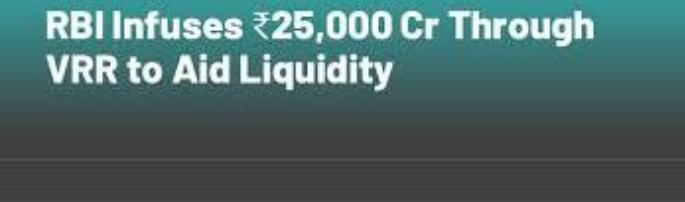
Core Summary of the Liquidity Operation • Liquidity Infusion: On Friday, the Reserve Bank of India (RBI) injected ₹25,101 crore into the banking system through a 3-day Variable Rate Repo (VRR) auction to address transient liquidity deficits. • Auction Specifics: While the RBI had notified an intent to inject up to ₹75,000 crore, the actual absorption by banks was significantly lower, with funds being disbursed at a cut-off and weighted average rate of 5.26%. • Primary Drivers of Deficit: The recent tightening of liquidity in the banking system is primarily attributed to large-scale outflows due to advance tax payments and year-end closing requirements. • Frequency of Intervention: This marks a continued trend of active liquidity management, following a similar infusion of ₹48,014 crore on March 17, indicating the RBI\'s commitment to maintaining stable call money rates. • Operational Mechanism: The use of the VRR tool allows the RBI to provide short-term capital to banks, ensuring that the Weighted Average Call Rate (WACR) remains aligned with the Repo rate, which is the primary signaling rate. • Market Sentiment: The lower-than-expected subscription to the ₹75,000 crore notified amount suggests that while there is a deficit, banks are managing their immediate requirements through other internal windows or the interbank market. Key Definitions • Variable Rate Repo (VRR): An auction-based tool used by the RBI to inject liquidity into the banking system when it falls into a deficit. Unlike the fixed-rate repo, the interest rate here is determined through competitive bidding. • Transient Liquidity: Short-term fluctuations in the availability of cash within the banking system, usually caused by seasonal factors like tax payments, government spending delays, or festival-linked currency withdrawals. • Cut-off Rate: The lowest interest rate at which the RBI decides to lend money to banks in a repo auction. Constitutional & Legal Provisions • Reserve Bank of India Act, 1934: Provides the legal mandate for the RBI to operate the Monetary Policy Framework and manage liquidity to maintain price stability while keeping in mind the objective of growth. • Section 45ZB: Pertains to the constitution of the Monetary Policy Committee (MPC), which sets the benchmark policy rates that these VRR auctions aim to track. • Article 280: While primarily about the Finance Commission, it relates to the broader fiscal-monetary interface as tax collections (advance tax) managed under this article directly impact the liquidity handled by the RBI. Additional Important Keypoints • Liquidity Adjustment Facility (LAF): VRR is a component of the revised LAF framework introduced to fine-tune liquidity. It complements the Standing Deposit Facility (SDF) and Marginal Standing Facility (MSF). • Impact on Yields: Active VRR auctions help in stabilizing short-term money market yields, preventing a spike in lending rates for corporates and retail borrowers. • Sterilization vs. Injection: While the RBI uses VRR to inject money, it uses VRRR (Variable Rate Reverse Repo) to suck out excess liquidity, demonstrating its \'two-way\' liquidity management approach. Conclusion The RBI\'s recent VRR auction underscores its proactive role as the \'Lender of Last Resort\' and its focus on \'calibrated withdrawal of accommodation\' or neutral liquidity stance. By addressing the temporary friction caused by advance tax outflows, the central bank ensures that the transmission of monetary policy remains effective and that the credit needs of the economy are met without undue volatility in interest rates. UPSC Relevance • General Studies III: Indian Economy and issues relating to planning, mobilization of resources, growth, development and employment; Monetary Policy; Banking Sector and RBI\'s instruments of credit control. • Prelims Focus: Concepts of Repo, Reverse Repo, VRR, SDF, and the impact of fiscal actions (taxation) on monetary liquidity


Address : 506, 3rd EYE THREE (III), Opp. Induben Khakhrawala, Girish Cold Drink Cross Road, CG Road, Navrangpura, Ahmedabad, 380009.
Mobile : 8469231587 / 9586028957
Telephone : 079-40098991
E-mail: dics.upsc@gmail.com
Address: A-306, The Landmark, Urjanagar-1, Opp. Spicy Street, Kudasan – Por Road, Kudasan, Gandhinagar – 382421
Mobile : 9723832444 / 9723932444
E-mail: dics.gnagar@gmail.com
Address: 2nd Floor, 9 Shivali Society, L&T Circle, opp. Ratri Bazar, Karelibaugh, Vadodara, 390018
Mobile : 9725692037 / 9725692054
E-mail: dics.vadodara@gmail.com
Address: 403, Raj Victoria, Opp. Pal Walkway, Near Galaxy Circle, Pal, Surat-394510
Mobile : 8401031583 / 8401031587
E-mail: dics.surat@gmail.com
Address: 303,305 K 158 Complex Above Magson, Sindhubhavan Road Ahmedabad-380059
Mobile : 9974751177 / 8469231587
E-mail: dicssbr@gmail.com
Address: 57/17, 2nd Floor, Old Rajinder Nagar Market, Bada Bazaar Marg, Delhi-60
Mobile : 9104830862 / 9104830865
E-mail: dics.newdelhi@gmail.com