

Ahmedabad
(Head Office)Address : 506, 3rd EYE THREE (III), Opp. Induben Khakhrawala, Girish Cold Drink Cross Road, CG Road, Navrangpura, Ahmedabad, 380009.
Mobile : 8469231587 / 9586028957
Telephone : 079-40098991
E-mail: dics.upsc@gmail.com

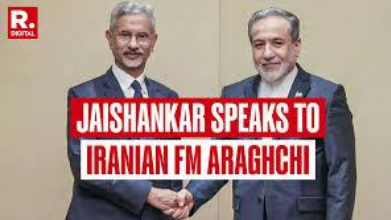
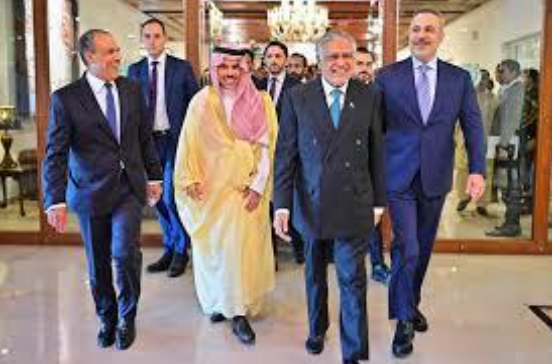
• Request for Intervention: Iranian Foreign Minister Abbas Araghchi has urged India, as the current BRICS Chair, to leverage the grouping’s influence to support \'global stability and security\' amid the ongoing conflict in West Asia. • BRICS as a Security Forum: Tehran has explicitly called for BRICS to play a \'constructive role\' and condemn military aggression against Iran, signaling an attempt to transform the bloc from an economic collective into a geopolitical arbiter. • India’s Strategic Balancing: The outreach presents a diplomatic challenge for New Delhi, which has maintained a neutral stance by not criticizing U.S.-Israel strikes while simultaneously negotiating with Iran for the safe passage of Indian vessels through the Strait of Hormuz. • Summit Dynamics: The upcoming BRICS Summit in India will be the first major gathering since the war began, featuring new members like Iran and the UAE, which may shift the bloc’s traditional focus toward regional security crises. • High-Level Engagement: This conversation marks the fourth ministerial interaction since February 28, following a direct call between Prime Minister Narendra Modi and President Masoud Pezeshkian regarding maritime safety. • Absence of Consensus: Despite the escalating crisis, BRICS has yet to issue a collective statement, highlighting the internal complexities of a group that includes diverse strategic interests ranging from Russia and China to India and Brazil. Key Definitions • BRICS: A multilateral grouping originally consisting of Brazil, Russia, India, China, and South Africa, recently expanded (BRICS+) to include Iran, Egypt, Ethiopia, and the UAE, aimed at promoting SouthSouth cooperation. • Multilateralism: The process of organizing relations between three or more states based on shared principles and institutional frameworks, often as a counter-balance to unilateralism. • Strategic Autonomy: A foundational principle of Indian foreign policy that allows the country to make decisions based on its national interest without being coerced by other states or alliances. Constitutional & Legal Provisions • Article 51: A Directive Principle of State Policy (DPSP) that mandates the State to promote international peace and security, maintain just and honourable relations between nations, and foster respect for international law. • Article 73: Specifies that the executive power of the Union extends to matters with respect to which Parliament has power to make laws, which includes the signing and implementation of international treaties and participation in global forums like BRICS. • UN Charter, Chapter VIII: Recognizes the role of regional arrangements in maintaining international peace and security, providing a broad legal context for blocs like BRICS to engage in security dialogues. Additional Key Points for Examination • The \'Hormuz Factor\': India’s engagement is heavily driven by the necessity of the Strait of Hormuz for its energy security; any BRICS involvement must balance Tehran\'s security demands with global maritime stability. • Chairmanship Challenges: As the Chair, India is responsible for drafting the \'Leaders’ Declaration.\' Reconciling Iran’s demand for a condemnation of aggression with the varied stances of other members will test India’s \'Vishwa Mitra\' (Global Friend) diplomacy. • Shifting Bloc Identity: Originally an acronym for emerging economies, the push by Iran and Russia to include security mandates suggests a move toward making BRICS a \'Global South\' alternative to the G7. Conclusion Iran’s call for BRICS to intervene in the West Asian crisis underscores the growing expectation for the grouping to act as a geopolitical heavyweight. For India, the situation requires a delicate diplomatic act: fulfilling its responsibilities as the BRICS Chair while maintaining its strategic partnerships with Western powers. The outcome of the upcoming summit will likely define whether BRICS remains an economic cooperative or evolves into a significant security collective in a multipolar world. UPSC Relevance • GS Paper II: Bilateral, regional and global groupings and agreements involving India and/or affecting India’s interests; Effect of policies and politics of developed and developing countries on India’s interests. • International Relations: Structure and mandate of BRICS; India-Iran bilateral relations; Energy security and maritime corridors (Strait of Hormuz). • Prelims Link: Current BRICS members (BRICS+); Headquarters of the New Development Bank (NDB); India\'s 2026 BRICS Chairmanship; Map-based locations of the Persian Gulf and Levant region.


Address : 506, 3rd EYE THREE (III), Opp. Induben Khakhrawala, Girish Cold Drink Cross Road, CG Road, Navrangpura, Ahmedabad, 380009.
Mobile : 8469231587 / 9586028957
Telephone : 079-40098991
E-mail: dics.upsc@gmail.com
Address: A-306, The Landmark, Urjanagar-1, Opp. Spicy Street, Kudasan – Por Road, Kudasan, Gandhinagar – 382421
Mobile : 9723832444 / 9723932444
E-mail: dics.gnagar@gmail.com
Address: 2nd Floor, 9 Shivali Society, L&T Circle, opp. Ratri Bazar, Karelibaugh, Vadodara, 390018
Mobile : 9725692037 / 9725692054
E-mail: dics.vadodara@gmail.com
Address: 403, Raj Victoria, Opp. Pal Walkway, Near Galaxy Circle, Pal, Surat-394510
Mobile : 8401031583 / 8401031587
E-mail: dics.surat@gmail.com
Address: 303,305 K 158 Complex Above Magson, Sindhubhavan Road Ahmedabad-380059
Mobile : 9974751177 / 8469231587
E-mail: dicssbr@gmail.com
Address: 57/17, 2nd Floor, Old Rajinder Nagar Market, Bada Bazaar Marg, Delhi-60
Mobile : 9104830862 / 9104830865
E-mail: dics.newdelhi@gmail.com