


Ahmedabad
(Head Office)Address : 506, 3rd EYE THREE (III), Opp. Induben Khakhrawala, Girish Cold Drink Cross Road, CG Road, Navrangpura, Ahmedabad, 380009.
Mobile : 8469231587 / 9586028957
Telephone : 079-40098991
E-mail: dics.upsc@gmail.com

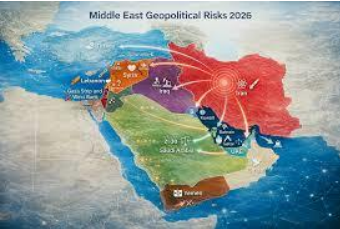
The ongoing conflict in West Asia, marked by the 2026 Iranian missile strikes on critical energy infrastructure in Qatar and the effective closure of the Strait of Hormuz, has triggered the most significant global energy disruption since the 1970s. Key facilities, including Shell\'s Pearl Gas-to-Liquids (GTL) plant and QatarEnergy’s LNG trains (joint ventures with ExxonMobil), have sustained severe damage, with repairs estimated to take up to five years. For India and the global economy, this \'energy war\' has led to record-high Brent crude prices, force majeure on long-term gas contracts, and a systemic threat to both energy and food security. Key Summary Points • Infrastructure Sabotage: Iranian missile strikes on March 18-19, 2026, targeted the Ras Laffan Industrial City, damaging 17% of Qatar’s LNG export capacity and Shell\'s Pearl GTL plant, which may remain offline for at least a year. • Financial Fallout for \'Big Oil\': Western energy giants face multi-billion dollar revenue losses; ExxonMobil alone estimates an annual loss of $5 billion. Conversely, soaring oil prices (exceeding $120/barrel) have temporarily boosted share prices despite physical asset damage. • The \'Hormuz Blockade\': The closure of the Strait of Hormuz has stranded approximately 20 million barrels of oil per day (one-fifth of global consumption) and 20% of global LNG, forcing a shift to costlier, longer maritime routes via the Cape of Good Hope. • Force Majeure and Supply Shocks: QatarEnergy has declared force majeure on long-term LNG contracts, severely impacting major importers like China, South Korea, Italy, Belgium, and India (specifically Petronet LNG). • Diplomatic Defiance: Iran\'s Foreign Minister, Abbas Araghchi, has positioned Tehran as a \'defiant victim,\' ruling out ceasefires and negotiations with the U.S. while threatening further strikes if Iranian infrastructure is targeted. • Macroeconomic Contagion: The crisis has catalyzed a \'second energy crisis\' for Europe and high \'imported inflation\' for India, where 90% of LPG imports are at risk due to the maritime blockade. Key Definitions • Force Majeure: A legal clause in contracts that frees both parties from liability or obligation when an extraordinary event or circumstance beyond their control (e.g., war, strike, or \'Act of God\') occurs. • Gas-to-Liquids (GTL): A refinery process that converts natural gas into high-quality liquid hydrocarbons such as gasoline, diesel, and wax. • Stagflation: An economic condition characterized by slow growth, high unemployment, and rising prices (inflation) simultaneously. Constitutional & Legal Provisions • Article 51 (Directive Principles): Mandates that the State shall endeavor to promote international peace and security and maintain just and honorable relations between nations—relevant to India’s diplomatic role in the Middle East. • Essential Services Maintenance Act (ESMA): Often invoked during energy crises to ensure the uninterrupted supply of petroleum and LPG as \'essential services\' to the public. • The Petroleum Act, 1934: Regulates the import, transport, and storage of petroleum, providing the legal basis for emergency government interventions during supply disruptions. • Article 297: Provides that all lands, minerals, and other things of value underlying the ocean within the territorial waters or the continental shelf of India vest in the Union—critical for offshore energy security. Conclusion The 2026 West Asia conflict has exposed the extreme vulnerability of the global \'just-in-time\' energy model, which relies on a single maritime chokepoint. While Western oil companies are suffering asset losses, the real burden falls on import-dependent nations like India, facing ballooning current account deficits and energy poverty. The shift toward \'energy sovereignty\' through renewables and diversified supply chains (e.g., U.S. shale and African gas) is no longer a climate goal but a strategic survival necessity. UPSC Relevance • GS Paper II: Effect of policies and politics of developed and developing countries on India’s interests; Indian Diaspora (safety of 8 million+ Indians in the Gulf). • GS Paper III: Infrastructure: Energy; Security challenges and their management in border areas; Impact of war on global supply chains. • Prelims Focus: Location of Ras Laffan, Pearl GTL technology, Strait of Hormuz geography, and India’s Strategic Petroleum Reserves (SPR).


Address : 506, 3rd EYE THREE (III), Opp. Induben Khakhrawala, Girish Cold Drink Cross Road, CG Road, Navrangpura, Ahmedabad, 380009.
Mobile : 8469231587 / 9586028957
Telephone : 079-40098991
E-mail: dics.upsc@gmail.com
Address: A-306, The Landmark, Urjanagar-1, Opp. Spicy Street, Kudasan – Por Road, Kudasan, Gandhinagar – 382421
Mobile : 9723832444 / 9723932444
E-mail: dics.gnagar@gmail.com
Address: 2nd Floor, 9 Shivali Society, L&T Circle, opp. Ratri Bazar, Karelibaugh, Vadodara, 390018
Mobile : 9725692037 / 9725692054
E-mail: dics.vadodara@gmail.com
Address: 403, Raj Victoria, Opp. Pal Walkway, Near Galaxy Circle, Pal, Surat-394510
Mobile : 8401031583 / 8401031587
E-mail: dics.surat@gmail.com
Address: 303,305 K 158 Complex Above Magson, Sindhubhavan Road Ahmedabad-380059
Mobile : 9974751177 / 8469231587
E-mail: dicssbr@gmail.com
Address: 57/17, 2nd Floor, Old Rajinder Nagar Market, Bada Bazaar Marg, Delhi-60
Mobile : 9104830862 / 9104830865
E-mail: dics.newdelhi@gmail.com