







Ahmedabad
(Head Office)Address : 506, 3rd EYE THREE (III), Opp. Induben Khakhrawala, Girish Cold Drink Cross Road, CG Road, Navrangpura, Ahmedabad, 380009.
Mobile : 8469231587 / 9586028957
Telephone : 079-40098991
E-mail: dics.upsc@gmail.com

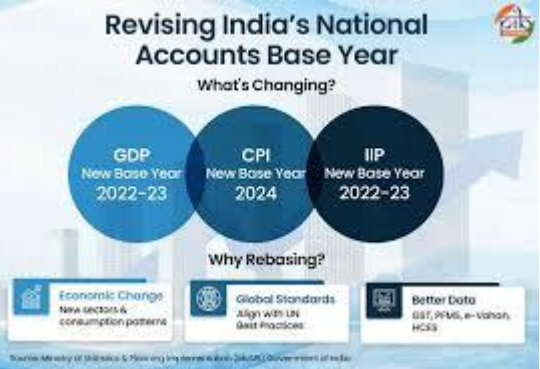
The Ministry of Statistics and Programme Implementation (MoSPI) is set to release a new series of national accounts, replacing the decade-old 2011-12 base year with 2022-23. This transition, informed by multiple expert sub-committees, incorporates modern data streams like GST and real-time corporate filings to provide a more granular and accurate reflection of India’s post-pandemic economic structure. Key Highlights and Summary • Base Year Update: The shift from 2011-12 to 2022-23 ensures that the GDP reflects current consumption patterns, technological advancements, and the expanded service economy, reducing the \'underestimation\' inherent in older price benchmarks. • Granular Corporate Tracking: Moving away from a \'bulk sector\' allocation, the new series uses activity-wise revenue shares. If a conglomerate operates in both steel and software, its value added is now split accurately between those sectors rather than being clubbed into one. • Formalizing Informal Data: For the first time, the household and unincorporated sectors will be estimated annually using the Annual Survey of Unincorporated Sector Enterprises (ASUSE) and Periodic Labour Force Survey (PLFS), replacing the previous method of \'extrapolation\' from old census data. • GST Integration: Goods and Services Tax (GST) data will be used extensively to estimate regional output and identify \'active\' private companies. This improves the accuracy of the \'Value Added\' tax-toGDP calculations and captures the formalization of the economy. • Expanded Government Coverage: The new series incorporates the value of housing services provided to government employees and increases the reporting of data from local bodies and autonomous institutes, ensuring a more comprehensive \'General Government\' sector footprint. • Financial Sector Refinement: Proxy-based estimations for Non-Banking Financial Companies (NBFCs) are being replaced by actual financial data from the Ministry of Corporate Affairs (MCA), while the RBI’s Statistical Table Related to Banks (STRBI) will be the primary source for banking activity. Constitutional and Legal Provisions • Article 246 (Seventh Schedule): \'Census\' and \'Statistics\' fall under the Union List (Entry 69 and 94), empowering the Central Government to collect and process national economic data. • Collection of Statistics Act, 2008: The primary legal framework that facilitates the collection of statistics related to economic, demographic, social, and environmental aspects by the government. • National Strategy for Statistics: A policy framework aimed at improving the administrative statistical system to meet international standards (like the IMF’s Special Data Dissemination Standard). Key Definitions • Gross Value Added (GVA): A measure of the value of goods and services produced in an economy, calculated as $Output - Intermediate\ Consumption$. It provides the sector-wise contribution to the economy. • Base Year: A specific year used as a benchmark for measuring real growth. Prices in the base year are used to calculate \'Constant Price\' GDP, removing the effects of inflation. • Private Final Consumption Expenditure (PFCE): The total spending by households and non-profit institutions on individual goods and services. It is a key indicator of domestic demand. • Unincorporated Sector: Small-scale businesses and household enterprises that are not incorporated as separate legal entities, often forming the backbone of the \'informal\' economy. Conclusion The 2022-23 revision is a critical structural update that aligns India’s national accounting with global best practices. By integrating GST data and annual surveys for the unincorporated sector, the government reduces its reliance on \'proxies\' and \'imputations.\' This results in a more transparent data regime that helps policymakers and investors understand the true extent of formalization and consumption shifts in the Indian economy. UPSC Relevance • GS Paper III: Indian Economy and issues relating to planning, mobilization of resources, growth, development, and employment; Inclusive growth. • Prelims Focus: Difference between GDP at Constant vs. Current prices, GVA vs. GDP, and the role of MoSPI and the National Statistical Office (NSO). • Analytical Importance: Understanding how base year changes affect \'Real GDP\' growth rates and why certain sectors might see a \'statistical jump\' or \'dip\' following a methodology shift.


Address : 506, 3rd EYE THREE (III), Opp. Induben Khakhrawala, Girish Cold Drink Cross Road, CG Road, Navrangpura, Ahmedabad, 380009.
Mobile : 8469231587 / 9586028957
Telephone : 079-40098991
E-mail: dics.upsc@gmail.com
Address: A-306, The Landmark, Urjanagar-1, Opp. Spicy Street, Kudasan – Por Road, Kudasan, Gandhinagar – 382421
Mobile : 9723832444 / 9723932444
E-mail: dics.gnagar@gmail.com
Address: 2nd Floor, 9 Shivali Society, L&T Circle, opp. Ratri Bazar, Karelibaugh, Vadodara, 390018
Mobile : 9725692037 / 9725692054
E-mail: dics.vadodara@gmail.com
Address: 403, Raj Victoria, Opp. Pal Walkway, Near Galaxy Circle, Pal, Surat-394510
Mobile : 8401031583 / 8401031587
E-mail: dics.surat@gmail.com
Address: 303,305 K 158 Complex Above Magson, Sindhubhavan Road Ahmedabad-380059
Mobile : 9974751177 / 8469231587
E-mail: dicssbr@gmail.com
Address: 57/17, 2nd Floor, Old Rajinder Nagar Market, Bada Bazaar Marg, Delhi-60
Mobile : 9104830862 / 9104830865
E-mail: dics.newdelhi@gmail.com