








Ahmedabad
(Head Office)Address : 506, 3rd EYE THREE (III), Opp. Induben Khakhrawala, Girish Cold Drink Cross Road, CG Road, Navrangpura, Ahmedabad, 380009.
Mobile : 8469231587 / 9586028957
Telephone : 079-40098991
E-mail: dics.upsc@gmail.com

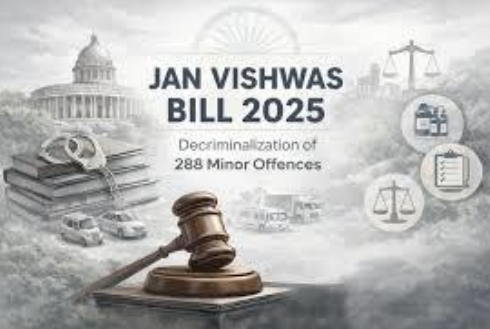
Union Finance Minister Nirmala Sitharaman is scheduled to introduce the Corporate Laws (Amendment) Bill, 2026, in the Lok Sabha. This legislative move aims to overhaul the existing regulatory framework governing Indian businesses by amending the Companies Act, 2013, and the Limited Liability Partnership (LLP) Act, 2008. The bill represents a strategic shift from a \'punitive\' to a \'facilitative\' oversight model, focusing on declogging the judicial system and fostering a conducive environment for startups, small firms, and Farmer Producer Organizations (FPOs). • Decriminalization of Minor Offences: A core objective of the bill is to replace criminal penalties with civil monetary fines for procedural and technical lapses. This reduces the \'fear of the law\' for honest business owners and ensures that criminal courts are not burdened with non-fraudulent compliance delays. • Support for FPOs and Startups: The bill introduces specific relaxations for \'Producer Companies\' (entities set up by farmers) and startups. These include reduced compliance burdens and simplified filing requirements, aimed at integrating the primary sector with corporate efficiencies. • LLP Act Modernization: By amending the LLP Act, 2008, the government seeks to provide greater operational flexibility to partners while maintaining limited liability protections. This makes the LLP structure more attractive for professional services and small-scale enterprises. • Reduction in Compliance Cost: The amendments aim to streamline disclosure norms and governance requirements, particularly for smaller firms, thereby reducing the \'compliance tax\' that often hampers the growth of the MSME sector. • Strengthening Civil Penalties: While decriminalizing minor slips, the bill proposes a more robust In-house Adjudication Mechanism (IAM). This allows for faster settlement of defaults through designated officers, bypassing lengthy litigation in the National Company Law Tribunal (NCLT). • Ease of Doing Business (EoDB) 2.0: The bill is a legislative manifestation of India’s EoDB 2.0 strategy, which focuses on trust-based governance and the removal of redundant legal hurdles that act as barriers to domestic and foreign investment. Key Definitions • Decriminalization: The legislative process of transforming a criminal offense into a civil or administrative one, where the penalty involves a fine rather than imprisonment. • Producer Company: A body corporate registered under the Companies Act that deals with the primary produce of its members (farmers, artisans, etc.), combining the benefits of a cooperative with the regulatory framework of a company. • Limited Liability Partnership (LLP): A hybrid corporate business vehicle that provides the benefits of limited liability of a company but allows its members the flexibility of organizing their internal structure as a partnership. Constitutional and Legal Provisions • Article 19(1)(g): Grants citizens the right to practice any profession, or to carry on any occupation, trade, or business. The bill facilitates this right by removing disproportionate legal obstacles. • Article 39(b) & (c): Directive Principles of State Policy that mandate the state to ensure that the ownership and control of material resources are distributed for the common good and to prevent the concentration of wealth (relevant to FPOs and small firms). • Seventh Schedule (Entry 43 & 44, Union List): Grants Parliament the exclusive power to legislate on the incorporation, regulation, and winding up of trading corporations, including banking, insurance, and financial corporations. • Companies Act, 2013: The principal legislation for company law in India; the 2026 Bill follows previous decriminalization rounds in 2018, 2019, and 2020. Important Keypoints for UPSC Mains • Trust-Based Governance: The shift from \'Inspector Raj\' to \'Digital Governance\' and \'Civil Penalties\' reflects a mature regulatory ecosystem where the state acts as a partner in growth rather than a suspicious supervisor. • Impact on NCLT Workload: By diverting technical defaults to an in-house adjudication process, the bill allows the NCLT to focus on high-stakes cases like insolvency and corporate fraud under the IBC. • Farmer Income Doubling: By easing the compliance for Producer Companies, the bill supports the institutionalization of agriculture, allowing farmers to access better credit, technology, and market linkages. • Foreign Direct Investment (FDI): Clearer and less litigious corporate laws are a primary factor for foreign investors when assessing \'Ease of Doing Business\' in a developing economy. Conclusion The Corporate Laws (Amendment) Bill, 2026, is a vital step in India’s journey toward becoming a $5 trillion economy. By differentiating between \'serious fraud\' and \'technical defaults,\' the law provides the corporate sector with the necessary \'breathing room\' to innovate and scale. However, the success of these reforms will hinge on the efficiency of the Civil Adjudication Mechanism and ensuring that \'decriminalization\' does not inadvertently lower the bar for corporate transparency and accountability. UPSC Relevance • Prelims: Features of the Companies Act and LLP Act; Concepts of Decriminalization; Producer Companies and FPOs. • Mains (GS Paper II & III): Government policies and interventions for development in various sectors; Indian Economy and issues relating to planning, mobilization of resources, and growth; Ease of doing business.


Address : 506, 3rd EYE THREE (III), Opp. Induben Khakhrawala, Girish Cold Drink Cross Road, CG Road, Navrangpura, Ahmedabad, 380009.
Mobile : 8469231587 / 9586028957
Telephone : 079-40098991
E-mail: dics.upsc@gmail.com
Address: A-306, The Landmark, Urjanagar-1, Opp. Spicy Street, Kudasan – Por Road, Kudasan, Gandhinagar – 382421
Mobile : 9723832444 / 9723932444
E-mail: dics.gnagar@gmail.com
Address: 2nd Floor, 9 Shivali Society, L&T Circle, opp. Ratri Bazar, Karelibaugh, Vadodara, 390018
Mobile : 9725692037 / 9725692054
E-mail: dics.vadodara@gmail.com
Address: 403, Raj Victoria, Opp. Pal Walkway, Near Galaxy Circle, Pal, Surat-394510
Mobile : 8401031583 / 8401031587
E-mail: dics.surat@gmail.com
Address: 303,305 K 158 Complex Above Magson, Sindhubhavan Road Ahmedabad-380059
Mobile : 9974751177 / 8469231587
E-mail: dicssbr@gmail.com
Address: 57/17, 2nd Floor, Old Rajinder Nagar Market, Bada Bazaar Marg, Delhi-60
Mobile : 9104830862 / 9104830865
E-mail: dics.newdelhi@gmail.com