
Ahmedabad
(Head Office)Address : 506, 3rd EYE THREE (III), Opp. Induben Khakhrawala, Girish Cold Drink Cross Road, CG Road, Navrangpura, Ahmedabad, 380009.
Mobile : 8469231587 / 9586028957
E-mail: dics.upsc@gmail.com

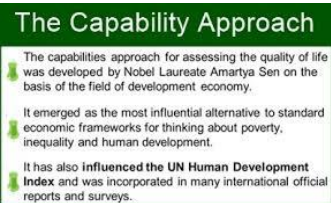
• Redefining Development: In Amartya Sen’s framework, development is viewed as the expansion of \'substantive freedoms\' (capabilities) that allow individuals to lead lives they have reason to value, moving beyond narrow economic metrics like GDP or per capita income. • Capabilities vs. Functionings: Sen distinguishes between \'capabilities\' (the real opportunity to achieve) and \'functionings\' (the actual achievements or \'beings and doings\' like being well-nourished), emphasizing that the freedom to choose is as morally important as the outcome itself. • Agency-Centric Model: The approach shifts the focus from treating people as passive \'beneficiaries\' of state largesse to recognizing them as active \'agents\' of change whose voices and participation are central to the development process. • Critique of Skill Reductionism: Sen cautions against reducing education to mere \'human capital\' or jobmarket skill formation; true education must foster critical thinking and the \'equality of autonomy\' necessary for meaningful democratic participation. • Niti vs. Nyaya: A crucial distinction in Sen’s theory of justice is between niti (the fitness of institutions and formal rules) and nyaya (the realization of justice in the actual lives of people), arguing that institutional design is insufficient if it does not produce lived justice. • Contemporary Challenges: In the era of \'post-truth\' politics and AI, the erosion of critical reasoning and the convergence of state-market interests (plutocratic populism) threaten the enabling conditions required for capabilities to flourish, leading to a disconnect between theory and practice. Key Definitions • Capabilities: The various combinations of functionings (beings and doings) that a person can achieve; it represents the freedom to achieve alternative functioning combinations. • Human Capital: An instrumental view of humans as a means of production through skill and education, whereas the Capability Approach views human life as an end in itself. • Substantive Freedom: The actual ability or opportunity to do something, as opposed to formal legal rights that a person may not have the resources or health to exercise. Constitutional & Legal Framework • Article 21: The Right to Life and Personal Liberty. The Supreme Court has expanded this to include the \'right to live with dignity,\' mirroring Sen’s idea that life is more than mere animal existence. • Directive Principles of State Policy (Part IV): Articles 38 and 39 mandate the State to secure a social order for the promotion of the welfare of the people and minimize inequalities in status and opportunity. • Fundamental Duties (Article 51A): Specifically 51A(h), which mandates the development of \'scientific temper, humanism and the spirit of inquiry,\' aligning with the capability to think and reason. • Right to Education (RTE) Act, 2009: A legal manifestation of providing the capability of literacy, though Sen’s approach would further evaluate the quality of reasoning it produces. Additional Important Keypoints • Collaboration with Mahbub ul Haq: This approach was instrumental in creating the Human Development Index (HDI), which ranks countries based on health, education, and income rather than just wealth. • Difference with Martha Nussbaum: Unlike Nussbaum, who proposed a \'central list\' of 10 functional capabilities, Sen leaves the list open-ended to avoid paternalism and allow for democratic deliberation. • Public Reasoning: Sen emphasizes that the \'priority\' of which capabilities matter most should be decided through open public debate, making democracy a constituent part of development. Conclusion The Capabilities Approach serves as a powerful corrective to economic reductionism by placing human freedom at the heart of progress. However, its effectiveness in India is currently challenged by a \'post-truth\' environment and a governance model that prioritizes technical skill over critical agency. For India to truly develop, it must bridge the gap between niti (institutional rules) and nyaya (actualized justice), ensuring that education and policy foster not just workers, but free-thinking citizens. UPSC Relevance • GS Paper I: Social empowerment; Poverty and developmental issues. • GS Paper II: Welfare schemes for vulnerable sections; Issues relating to development and management of Social Sector/Services relating to Health, Education, Human Resources. • GS Paper IV (Ethics): Human Values; Concept of Justice (John Rawls vs. Amartya Sen); Philosophical basis of governance. • Essay: Frequently used as a foundational framework for topics on Education, Women Empowerment, and the Philosophy of Development.


Address : 506, 3rd EYE THREE (III), Opp. Induben Khakhrawala, Girish Cold Drink Cross Road, CG Road, Navrangpura, Ahmedabad, 380009.
Mobile : 8469231587 / 9586028957
E-mail: dics.upsc@gmail.com
Address: A-306, The Landmark, Urjanagar-1, Opp. Spicy Street, Kudasan – Por Road, Kudasan, Gandhinagar – 382421
Mobile : 9723832444 / 9723932444
E-mail: dics.gnagar@gmail.com
Address: 2nd Floor, 9 Shivali Society, L&T Circle, opp. Ratri Bazar, Karelibaugh, Vadodara, 390018
Mobile : 9725692037 / 9725692054
E-mail: dics.vadodara@gmail.com
Address: 403, Raj Victoria, Opp. Pal Walkway, Near Galaxy Circle, Pal, Surat-394510
Mobile : 8401031583 / 8401031587
E-mail: dics.surat@gmail.com
Address: 303,305 K 158 Complex Above Magson, Sindhubhavan Road Ahmedabad-380059
Mobile : 9974751177 / 8469231587
E-mail: dicssbr@gmail.com
Address: 57/17, 2nd Floor, Old Rajinder Nagar Market, Bada Bazaar Marg, Delhi-60
Mobile : 9104830862 / 9104830865
E-mail: dics.newdelhi@gmail.com