







Ahmedabad
(Head Office)Address : 506, 3rd EYE THREE (III), Opp. Induben Khakhrawala, Girish Cold Drink Cross Road, CG Road, Navrangpura, Ahmedabad, 380009.
Mobile : 8469231587 / 9586028957
Telephone : 079-40098991
E-mail: dics.upsc@gmail.com

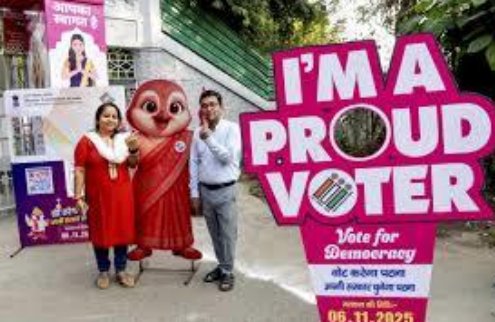
The Election Commission of India has recently announced the schedule for five Assembly elections (April-May 2026), bringing the focus back to the fundamental mechanics of Indian democracy. Amidst this, the Supreme Court has revisited the discourse on mandatory voting. While high voter turnout is a hallmark of a robust democracy, the debate centers on whether the \'Right to Vote\' also includes the \'Right Not to Vote,\' and whether penalizing non-participation is constitutionally and practically viable in the Indian context. • Nature of the Right: In India, the right to vote is primarily recognized as a statutory right rather than a fundamental right. It is derived from Article 326 of the Constitution and further delineated by the Representation of the People Acts of 1950 and 1951. • Compulsory Voting Global Context: Countries like Australia, Brazil, and Argentina enforce mandatory voting through fines, while Peru restricts access to certain public services for non-voters. While this increases turnout by approximately 7% on average, it relies heavily on the severity of legal penalties. • Recommendations of Committees: The Dinesh Goswami Committee (1990) and the Law Commission’s 255th Report (2015) have both argued against compulsory voting in India. They cited implementation hurdles and the philosophy that participation should be voluntary and based on civic awareness rather than coercion. • Constitutional Conflict: Mandatory voting is often viewed as a potential violation of Article 19(1)(a) (Freedom of Expression). The Supreme Court has previously noted that the decision to stay away from the poll is also a form of expression, protected under the umbrella of individual liberty. • Practical Barriers for Turnout: Low turnout in India is often not due to apathy alone but due to structural issues such as migrant workers\' inability to reach their home constituencies and the lack of robust remote voting technologies. • Proposed Alternatives: Instead of punitive measures, the focus is shifting toward \'Systematic Voters\' Education and Electoral Participation\' (SVEEP) programs, stricter enforcement of polling day holidays, improved transport facilities, and exploring secure remote voting methods. Key Definitions • Statutory Right: A right created by an enactment of a legislative body (Parliament or State Legislature) as opposed to a right directly conferred by the Constitution (Fundamental Right). • Electoral Roll: A formal list of all persons in a particular constituency who are entitled to vote in an election. • Ordinary Resident: Under Section 19 of the RPA 1950, it is the primary condition for being registered in a constituency, generally meaning the place where a person normally lives. Constitutional and Legal Provisions • Article 326: Grants Universal Adult Suffrage, stating that every citizen above 18 years, not otherwise disqualified, is entitled to be registered as a voter. • Representation of the People Act, 1950: Governs the preparation of electoral rolls and the qualification of voters (Section 19). • Representation of the People Act, 1951: Governs the actual conduct of elections and specifies the right to vote (Section 62). • Article 19(1)(a): Protects freedom of speech and expression; the act of voting (or not voting) is considered a facet of this expression. • NOTA (None of the Above): Introduced following the PUCL vs. Union of India (2013) judgment, allowing voters to register their dissent against all candidates, further strengthening the \'Right to Reject.\' Important Keypoints for UPSC Mains • Democratic Legitimacy: Critics of the \'First Past the Post\' system argue that low turnout allows candidates to win with only a minority of the total electorate\'s support, potentially diluting the representative character of the government. • SVEEP Initiative: The Election Commission’s flagship program for voter education and awareness aimed at increasing turnout through \'Informative, Motivating, and Facilitative\' campaigns. • Technology in Elections: The debate on Remote Voting Machines (RVMs) is crucial for including domestic migrants, but it requires political consensus and ironclad security protocols to maintain public trust. • Compulsory Voting vs. Duty: While the Constitution identifies certain \'Fundamental Duties\' (Article 51A), voting is currently not one of them. Elevating it to a duty would require a Constitutional Amendment. Conclusion Compulsory voting remains a \'harsh measure\' ill-suited for a diverse and populous democracy like India. The path to a more representative democracy lies in deepening \'Civic Literacy\' and removing the physical and technological barriers that prevent marginalized groups and migrants from exercising their franchise. As the 2026 Assembly polls approach, the focus remains on making the ballot box accessible rather than making the booth mandatory. UPSC Relevance • Prelims: Article 326, RPA 1950/1951 provisions, Voter eligibility, and NOTA. • Mains (GS Paper II): Salient features of the Representation of People\'s Act; Appointment to various Constitutional posts, powers, functions, and responsibilities of various Constitutional Bodies; Comparison of the Indian constitutional scheme with that of other countries.


Address : 506, 3rd EYE THREE (III), Opp. Induben Khakhrawala, Girish Cold Drink Cross Road, CG Road, Navrangpura, Ahmedabad, 380009.
Mobile : 8469231587 / 9586028957
Telephone : 079-40098991
E-mail: dics.upsc@gmail.com
Address: A-306, The Landmark, Urjanagar-1, Opp. Spicy Street, Kudasan – Por Road, Kudasan, Gandhinagar – 382421
Mobile : 9723832444 / 9723932444
E-mail: dics.gnagar@gmail.com
Address: 2nd Floor, 9 Shivali Society, L&T Circle, opp. Ratri Bazar, Karelibaugh, Vadodara, 390018
Mobile : 9725692037 / 9725692054
E-mail: dics.vadodara@gmail.com
Address: 403, Raj Victoria, Opp. Pal Walkway, Near Galaxy Circle, Pal, Surat-394510
Mobile : 8401031583 / 8401031587
E-mail: dics.surat@gmail.com
Address: 303,305 K 158 Complex Above Magson, Sindhubhavan Road Ahmedabad-380059
Mobile : 9974751177 / 8469231587
E-mail: dicssbr@gmail.com
Address: 57/17, 2nd Floor, Old Rajinder Nagar Market, Bada Bazaar Marg, Delhi-60
Mobile : 9104830862 / 9104830865
E-mail: dics.newdelhi@gmail.com