






Ahmedabad
(Head Office)Address : 506, 3rd EYE THREE (III), Opp. Induben Khakhrawala, Girish Cold Drink Cross Road, CG Road, Navrangpura, Ahmedabad, 380009.
Mobile : 8469231587 / 9586028957
Telephone : 079-40098991
E-mail: dics.upsc@gmail.com

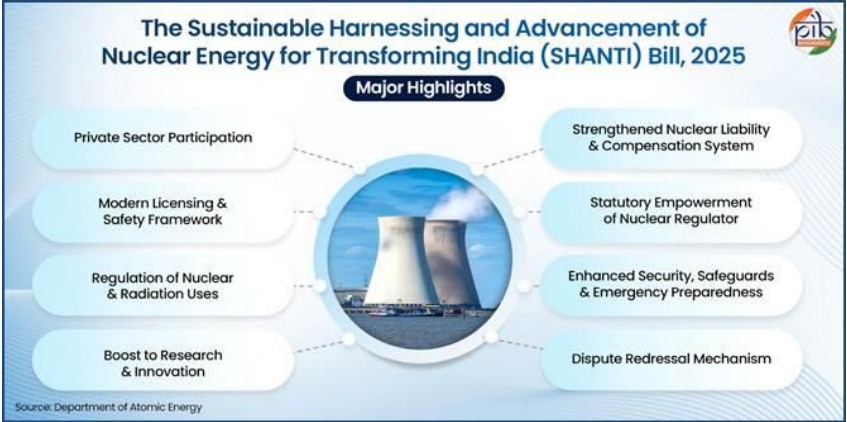
• Ambitious Capacity Expansion: The Union Budget 2025-26 set a target to increase India’s nuclear power capacity from 8,180 MW to 100 GW (1,00,000 MW) by 2047. This is essential to meet the energy demands of a \'Viksit Bharat\' while achieving the \'Net Zero\' emission target by 2070. • Legislative Transformation via SHANTI Act: The Sustainable Harnessing and Advancement of Nuclear Energy for Transforming India (SHANTI) Act, 2025, repealed the 1962 Atomic Energy Act and the 2010 Civil Liability for Nuclear Damage Act (CLNDA). It ends the Department of Atomic Energy’s (DAE) exclusive monopoly by allowing private companies to build, own, and operate nuclear plants. • Regulatory and Liability Reforms: The Act grants statutory status to the Atomic Energy Regulatory Board (AERB) and revises the nuclear liability framework. These changes are designed to mitigate risks for private and foreign investors, addressing long-standing hurdles in the nuclear supply chain. • Nuclear as a Baseload Necessity: While India aims for 500 GW of renewables by 2030, renewables face intermittency and land-intensity challenges. Nuclear power provides a steady, low-carbon \'baseload\' (currently 3% of generation from 1.8% capacity), making it the preferred alternative to coal-based thermal power. • Small Modular Reactors (SMRs) and PHWRs: The government is focusing on indigenous SMRs (5 MW to 200 MW) for captive use in energy-intensive industries like steel and data centers. The proven 220 MW Pressurized Heavy Water Reactor (PHWR) is being positioned as a \'workhorse\' for modularization and rapid deployment. • Three-Front Strategy for 100 GW: Realizing the target requires: (a) indigenizing foreign designs (EdF, Westinghouse) to lower costs; (b) accelerating R&D in Molten-Salt reactors and Thorium-HALEU cladding; and (c) establishing transparent rules for fuel ownership, waste management, and insurance. Key Definitions • Baseload Power: The minimum amount of electric power that a utility system must generate to meet the constant demand of its customers. Nuclear and thermal plants are typical baseload providers. • Small Modular Reactors (SMRs): Advanced nuclear reactors that have a power capacity of up to 300 MW per unit, which is about one-third of the generating capacity of traditional nuclear power reactors. • Fissile Material: Material capable of sustaining a nuclear fission chain reaction, such as Uranium-235 or Plutonium-239, used as fuel in nuclear reactors. Constitutional and Legal Provisions • Seventh Schedule (List I - Union List): Entry 6 gives the Central Government exclusive jurisdiction over \'Atomic energy and mineral resources necessary for its production.\' • SHANTI Act, 2025: The primary legal framework governing civilian nuclear energy, private participation, and regulatory oversight in India, replacing the Atomic Energy Act of 1962. • Article 51A (h): Part of Fundamental Duties, which encourages the development of \'scientific temper, humanism and the spirit of inquiry and reform,\' aligning with advanced nuclear research. Additional Key Points • Cost Competitiveness: India\'s construction cost for 700 MW PHWRs is approximately $2 million per MW, significantly lower than global averages, though unproven foreign designs may cost upwards of $5 million per MW. • The Thorium Route: India holds one of the world\'s largest Thorium reserves. Research into Thorium cladding with HALEU (High Assay Low Enriched Uranium) is a strategic alternative to the traditional Three-Stage Nuclear Power Programme. • Land Intensity: Renewable farms require nearly 10 times more land than thermal or nuclear plants to produce the same amount of electricity, a major constraint for a land-scarce country like India. Conclusion The SHANTI Act 2025 marks a paradigm shift from a state-controlled, secretive nuclear regime to a transparent, market-linked civilian nuclear sector. While the legislative framework is in place, the success of the 100 GW mission depends on the notification of clear rules regarding land use (exclusion zones), nuclear waste disposal, and a robust insurance pool. Effectively separating strategic defense interests from civilian power will be the litmus test for attracting large-scale private investment. UPSC Relevance • GS Paper III: Science and Technology—developments and their applications; Indigenization of technology; Infrastructure (Energy); Environmental pollution and degradation (Net Zero). • GS Paper II: Government policies and interventions for development in various sectors and issues arising out of their design and implementation.


Address : 506, 3rd EYE THREE (III), Opp. Induben Khakhrawala, Girish Cold Drink Cross Road, CG Road, Navrangpura, Ahmedabad, 380009.
Mobile : 8469231587 / 9586028957
Telephone : 079-40098991
E-mail: dics.upsc@gmail.com
Address: A-306, The Landmark, Urjanagar-1, Opp. Spicy Street, Kudasan – Por Road, Kudasan, Gandhinagar – 382421
Mobile : 9723832444 / 9723932444
E-mail: dics.gnagar@gmail.com
Address: 2nd Floor, 9 Shivali Society, L&T Circle, opp. Ratri Bazar, Karelibaugh, Vadodara, 390018
Mobile : 9725692037 / 9725692054
E-mail: dics.vadodara@gmail.com
Address: 403, Raj Victoria, Opp. Pal Walkway, Near Galaxy Circle, Pal, Surat-394510
Mobile : 8401031583 / 8401031587
E-mail: dics.surat@gmail.com
Address: 303,305 K 158 Complex Above Magson, Sindhubhavan Road Ahmedabad-380059
Mobile : 9974751177 / 8469231587
E-mail: dicssbr@gmail.com
Address: 57/17, 2nd Floor, Old Rajinder Nagar Market, Bada Bazaar Marg, Delhi-60
Mobile : 9104830862 / 9104830865
E-mail: dics.newdelhi@gmail.com