






Ahmedabad
(Head Office)Address : 506, 3rd EYE THREE (III), Opp. Induben Khakhrawala, Girish Cold Drink Cross Road, CG Road, Navrangpura, Ahmedabad, 380009.
Mobile : 8469231587 / 9586028957
Telephone : 079-40098991
E-mail: dics.upsc@gmail.com

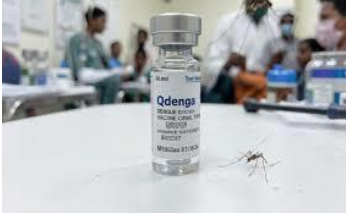
The Subject Expert Committee (SEC) under the Drugs Controller General of India (DCGI) has recently cleared Takeda’s tetravalent dengue vaccine, TAK-003 (Qdenga), for individuals aged 4 to 60 years, marking a paradigm shift from reactive vector control to preventive immunization. • Disease Modification vs. Transmission Block: Qdenga is primarily a \'disease-modifying\' vaccine rather than a transmission-blocking one; it significantly reduces the risk of severe dengue and hospitalization but does not entirely prevent infection or eliminate outbreaks. • Backbone and Serotype Efficacy: Developed on a DENV-2 genetic backbone, the vaccine shows high efficacy against Serotype 2 and reasonable protection against Serotype 1, but its performance against Serotypes 3 and 4 is notably lower, especially in \'dengue-naive\' individuals (those never previously infected). • Simplified Administration: Unlike its predecessor (Dengvaxia), Qdenga does not require costly pre-vaccination screening to check for prior exposure, making it more viable for large-scale real-world settings in endemic regions. • Evolving Epidemiology: A critical challenge in India is the rising prominence of DENV-3; since the vaccine has limited efficacy against this serotype, its overall population-level impact may be constrained if DENV-3 becomes the dominant circulating strain. • Economic and Access Barriers: With an estimated cost of ₹6,000-12,000 for the full two-dose course (administered three months apart), affordability remains a major hurdle for public health integration, likely limiting initial uptake to the private sector. • Indigenous Pipeline: India is currently conducting Phase III trials for \'DengiAll\' (developed by Panacea Biotec and ICMR), a single-dose candidate that promises more balanced protection across all four serotypes and could be available by 2027. Key Definitions • Tetravalent Vaccine: A vaccine designed to elicit an immune response against four different antigen sources—in this case, all four serotypes of the dengue virus (DENV-1, 2, 3, and 4). • Serotypes: Distinct variations within a species of virus; for dengue, infection with one serotype provides lifelong immunity to that specific type but only short-term, partial protection against others. • Antibody-Dependent Enhancement (ADE): A phenomenon where previous infection or suboptimal vaccination can lead to more severe disease during a subsequent infection with a different serotype. Constitutional & Legal Provisions • Article 47: A Directive Principle of State Policy (DPSP) that obligates the State to regard the improvement of public health as among its primary duties. • Article 21: The Right to Life, which the judiciary has interpreted to include the \'Right to Health,\' encompassing access to essential life-saving vaccines. • Drugs and Cosmetics Act, 1940: The primary legislation governing the import, manufacture, and distribution of drugs (including vaccines) in India, overseen by the CDSCO and DCGI. • National Health Policy, 2017: Aims to attain the highest possible level of health and well-being for all through a preventive and promotive health care orientation. Conclusion: Qdenga represents a significant technological milestone in India\'s struggle against dengue, offering a vital tool to decompress the healthcare system during peak seasons by preventing severe clinical outcomes. However, it is not a \'silver bullet.\' Its success depends on continuous genomic surveillance of circulating serotypes and its integration into a broader strategy that maintains rigorous vector control. The ultimate goal for India remains the development of an affordable, single-dose indigenous vaccine that provides uniform protection against the country\'s diverse viral landscape. UPSC Relevance • GS Paper II (Social Justice/Health): Issues relating to development and management of Social Sector/Services relating to Health; Government policies and interventions. • GS Paper III (Science & Technology): Developments and their applications and effects in everyday life; indigenization of technology and developing new technology. • Prelims Focus: Difference between DENV serotypes, the role of DCGI/SEC, and the \'DengiAll\' trial status.


Address : 506, 3rd EYE THREE (III), Opp. Induben Khakhrawala, Girish Cold Drink Cross Road, CG Road, Navrangpura, Ahmedabad, 380009.
Mobile : 8469231587 / 9586028957
Telephone : 079-40098991
E-mail: dics.upsc@gmail.com
Address: A-306, The Landmark, Urjanagar-1, Opp. Spicy Street, Kudasan – Por Road, Kudasan, Gandhinagar – 382421
Mobile : 9723832444 / 9723932444
E-mail: dics.gnagar@gmail.com
Address: 2nd Floor, 9 Shivali Society, L&T Circle, opp. Ratri Bazar, Karelibaugh, Vadodara, 390018
Mobile : 9725692037 / 9725692054
E-mail: dics.vadodara@gmail.com
Address: 403, Raj Victoria, Opp. Pal Walkway, Near Galaxy Circle, Pal, Surat-394510
Mobile : 8401031583 / 8401031587
E-mail: dics.surat@gmail.com
Address: 303,305 K 158 Complex Above Magson, Sindhubhavan Road Ahmedabad-380059
Mobile : 9974751177 / 8469231587
E-mail: dicssbr@gmail.com
Address: 57/17, 2nd Floor, Old Rajinder Nagar Market, Bada Bazaar Marg, Delhi-60
Mobile : 9104830862 / 9104830865
E-mail: dics.newdelhi@gmail.com