






Ahmedabad
(Head Office)Address : 506, 3rd EYE THREE (III), Opp. Induben Khakhrawala, Girish Cold Drink Cross Road, CG Road, Navrangpura, Ahmedabad, 380009.
Mobile : 8469231587 / 9586028957
Telephone : 079-40098991
E-mail: dics.upsc@gmail.com

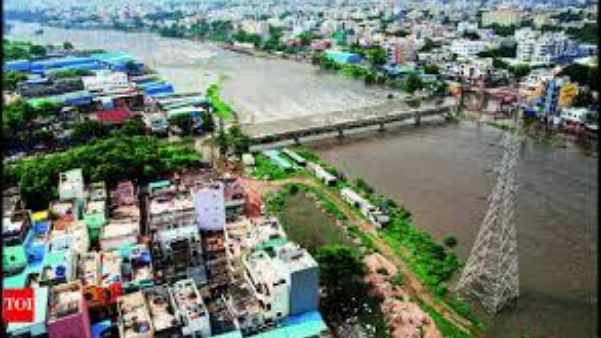
• Project Scope and Vision: The Telangana government aims to transform the 55 km Hyderabad stretch of the Musi River from a seasonal sewage-filled channel into a perennial urban waterfront. The plan includes leisure spaces, heritage restoration, and a cultural precinct featuring a \'world-tallest\' Gandhi statue at the confluence of the Musa and Esi rivulets. • Hydrological Engineering: To ensure year-round flow, the project proposes channeling 2.5 tmcft of water from the Godavari River via the Mallanna Sagar Reservoir into the twin flood-control reservoirs, Osman Sagar and Himayat Sagar. • Environmental Remediation: Addressing the severe pollution levels, the government plans to add 39 new Sewage Treatment Plants (STPs) to the existing 31, aiming to treat all urban discharge before it enters the river system. • Socio-Economic Conflict: The project has faced intense backlash due to the forced eviction of slum dwellers from the riverbed. Activists under the \'Musi Jan Andolan\' umbrella criticize the government for prioritizing aesthetic development over the rehabilitation rights of long-term residents. • Funding and Administrative Status: The first phase has received in-principle approval from the Asian Development Bank (ADB). However, controversy persists as land acquisition notifications were issued before the final Detailed Project Report (DPR) was made available for public scrutiny. • Geographical Context: Originating in the Ananthagiri Hills, the Musi is a tributary of the Krishna River. Historically, it is known for the devastating 1908 floods, which led to the creation of the city\'s modern flood protection infrastructure. Key Definitions • Perennial River: A stream or river that has continuous flow in parts of its bed throughout the year during years of normal rainfall. • TMCFT: Abbreviation for Thousand Million Cubic Feet, a unit of volume commonly used in India to measure the capacity of reservoirs and river flow. • Riverfront Development: An urban planning approach that focuses on the ecological restoration and commercial/recreational enhancement of land adjacent to a river. Constitutional & Legal Framework • Article 21: The Right to Life includes the right to a clean environment and, by judicial extension, the right to livelihood and shelter, which are central to the displacement debate. • The Right to Fair Compensation and Transparency in Land Acquisition, Rehabilitation and Resettlement Act, 2013 (LARR): This Act mandates a social impact assessment and ensures that displaced persons are adequately compensated and resettled. • Article 48A: A Directive Principle of State Policy (DPSP) that directs the State to endeavor to protect and improve the environment and safeguard the forests and wildlife. • Article 51A(g): A Fundamental Duty of citizens to protect and improve the natural environment, including forests, lakes, rivers, and wildlife. Additional Important Keypoints • Historical Significance: The 1908 Musi floods were a turning point for Hyderabad\'s urban planning, leading to the birth of the City Improvement Trust and planned drainage systems. • Inter-Basin Transfer: The proposal to bring Godavari water to the Musi represents a significant interbasin water transfer project, which has its own set of ecological and federal implications. • Consortium Approach: The preparation of the DPR by a five-company consortium indicates an attempt to bring international urban design standards to the project. Conclusion The Musi Riverfront Development Project represents a classic urban governance dilemma: the need for environmental restoration and modernization versus the protection of vulnerable communities. While the rejuvenation of a \'dead\' river is essential for Hyderabad\'s ecological health, the success of the project hinges on a \'people-first\' approach to resettlement and transparent administrative processes. UPSC Relevance • GS Paper I: Geographical features and their location-changes in critical geographical features (rivers). • GS Paper II: Government policies and interventions for development in various sectors and issues arising out of their design and implementation; Statutory and quasi-judicial bodies. • GS Paper III: Conservation, environmental pollution, and degradation; Environmental impact assessment; Disaster management (urban flooding). • Prelims: Tributaries of the Krishna River, Ananthagiri Hills, National River Conservation Plan (NRCP), and basics of the LARR Act.


Address : 506, 3rd EYE THREE (III), Opp. Induben Khakhrawala, Girish Cold Drink Cross Road, CG Road, Navrangpura, Ahmedabad, 380009.
Mobile : 8469231587 / 9586028957
Telephone : 079-40098991
E-mail: dics.upsc@gmail.com
Address: A-306, The Landmark, Urjanagar-1, Opp. Spicy Street, Kudasan – Por Road, Kudasan, Gandhinagar – 382421
Mobile : 9723832444 / 9723932444
E-mail: dics.gnagar@gmail.com
Address: 2nd Floor, 9 Shivali Society, L&T Circle, opp. Ratri Bazar, Karelibaugh, Vadodara, 390018
Mobile : 9725692037 / 9725692054
E-mail: dics.vadodara@gmail.com
Address: 403, Raj Victoria, Opp. Pal Walkway, Near Galaxy Circle, Pal, Surat-394510
Mobile : 8401031583 / 8401031587
E-mail: dics.surat@gmail.com
Address: 303,305 K 158 Complex Above Magson, Sindhubhavan Road Ahmedabad-380059
Mobile : 9974751177 / 8469231587
E-mail: dicssbr@gmail.com
Address: 57/17, 2nd Floor, Old Rajinder Nagar Market, Bada Bazaar Marg, Delhi-60
Mobile : 9104830862 / 9104830865
E-mail: dics.newdelhi@gmail.com