





Ahmedabad
(Head Office)Address : 506, 3rd EYE THREE (III), Opp. Induben Khakhrawala, Girish Cold Drink Cross Road, CG Road, Navrangpura, Ahmedabad, 380009.
Mobile : 8469231587 / 9586028957
Telephone : 079-40098991
E-mail: dics.upsc@gmail.com

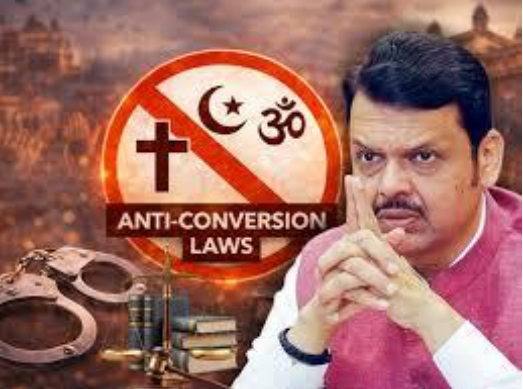
The Maharashtra Legislature recently passed the Maharashtra Freedom of Religion Bill, 2026, aimed at prohibiting unlawful religious conversions. While the government defends the legislation as a necessary measure to maintain public order and social harmony, civil society groups and legal experts have raised significant concerns regarding its impact on personal liberty and the right to privacy. Key Summary Points • Prohibition of Unlawful Conversion: The Bill explicitly bans conversions carried out through force, allurement, misrepresentation, undue influence, coercion, or any other fraudulent means. • Mandatory Disclosure Procedure: It institutionalizes an elaborate process for conversion, requiring a declaration of intent to be submitted to district authorities 60 days in advance, followed by a postconversion declaration. • Broad Complainant Base: The law empowers not just the victim but also parents, siblings, or any person related by blood, marriage, or adoption to register a police complaint against an alleged unlawful conversion. • Marital Implications: Any marriage solemnized solely for the purpose of unlawful conversion can be declared null and void by a court. However, children born from such unions retain succession rights to the property of both parents. • Stringent Penalties: Offenses are cognizable and nonbailable, with punishments ranging from 7 to 10 years of imprisonment and fines up to ₹7 lakh, particularly in cases involving minors, women, or persons from SC/ST communities. • Administrative Shift: The Bill moves matters of faith and marriage—traditionally handled by civil courts—into the domain of revenue and police authorities, necessitating a new state-run certification system for religious identity. Additional Important Keypoints • Burden of Proof: Similar to laws in other states, the burden of proving that a conversion was not forced or fraudulent typically rests on the person who converted or the individual who facilitated the conversion. • Protection of Minorities and Vulnerable Groups: The Bill prescribes higher penalties (up to 7 years\' jail and ₹5 lakh fine) if the converted individual is a minor, a woman, or belongs to the Scheduled Castes or Scheduled Tribes. • Mass Conversions: The legislation defines mass conversion as the conversion of two or more persons simultaneously, attracting the highest tier of penalties and potential cancellation of institutional registrations. Constitutional & Legal Provisions • Article 25: Guarantees the freedom of conscience and the right to freely profess, practice, and propagate religion. The Supreme Court in the Stainislaus case (1977) held that the right to \'propagate\' does not include the right to \'convert\' another person. • Article 21: The Right to Life and Personal Liberty. Critics argue that the 60-day notice violates the \'Right to Privacy\' and \'Right to Choose a Partner,\' as established in the Puttaswamy and Hadiya judgments. • Public Order (State List): The Maharashtra government invokes \'Public Order\' (Entry 1, List II) to justify the law, arguing that forcible conversions cause social unrest. • Article 13: Mandates that the State shall not make any law that takes away or abridges fundamental rights; this is the primary ground on which the Bill may face judicial scrutiny. Definition of Key Words • Allurement: Offering any gift, gratification, easy money, or material benefit (including employment or free education) to induce religious conversion. • Cognizable Offense: An offense in which the police can arrest a person without a warrant and has the authority to investigate without prior permission from a magistrate. • Non-Bailable: A category of offense where bail is not a matter of right for the accused and is instead granted at the sole discretion of the court. • Undue Influence: The unfair use of a position of power or authority to influence the will of another person to obtain their consent for conversion. Conclusion The Maharashtra Freedom of Religion Bill, 2026, reflects a growing trend of state-level \'Anti-Conversion\' laws in India. While its stated objective is to protect vulnerable individuals from predatory proselytization, its procedural requirements—such as public notices—create a tension between state oversight and the individual\'s right to privacy. The eventual success of this law will depend on whether the executive can prevent its misuse by vigilante groups while ensuring that the \'Right to Freedom of Religion\' remains a reality for all citizens. UPSC Relevance • GS Paper II (Polity & Constitution): Fundamental Rights (Articles 21 and 25); Judicial Review of state laws; the conflict between individual liberty and state-imposed public order. • GS Paper II (Social Justice): Protection of vulnerable sections including women, minors, and SC/ST communities; the role of civil society in monitoring legislative overreach.


Address : 506, 3rd EYE THREE (III), Opp. Induben Khakhrawala, Girish Cold Drink Cross Road, CG Road, Navrangpura, Ahmedabad, 380009.
Mobile : 8469231587 / 9586028957
Telephone : 079-40098991
E-mail: dics.upsc@gmail.com
Address: A-306, The Landmark, Urjanagar-1, Opp. Spicy Street, Kudasan – Por Road, Kudasan, Gandhinagar – 382421
Mobile : 9723832444 / 9723932444
E-mail: dics.gnagar@gmail.com
Address: 2nd Floor, 9 Shivali Society, L&T Circle, opp. Ratri Bazar, Karelibaugh, Vadodara, 390018
Mobile : 9725692037 / 9725692054
E-mail: dics.vadodara@gmail.com
Address: 403, Raj Victoria, Opp. Pal Walkway, Near Galaxy Circle, Pal, Surat-394510
Mobile : 8401031583 / 8401031587
E-mail: dics.surat@gmail.com
Address: 303,305 K 158 Complex Above Magson, Sindhubhavan Road Ahmedabad-380059
Mobile : 9974751177 / 8469231587
E-mail: dicssbr@gmail.com
Address: 57/17, 2nd Floor, Old Rajinder Nagar Market, Bada Bazaar Marg, Delhi-60
Mobile : 9104830862 / 9104830865
E-mail: dics.newdelhi@gmail.com