








Ahmedabad
(Head Office)Address : 506, 3rd EYE THREE (III), Opp. Induben Khakhrawala, Girish Cold Drink Cross Road, CG Road, Navrangpura, Ahmedabad, 380009.
Mobile : 8469231587 / 9586028957
Telephone : 079-40098991
E-mail: dics.upsc@gmail.com

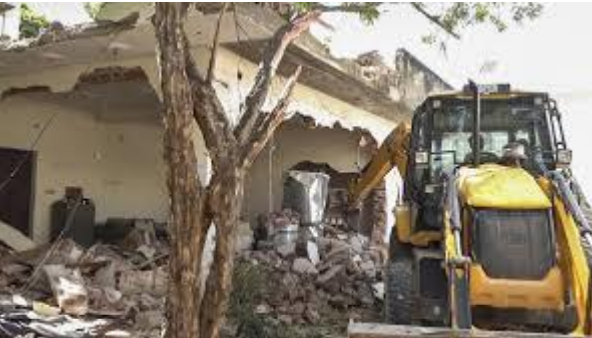
The Allahabad High Court recently addressed the growing administrative trend of \'punitive demolitions,\' where properties linked to criminal suspects are razed shortly after an FIR is filed. By framing five substantive questions, the Court has challenged the transformation of executive discretion into extra-judicial punishment, reaffirming that the power to penalize resides solely with the judiciary. Key Highlights and Summary • Judicial Over Punishment: The Court emphasized that administrative authorities cannot assume the role of the judiciary. Punishment must follow a predictable sequence: allegation, investigation, adjudication, and only then sanction. • Challenge to \'Colorable Exercise of Power\': While municipal laws allow the removal of unauthorized structures, using these laws specifically against persons accused of crimes constitutes a \'colorable exercise of power\'—using a legal tool for an impermissible, punitive objective. • Violation of Procedural Safeguards: Statutes like the UP Municipal Corporation Act, 1959, require a structured process: identifying a violation, issuing written notice, providing an opportunity to be heard, and passing a reasoned order. Instant demolitions bypass these mandatory steps. • Separation of Powers: Punitive demolitions erode the constitutional boundary between the executive and the legislature. The executive cannot impose consequences (like loss of shelter) based on suspicion alone, as this undermines the \'presumption of innocence.\' • Irreversible Harm and Accountability: The High Court raised concerns regarding the \'irreversible harm\' inflicted on families not implicated in crimes. It questioned the standards for preventive judicial intervention and mechanisms to ensure official accountability when municipal powers are misapplied. Constitutional and Legal Provisions • Article 14: Guarantees equality before the law. Selective demolitions targeting specific individuals connected to criminal cases violate the principle of non-arbitrariness. • Article 21: Protects the right to life and personal liberty. The Supreme Court has expanded this to include the \'Right to Shelter,\' stating that no person shall be deprived of their home without a procedure established by law. • Article 300A: Explicitly states that \'no person shall be deprived of his property save by authority of law.\' • UP Urban Planning and Development Act, 1973: Sections of this act provide for the regulation of land use and building codes, intended as regulatory measures rather than instruments of instant criminal justice. • SC Directions (2024 INSC 866): The Supreme Court categorically held that property cannot be demolished solely because an owner or occupant is an accused or a convict. Key Definitions • Bulldozer Justice: A colloquial term for the administrative practice of demolishing the houses or businesses of those accused of crimes, often without following the prescribed legal procedure for \'unauthorized construction.\' • Due Process of Law: A constitutional guarantee that all legal proceedings will be fair and that one will be given notice of the proceedings and an opportunity to be heard before the government acts to take away one\'s life, liberty, or property. • Colorable Exercise of Power: A legal doctrine where an authority, while appearing to act within its jurisdiction, actually uses its power to achieve an end that it is not authorized to pursue. Additional Critical Keypoints The Allahabad High Court\'s intervention highlights that a \'registration of an FIR\' does not render a structure illegal. Even if a structure is unauthorized, most municipal laws provide for the possibility of regularization (paying a fee to make the structure legal) or an appeal period, suggesting that demolition is a \'measure of last resort.\' Conclusion: While the enforcement of building regulations is essential for urban management, it cannot be weaponized as a tool for exemplary punishment. Punitive demolitions represent an inversion of the constitutional sequence of justice. For the Rule of Law to prevail, the distinction between a \'regulatory violation\' and \'criminal culpability\' must be strictly maintained by the state. UPSC Relevance • GS Paper II: Separation of Powers between various organs; Dispute Redressal Mechanisms and Institutions; Government policies and interventions for development. • GS Paper IV: Ethics and Governance (Administrative Neutrality, Justice vs. Retribution); Accountability and Ethical Governance. • Prelims: Fundamental Rights (Articles 14, 19, 21), Right to Property (Article 300A), and the jurisdiction of High Courts and the Supreme Court in issuing directions.


Address : 506, 3rd EYE THREE (III), Opp. Induben Khakhrawala, Girish Cold Drink Cross Road, CG Road, Navrangpura, Ahmedabad, 380009.
Mobile : 8469231587 / 9586028957
Telephone : 079-40098991
E-mail: dics.upsc@gmail.com
Address: A-306, The Landmark, Urjanagar-1, Opp. Spicy Street, Kudasan – Por Road, Kudasan, Gandhinagar – 382421
Mobile : 9723832444 / 9723932444
E-mail: dics.gnagar@gmail.com
Address: 2nd Floor, 9 Shivali Society, L&T Circle, opp. Ratri Bazar, Karelibaugh, Vadodara, 390018
Mobile : 9725692037 / 9725692054
E-mail: dics.vadodara@gmail.com
Address: 403, Raj Victoria, Opp. Pal Walkway, Near Galaxy Circle, Pal, Surat-394510
Mobile : 8401031583 / 8401031587
E-mail: dics.surat@gmail.com
Address: 303,305 K 158 Complex Above Magson, Sindhubhavan Road Ahmedabad-380059
Mobile : 9974751177 / 8469231587
E-mail: dicssbr@gmail.com
Address: 57/17, 2nd Floor, Old Rajinder Nagar Market, Bada Bazaar Marg, Delhi-60
Mobile : 9104830862 / 9104830865
E-mail: dics.newdelhi@gmail.com