






Ahmedabad
(Head Office)Address : 506, 3rd EYE THREE (III), Opp. Induben Khakhrawala, Girish Cold Drink Cross Road, CG Road, Navrangpura, Ahmedabad, 380009.
Mobile : 8469231587 / 9586028957
Telephone : 079-40098991
E-mail: dics.upsc@gmail.com

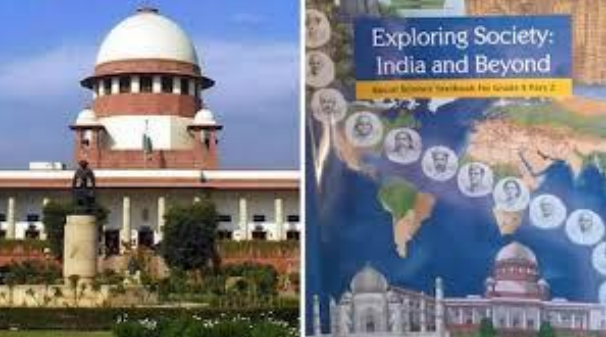
Summary of Key Developments • High-Level Expert Panel: The Union Government has constituted a specialized committee including former Supreme Court judge Justice Indu Malhotra and senior advocate K.K. Venugopal to finalize NCERT legal studies curricula for Class 8 and above. • Judicial Collaboration: The panel will work in association with Justice Aniruddha Bose, Director of the National Judicial Academy, ensuring that legal education for \'impressionable minds\' remains balanced and institutionally sound. • Origin of Dispute: The Supreme Court took suo motu cognisance of a Class 8 Social Science textbook chapter titled \'The Role of the Judiciary in our Society,\' specifically a sub-topic on \'Corruption in the Judiciary\' deemed to be maligning the institution. • Contempt and Ban: Following the observation that the content was a \'calculated move\' to create bias, the Court initiated contempt proceedings and ordered a \'blanket and complete\' ban on the textbook, despite the Centre withdrawing 82,000 copies. • Mandatory Approval Mechanism: The Court has directed that any revised or rewritten chapters concerning the judiciary must not be published unless vetted and approved by this committee of domain experts. • Broader Curricular Reform: While initially focused on Class 8, the committee\'s mandate has been expanded to review and guide the legal studies curriculum across all higher secondary grades to ensure academic integrity. Key Definitions • Suo Motu Cognisance: A Latin term meaning \'on its own motion,\' referring to a situation where a court takes up a case on its own without any complaint or petition filed by a party. • National Judicial Academy (NJA): A premier government-funded training institute in Bhopal for the judges of the Supreme Court, High Courts, and the District Judiciary. • Contempt of Court: Under the Contempt of Courts Act, 1971, it refers to any act that lowers the authority of a court or interferes with the administration of justice. Constitutional & Legal Provisions • Article 129 & 215: Empowers the Supreme Court and High Courts respectively to punish for contempt of themselves to protect the dignity of the judicial process. • Article 21A: While providing the Right to Education, the state is responsible for ensuring the quality and appropriateness of the curriculum provided to children. • Seventh Schedule (Entry 66, List I): Coordination and determination of standards in institutions for higher education or research and scientific and technical institutions lie with the Union. • National Curriculum Framework (NCF): The guiding document for NCERT, which must align with Constitutional values as per the National Policy on Education (NPE). Additional Important Keypoints • Doctrine of \'Impressionable Minds\': The Court emphasized that school-age children lack the critical faculty to distinguish between isolated instances and systemic failures, making balanced content essential. • Independence of Judiciary: Protecting the image of the judiciary from \'unwarranted maligning\' is viewed as a corollary to maintaining the independence of the third pillar of democracy. • Role of National Judicial Academy: The involvement of the NJA signifies a shift toward integrating judicial perspectives directly into educational pedagogy concerning law. Conclusion The formation of this expert committee marks a significant intervention by the judiciary into the domain of educational policy. By involving top-tier jurists in the framing of school textbooks, the Supreme Court aims to bridge the gap between academic freedom and institutional respect. This development underscores that while \'Corruption in the Judiciary\' is a valid subject for academic critique at higher levels, its presentation in primary education must be handled with extreme nuance to prevent the erosion of public trust in democratic institutions. UPSC Relevance • General Studies II: Issues relating to the development and management of Social Sector/Services relating to Education; Structure, organization and functioning of the Judiciary. • General Studies IV (Ethics): Content and characteristics of moral reasoning; Role of educational institutions in value-based learning; Institutional integrity


Address : 506, 3rd EYE THREE (III), Opp. Induben Khakhrawala, Girish Cold Drink Cross Road, CG Road, Navrangpura, Ahmedabad, 380009.
Mobile : 8469231587 / 9586028957
Telephone : 079-40098991
E-mail: dics.upsc@gmail.com
Address: A-306, The Landmark, Urjanagar-1, Opp. Spicy Street, Kudasan – Por Road, Kudasan, Gandhinagar – 382421
Mobile : 9723832444 / 9723932444
E-mail: dics.gnagar@gmail.com
Address: 2nd Floor, 9 Shivali Society, L&T Circle, opp. Ratri Bazar, Karelibaugh, Vadodara, 390018
Mobile : 9725692037 / 9725692054
E-mail: dics.vadodara@gmail.com
Address: 403, Raj Victoria, Opp. Pal Walkway, Near Galaxy Circle, Pal, Surat-394510
Mobile : 8401031583 / 8401031587
E-mail: dics.surat@gmail.com
Address: 303,305 K 158 Complex Above Magson, Sindhubhavan Road Ahmedabad-380059
Mobile : 9974751177 / 8469231587
E-mail: dicssbr@gmail.com
Address: 57/17, 2nd Floor, Old Rajinder Nagar Market, Bada Bazaar Marg, Delhi-60
Mobile : 9104830862 / 9104830865
E-mail: dics.newdelhi@gmail.com