




Ahmedabad
(Head Office)Address : 506, 3rd EYE THREE (III), Opp. Induben Khakhrawala, Girish Cold Drink Cross Road, CG Road, Navrangpura, Ahmedabad, 380009.
Mobile : 8469231587 / 9586028957
Telephone : 079-40098991
E-mail: dics.upsc@gmail.com

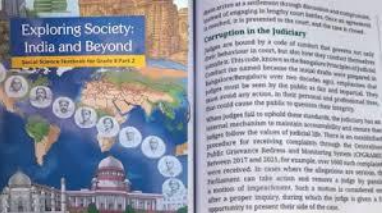
The Supreme Court of India recently directed a \'complete blanket ban\' on a Class 8 NCERT social science textbook, citing passages concerning judicial delay and corruption as an attempt to undermine institutional dignity. This move has sparked a significant constitutional debate regarding the boundaries of judicial authority, the right to free speech under Article 19, and the necessity of institutional transparency in a healthy democracy. • Censorship and Article 19: Legal experts argue that a book ban is an extreme form of censorship. Under the Constitution, free speech can only be restricted by a \'law\' made by the state on specific grounds mentioned in Article 19(2); however, judicial orders generally do not fall under the definition of \'law\' for such restrictions. • Contempt of Court Threshold: For a publication to be considered criminal contempt under the Contempt of Courts Act, 1971, it must \'scandalize\' the court or interfere with justice. The controversy centers on whether general references to case backlogs and judicial ethics meet this high threshold of malicious intent. • Due Process Concerns: The Court ordered the \'disassociation\' of the textbook\'s authors from future government projects. Critics point out that this punishment was awarded without a formal hearing or due process, potentially signaling a narrowing space for academic dissent. • Acknowledging Systemic Challenges: While the Court viewed the omissions of its \'transformative initiatives\' as problematic, historical precedents like K. Veeraswami vs Union of India (1991) established that judges are \'public servants\' and must be subject to the highest standards of honesty to maintain public trust. • Global Best Practices: International examples, such as the Kenyan judicial reforms (2011–2013), demonstrate that institutional credibility is restored through acknowledging corruption and establishing ombudspersons rather than suppressing critical discourse. • Role of Civil Society: The incident underscores the tension between protecting the \'dignity of the robes\' and the democratic requirement for an informed citizenry that understands both the strengths and the systemic challenges of the third pillar of the State. Key Definitions • Judicial Review: The power of the judiciary to examine the constitutionality of legislative enactments and executive orders, ensuring they align with the fundamental rights of citizens. • Criminal Contempt: As per Section 2(c) of the Contempt of Courts Act, 1971, it includes the publication of any matter which scandalizes or lowers the authority of any court or prejudices judicial proceedings. • In-house Procedure: A self-evolved mechanism by the Supreme Court to look into complaints against judges, aimed at maintaining internal accountability without external political interference. Constitutional & Legal Provisions • Article 19(1)(a): Guarantees the fundamental right to freedom of speech and expression to all citizens. • Article 19(2): Allows the State to impose \'reasonable restrictions\' on free speech in the interests of the sovereignty of India, public order, and \'contempt of court.\' • Article 124(4): Outlines the stringent process for the removal of a Supreme Court Judge on the grounds of \'proved misbehaviour or incapacity.\' • Prevention of Corruption Act, 1988: As interpreted in the K. Veeraswami case, this applies to the judiciary, although prior sanction from the President (consulting the CJI) is required for prosecution. Conclusion The balance between judicial dignity and public criticism is delicate. While protecting the court from baseless vitriol is essential for the rule of law, the suppression of academic data on delays and ethics may inadvertently hamper reform. A judiciary that remains open to introspection and acknowledges its \'bad apples\' is more likely to command genuine public respect than one that relies on the power of prohibition. UPSC Relevance • GS Paper II: Indian Constitution—significant provisions and basic structure; Structure, organization and functioning of the Judiciary; Issues arising out of the design and implementation of policies. • GS Paper IV: Ethics and Human Interface (Values in public life); Accountability and ethical governance. • Mains Perspective: \'Constructive criticism is the lifeblood of democracy.\' In light of this statement, evaluate the impact of judicial censorship on academic freedom and the right to information in India.


Address : 506, 3rd EYE THREE (III), Opp. Induben Khakhrawala, Girish Cold Drink Cross Road, CG Road, Navrangpura, Ahmedabad, 380009.
Mobile : 8469231587 / 9586028957
Telephone : 079-40098991
E-mail: dics.upsc@gmail.com
Address: A-306, The Landmark, Urjanagar-1, Opp. Spicy Street, Kudasan – Por Road, Kudasan, Gandhinagar – 382421
Mobile : 9723832444 / 9723932444
E-mail: dics.gnagar@gmail.com
Address: 2nd Floor, 9 Shivali Society, L&T Circle, opp. Ratri Bazar, Karelibaugh, Vadodara, 390018
Mobile : 9725692037 / 9725692054
E-mail: dics.vadodara@gmail.com
Address: 403, Raj Victoria, Opp. Pal Walkway, Near Galaxy Circle, Pal, Surat-394510
Mobile : 8401031583 / 8401031587
E-mail: dics.surat@gmail.com
Address: 303,305 K 158 Complex Above Magson, Sindhubhavan Road Ahmedabad-380059
Mobile : 9974751177 / 8469231587
E-mail: dicssbr@gmail.com
Address: 57/17, 2nd Floor, Old Rajinder Nagar Market, Bada Bazaar Marg, Delhi-60
Mobile : 9104830862 / 9104830865
E-mail: dics.newdelhi@gmail.com