






Ahmedabad
(Head Office)Address : 506, 3rd EYE THREE (III), Opp. Induben Khakhrawala, Girish Cold Drink Cross Road, CG Road, Navrangpura, Ahmedabad, 380009.
Mobile : 8469231587 / 9586028957
Telephone : 079-40098991
E-mail: dics.upsc@gmail.com

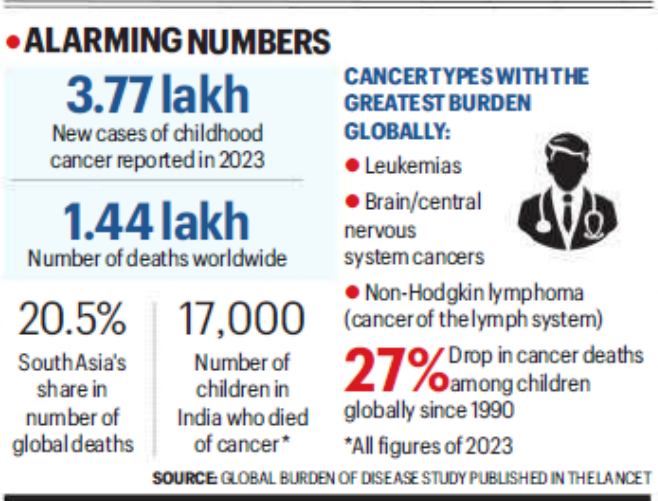
A recent study published in The Lancet based on the Global Burden of Disease (GBD) 2023 data highlights a concerning trend: cancer has become the 10th leading cause of death among children in India. While global childhood cancer deaths have declined by 27% since 1990, the burden remains disproportionately high in Lowand Middle-Income Countries (LMICs), including India. The study emphasizes that approximately 17,000 children died of cancer in India in 2023 alone, underscoring the urgent need for integrating pediatric oncology into national health planning. Core Summary of the GBD 2023 Findings • Ranking and Mortality: Cancer is now the 10th leading cause of death for children in India and the 8th globally, surpassing infectious diseases like measles and tuberculosis in some regions. • Global Inequity: LMICs account for 85% of new childhood cancer cases and a staggering 94% of global childhood cancer deaths, primarily due to delayed diagnosis and lack of specialized care. • India-Specific Data: In 2023, India recorded roughly 17,000 childhood cancer deaths. While mortality has seen a 16.9% decline since 1990, the rate of improvement lags behind high-income nations. • Prevalent Cancer Types: Leukemias remain the most common childhood cancer, followed by cancers of the brain/central nervous system and non-Hodgkin lymphoma. • Policy Omission: Experts note that despite the high burden, childhood cancer is currently not a discrete component of India’s national cancer control planning, which primarily focuses on adult cancers (oral, breast, and cervical). • Impact of Resources: Survival rates in high-income countries exceed 80%, but drop to less than 30% in many resource-limited settings, highlighting that most of these deaths are preventable with timely intervention. Key Definitions • Childhood Cancer: Cancers occurring in children aged 0–14 years. Unlike adult cancers, these are often not related to lifestyle factors and involve tissues rather than organs. • DALY (Disability-Adjusted Life Year): A measure of overall disease burden, expressed as the number of years lost due to ill-health, disability, or early death ($1 DALY = 1 lost year of healthy life$). • Paediatric Oncology: A specialized branch of medicine focused on the diagnosis and treatment of cancer in children and adolescents. Constitutional & Statutory Framework • Article 21: The Right to Life includes the Right to Health. The state has a constitutional obligation to provide accessible and affordable healthcare, especially for vulnerable groups like children. • Article 47 (DPSP): Mandates the State to regard the improvement of public health as among its primary duties. • National Health Policy (NHP) 2017: Aims to reach the highest possible level of health and well-being for all through a preventive and promotive health care orientation. • NPCDCS (National Programme for Prevention and Control of Cancer, Diabetes, Cardiovascular Diseases and Stroke): The flagship program launched in 2010 to manage non-communicable diseases, though currently lacking a specific pediatric focus. Government Initiatives for Cancer Care • Ayushman Bharat (PM-JAY): Provides an annual health cover of ₹5 lakh per family, covering over 200 cancer treatment packages including chemotherapy and radiation. • Rashtriya Arogya Nidhi (RAN): Offers financial assistance of up to ₹15 lakh for poor patients suffering from life-threatening diseases, including cancer, for treatment at super-specialty government hospitals. • Tertiary Care Cancer Centres (TCCC): Under the PMSSY, the government supports the setting up of State Cancer Institutes (SCI) and TCCCs to enhance regional treatment infrastructure. • National Cancer Grid (NCG): A network of major cancer centers across India created to standardize protocols and improve the quality of care nationwide. Additional Important Keypoints • Diagnosis Challenges: In rural India, lack of awareness and a shortage of pediatric oncologists often lead to diagnosis at advanced stages, significantly reducing the chances of a cure. • Economic Burden: Cancer treatment often causes \'catastrophic health expenditure,\' pushing families into a cycle of generational poverty due to high out-of-pocket costs. • Standardized Registries: There is a critical need for robust, population-based pediatric cancer registries to guide policy and resource allocation accurately. Conclusion The transition of childhood cancer into a top-ten cause of death in India signals a shift in the pediatric disease landscape from infectious to non-communicable diseases. Improving survival rates requires a multi-pronged approach: moving beyond adult-centric screening to include pediatric diagnostic protocols, investing in rural healthcare infrastructure, and providing comprehensive financial protection. As most childhood cancers are curable with generic medicines and timely surgery, the focus must shift from mere \'treatment\' to \'early detection and equity.\' UPSC Relevance • GS Paper II (Governance/Social Justice): Relevant for topics like \'Issues relating to development and management of Social Sector/Services relating to Health\' and \'Welfare schemes for vulnerable sections.\' • GS Paper III (Science & Technology): Direct link to \'Issues related to Biotechnology and Health\' and the impact of non-communicable diseases on India\'s demographic dividend.


Address : 506, 3rd EYE THREE (III), Opp. Induben Khakhrawala, Girish Cold Drink Cross Road, CG Road, Navrangpura, Ahmedabad, 380009.
Mobile : 8469231587 / 9586028957
Telephone : 079-40098991
E-mail: dics.upsc@gmail.com
Address: A-306, The Landmark, Urjanagar-1, Opp. Spicy Street, Kudasan – Por Road, Kudasan, Gandhinagar – 382421
Mobile : 9723832444 / 9723932444
E-mail: dics.gnagar@gmail.com
Address: 2nd Floor, 9 Shivali Society, L&T Circle, opp. Ratri Bazar, Karelibaugh, Vadodara, 390018
Mobile : 9725692037 / 9725692054
E-mail: dics.vadodara@gmail.com
Address: 403, Raj Victoria, Opp. Pal Walkway, Near Galaxy Circle, Pal, Surat-394510
Mobile : 8401031583 / 8401031587
E-mail: dics.surat@gmail.com
Address: 303,305 K 158 Complex Above Magson, Sindhubhavan Road Ahmedabad-380059
Mobile : 9974751177 / 8469231587
E-mail: dicssbr@gmail.com
Address: 57/17, 2nd Floor, Old Rajinder Nagar Market, Bada Bazaar Marg, Delhi-60
Mobile : 9104830862 / 9104830865
E-mail: dics.newdelhi@gmail.com