





Ahmedabad
(Head Office)Address : 506, 3rd EYE THREE (III), Opp. Induben Khakhrawala, Girish Cold Drink Cross Road, CG Road, Navrangpura, Ahmedabad, 380009.
Mobile : 8469231587 / 9586028957
Telephone : 079-40098991
E-mail: dics.upsc@gmail.com

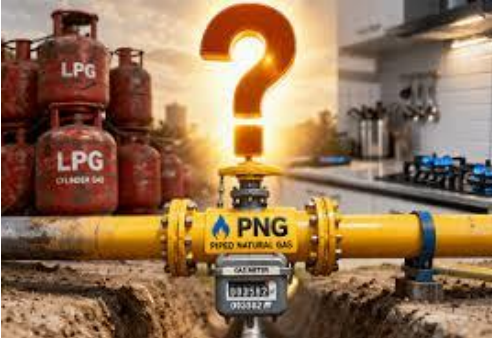
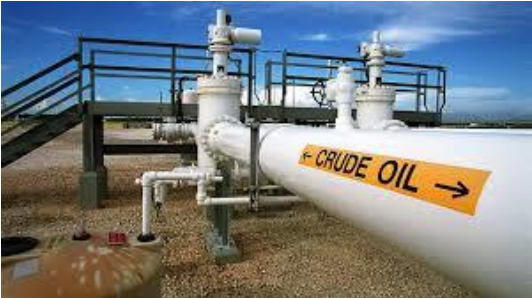
India is currently undergoing a strategic shift in its household energy landscape, moving away from a high reliance on imported LPG cylinders toward a domestically integrated Piped Natural Gas (PNG) network to ensure energy security. • The \'Switch or Surrender\' Mandate: Under the Natural Gas and Petroleum Products Distribution Order, 2026, the government has mandated that households in areas with functional PNG infrastructure must transition to piped gas; failure to do so within three months will result in the cessation of their LPG supply. • Strategic Necessity vs. Imports: India currently consumes 34 million tonnes of LPG annually, of which 60% is imported. With 90% of these imports traditionally transiting through the now-disrupted Strait of Hormuz, the push for PNG is a direct response to external supply shocks and the need for fuel diversification. • Supply & Production Potential: While India has 33 crore LPG connections, officials estimate that domestic natural gas production could eventually cater to 30 crore connections. A projected 25% increase in domestic output, aided by the KG-DWN 98/2 block in the Krishna-Godavari basin, is central to this goal. • Infrastructure Milestones: As of early 2026, India’s gas pipeline network has expanded to over 25,000 km, with another 10,000 km under construction. The government aims to reach 12 crore PNG connections by 2034, requiring a Compounded Annual Growth Rate (CAGR) of approximately 24%. • Operational Advantages: PNG is a \'drop-in\' replacement for LPG in kitchens, offering higher safety as it is lighter than air (dispersing quickly during leaks). Economically, it is positioned to be more competitive, with monthly costs typically lower than those of a 14.2 kg LPG cylinder. • Last-Mile Challenges: Despite aggressive licensing for over 300 geographical areas, nearly 90 regions remain unconnected to main trunk pipelines. Urban \'last-mile\' connectivity and the lack of long-term storage (unlike the European model) remain significant hurdles to achieving total saturation. Key Definitions • LPG (Liquefied Petroleum Gas): A flammable mixture of hydrocarbon gases (propane and butane), stored in pressurized cylinders in liquid form. • PNG (Piped Natural Gas): Natural gas (primarily methane) delivered to consumers through a network of pipelines at low pressure. • LNG (Liquefied Natural Gas): Natural gas cooled to –160°C to turn it into liquid for compact shipping; it must be \'regasified\' at terminals before pipeline distribution. • CNG (Compressed Natural Gas): Natural gas compressed to high pressure (200-250 kg/cm2), used primarily as a cleaner fuel for internal combustion engines in vehicles. Constitutional & Legal Provisions • Essential Commodities Act, 1955: The legal bedrock for the 2026 Order, allowing the government to regulate the distribution of petroleum and gas as essential products. • Entry 53, List I (Union List): Grants the Union exclusive jurisdiction over \'Regulation and development of oilfields and mineral oil resources; petroleum and petroleum products.\' • Article 38 & 39 (DPSP): Directs the State to promote the welfare of people by securing a social order where resources are used for the common good (Energy Justice). • PNGRB Act, 2006: Established the Petroleum and Natural Gas Regulatory Board to protect the interests of consumers and entities engaged in specified activities relating to petroleum and natural gas. Conclusion: The transition from LPG to PNG is no longer merely an environmental preference but a national security priority. By leveraging the \'One Nation, One Gas Grid\' framework and implementing the 2026 mandate, India seeks to insulate its households from the volatility of West Asian geopolitics. While the \'just-intime\' nature of the LNG system poses risks, the long-term benefit lies in a more stable, cost-effective, and domestically anchored energy ecosystem. UPSC Relevance • GS Paper III (Economy & Energy): Critical for topics like \'Energy,\' \'Infrastructure,\' and \'Investment Models.\'


Address : 506, 3rd EYE THREE (III), Opp. Induben Khakhrawala, Girish Cold Drink Cross Road, CG Road, Navrangpura, Ahmedabad, 380009.
Mobile : 8469231587 / 9586028957
Telephone : 079-40098991
E-mail: dics.upsc@gmail.com
Address: A-306, The Landmark, Urjanagar-1, Opp. Spicy Street, Kudasan – Por Road, Kudasan, Gandhinagar – 382421
Mobile : 9723832444 / 9723932444
E-mail: dics.gnagar@gmail.com
Address: 2nd Floor, 9 Shivali Society, L&T Circle, opp. Ratri Bazar, Karelibaugh, Vadodara, 390018
Mobile : 9725692037 / 9725692054
E-mail: dics.vadodara@gmail.com
Address: 403, Raj Victoria, Opp. Pal Walkway, Near Galaxy Circle, Pal, Surat-394510
Mobile : 8401031583 / 8401031587
E-mail: dics.surat@gmail.com
Address: 303,305 K 158 Complex Above Magson, Sindhubhavan Road Ahmedabad-380059
Mobile : 9974751177 / 8469231587
E-mail: dicssbr@gmail.com
Address: 57/17, 2nd Floor, Old Rajinder Nagar Market, Bada Bazaar Marg, Delhi-60
Mobile : 9104830862 / 9104830865
E-mail: dics.newdelhi@gmail.com