






Ahmedabad
(Head Office)Address : 506, 3rd EYE THREE (III), Opp. Induben Khakhrawala, Girish Cold Drink Cross Road, CG Road, Navrangpura, Ahmedabad, 380009.
Mobile : 8469231587 / 9586028957
Telephone : 079-40098991
E-mail: dics.upsc@gmail.com

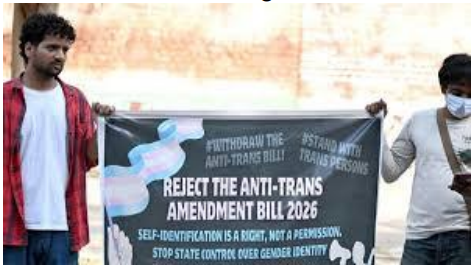
Context: The recently notified Transgender Persons (Protection of Rights) Amendment Bill, 2026, has sparked intense national debate. Critics and mental health practitioners argue that the Bill reverses a decade of judicial and legislative progress by replacing the principle of \'self-identification\' with \'bureaucratic gatekeeping,\' potentially triggering a public mental health crisis. Key Concerns and Implications of the 2026 Amendment • Reversal of Self-Identification: The Amendment fundamentally departs from the \'self-identification\' cornerstone established by the NALSA judgment. It mandates that individuals appear before a medical board to \'prove\' their gender identity to obtain a legal certificate from a District Magistrate. • Medical and Bureaucratic Gatekeeping: By requiring a medical assessment, the Bill introduces \'evaluative biomarkers\' for gender identity—a concept rejected by global medical standards, which recognize gender as a deeply held personal experience rather than a biological certainty to be verified by strangers. • Violation of Bodily Autonomy: Experts fear that in the absence of standardized criteria, medical boards may resort to invasive physical or genital examinations. Such scrutiny is viewed as a direct violation of the right to privacy and dignity enshrined under the Constitution. • Criminalization of Support: The Bill introduces a controversial clause penalizing \'undue influence\' in helping someone identify as transgender, with prison terms up to 15 years. This creates significant legal risks for mental health practitioners, NGOs, and allies who provide gender-affirming care. • Erosion of Welfare Access: The added layers of scrutiny and potential humiliation are expected to deter vulnerable individuals from approaching the state for welfare schemes, effectively shrinking access to education, housing, and healthcare provided under the 2019 Act. • Erasure of Diversity: The Amendment is criticized for collapsing distinct identities—Transgender, Intersex, and Hijra—into a single category, thereby erasing the unique cultural and biological nuances of these diverse communities. Essential Definitions • Cisgender: A term used to describe a person whose gender identity corresponds with the sex assigned to them at birth. • Self-Identification: The legal principle that an individual is the sole authority on their own gender identity, requiring no external medical or state validation. • Gender-Affirming Practices: Healthcare and social interventions (psychological, medical, or surgical) designed to support and affirm an individual’s gender identity when it conflicts with the sex assigned at birth. Constitutional and Legal Framework • NALSA vs. Union of India (2014): The landmark Supreme Court ruling that recognized transgender persons as a \'Third Gender\' and upheld the right to self-identify one\'s gender as part of personal autonomy. • Article 14 & 15: Guarantees equality before the law and prohibits discrimination on the basis of sex (interpreted by the SC to include gender identity). • Article 19(1)(a): Protects freedom of expression, which includes the right to express one\'s selfidentified gender through dress, words, or action. • Article 21: The Right to Life and Personal Liberty, which the SC has ruled includes the right to live with dignity and the right to privacy regarding one\'s identity. • Transgender Persons (Protection of Rights) Act, 2019: The parent legislation that sought to provide a welfare framework, now being significantly altered by the 2026 Amendment. Conclusion The 2026 Amendment represents a significant shift from a rights-based approach to a policing-based model of gender identity. While the government cites the prevention of misuse as a motive, the resulting \'medicalization\' of identity risks marginalizing an already vulnerable community. True progress lies in administrative audits and sensitization rather than mandating intrusive physical verifications that compromise constitutional morality. UPSC Relevance • GS Paper II (Governance & Social Justice): Welfare schemes for vulnerable sections; Laws and institutions constituted for the protection and betterment of vulnerable sections. • GS Paper II (Polity): Fundamental Rights (Articles 14, 15, 19, 21); Judicial overreach vs. Legislative intent; Constitutional Morality


Address : 506, 3rd EYE THREE (III), Opp. Induben Khakhrawala, Girish Cold Drink Cross Road, CG Road, Navrangpura, Ahmedabad, 380009.
Mobile : 8469231587 / 9586028957
Telephone : 079-40098991
E-mail: dics.upsc@gmail.com
Address: A-306, The Landmark, Urjanagar-1, Opp. Spicy Street, Kudasan – Por Road, Kudasan, Gandhinagar – 382421
Mobile : 9723832444 / 9723932444
E-mail: dics.gnagar@gmail.com
Address: 2nd Floor, 9 Shivali Society, L&T Circle, opp. Ratri Bazar, Karelibaugh, Vadodara, 390018
Mobile : 9725692037 / 9725692054
E-mail: dics.vadodara@gmail.com
Address: 403, Raj Victoria, Opp. Pal Walkway, Near Galaxy Circle, Pal, Surat-394510
Mobile : 8401031583 / 8401031587
E-mail: dics.surat@gmail.com
Address: 303,305 K 158 Complex Above Magson, Sindhubhavan Road Ahmedabad-380059
Mobile : 9974751177 / 8469231587
E-mail: dicssbr@gmail.com
Address: 57/17, 2nd Floor, Old Rajinder Nagar Market, Bada Bazaar Marg, Delhi-60
Mobile : 9104830862 / 9104830865
E-mail: dics.newdelhi@gmail.com