





Ahmedabad
(Head Office)Address : 506, 3rd EYE THREE (III), Opp. Induben Khakhrawala, Girish Cold Drink Cross Road, CG Road, Navrangpura, Ahmedabad, 380009.
Mobile : 8469231587 / 9586028957
Telephone : 079-40098991
E-mail: dics.upsc@gmail.com

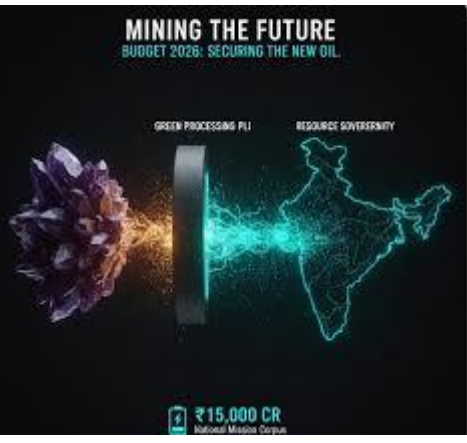
The Union Budget 2026 marks a paradigm shift in India\'s industrial strategy, elevating critical minerals from a niche policy concern to a core pillar of national security and the green energy transition. With the launch of the National Critical Mineral Mission (NCMM) and significant regulatory easing, India is positioning itself to break global supply chain monopolies and achieve technological sovereignty. Key Highlights and Summary • Policy Mainstreaming: Critical minerals have transitioned from being \'restricted atomic minerals\' (pre-2023) to a mainstream industrial priority, backed by the ₹16,300 crore National Critical Mineral Mission (NCMM) launched in January 2025. • Midstream Processing Strength: While mining takes years to scale, India already possesses high-purity processing capabilities (exceeding 99.9% purity) for copper, graphite, rare earth oxides, tin, and titanium, which can be leveraged for defense and cleantech. • Fiscal Incentives for Exploration: Budget 2026 allows tax deductions for exploration expenditure on nine key minerals—including lithium, beryllium, tantalum, and niobium—aiming for 1,200 exploration projects by FY2031. • Demand-Side Measures: The government has removed import duties on capital goods for mineral processing and is pushing for backward integration in battery and solar module manufacturing to ensure a \'guaranteed domestic market\' for processors. • AI-First Exploration: Under \'Mission Anveshan,\' the government is integrating seismic AI tools and the National Geospatial Policy to de-risk mineral discovery and improve prospectivity analysis of the National Geoscience Data Repository. • Geopolitical Realignment: India is countering the weaponization of supply chains by creating \'Rare Earth Corridors\' in coastal states and fostering deep industrial partnerships with the Quad (US, Japan, Australia) and the UK. Constitutional and Legal Provisions • Mines and Minerals (Development and Regulation) Amendment Act, 2023: The transformative legislation that removed several minerals from the \'atomic\' list, allowing private sector participation in exploration and mining. • Seventh Schedule (List I - Union List): Entry 54 empowers the Central Government to regulate mines and mineral development to the extent declared by Parliament to be expedient in the public interest. • National Geospatial Policy, 2022: Provides the legal framework for sharing high-resolution geological data, which is now essential for the AI-driven \'Mission Anveshan.\' • Royalty Rationalization: Legal provisions under the MMDR Act that align Indian royalty rates with global benchmarks to attract \'junior miners\' and foreign direct investment. Key Definitions • Critical Minerals: Metallic or non-metallic elements that are essential for modern technology (EVs, semiconductors, defense) and have a supply chain vulnerable to disruption. • Midstream Processing: The stage of the value chain involving the smelting, refining, and purifying of raw ores into high-purity materials ready for industrial use. • Junior Miners: Small-scale exploration companies that specialize in finding new mineral deposits but usually sell the mining rights to larger corporations for actual extraction. • Sintered Rare Earth Magnets: High-strength permanent magnets (made from neodymium, etc.) essential for EV motors and wind turbines; India has launched a ₹7,280 crore scheme for their domestic production. Conclusion India’s mineral strategy has evolved from \'policy intent\' to \'hard execution.\' By blending fiscal incentives with advanced technology like AI and international \'Mineral Security Partnerships,\' India aims to reduce its reliance on monopolistic suppliers. However, the success of this mission will depend on the speed of infrastructure development in \'Rare Earth Corridors\' and the ability to convert scientific expertise from the chemical and pharma sectors into industrial-scale mineral refining. UPSC Relevance • GS Paper I: Distribution of key natural resources across the world (including South Asia and the Indian subcontinent). • GS Paper II: Effect of policies and politics of developed and developing countries on India’s interests (Geopolitics of supply chains). • GS Paper III: Indian Economy (Industrial Policy); Science and Technology (AI in mining, Clean Energy); Security Challenges (Resource weaponization). • Prelims Focus: 30 Critical Minerals list, NCMM outlays, and the distinction between Atomic and Critical minerals under the MMDR Act.


Address : 506, 3rd EYE THREE (III), Opp. Induben Khakhrawala, Girish Cold Drink Cross Road, CG Road, Navrangpura, Ahmedabad, 380009.
Mobile : 8469231587 / 9586028957
Telephone : 079-40098991
E-mail: dics.upsc@gmail.com
Address: A-306, The Landmark, Urjanagar-1, Opp. Spicy Street, Kudasan – Por Road, Kudasan, Gandhinagar – 382421
Mobile : 9723832444 / 9723932444
E-mail: dics.gnagar@gmail.com
Address: 2nd Floor, 9 Shivali Society, L&T Circle, opp. Ratri Bazar, Karelibaugh, Vadodara, 390018
Mobile : 9725692037 / 9725692054
E-mail: dics.vadodara@gmail.com
Address: 403, Raj Victoria, Opp. Pal Walkway, Near Galaxy Circle, Pal, Surat-394510
Mobile : 8401031583 / 8401031587
E-mail: dics.surat@gmail.com
Address: 303,305 K 158 Complex Above Magson, Sindhubhavan Road Ahmedabad-380059
Mobile : 9974751177 / 8469231587
E-mail: dicssbr@gmail.com
Address: 57/17, 2nd Floor, Old Rajinder Nagar Market, Bada Bazaar Marg, Delhi-60
Mobile : 9104830862 / 9104830865
E-mail: dics.newdelhi@gmail.com