







Ahmedabad
(Head Office)Address : 506, 3rd EYE THREE (III), Opp. Induben Khakhrawala, Girish Cold Drink Cross Road, CG Road, Navrangpura, Ahmedabad, 380009.
Mobile : 8469231587 / 9586028957
Telephone : 079-40098991
E-mail: dics.upsc@gmail.com

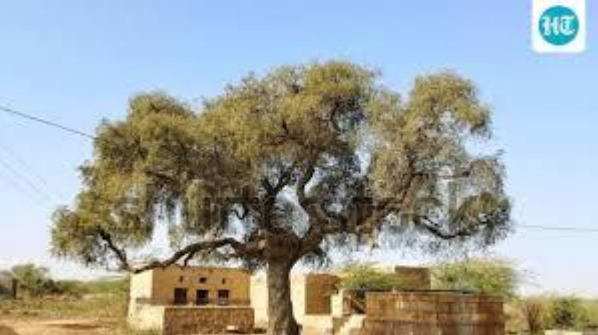
The Government of Rajasthan has recently enforced a statewide ban on the felling of Khejri trees (Prosopis cineraria), following an intense 11-day agitation led by the Bishnoi community and environmental activists. The protests, primarily centered in Bikaner, were triggered by the widespread removal of these trees to accommodate large-scale solar power projects. To provide a permanent solution, the state government has announced the introduction of a comprehensive Tree Protection Bill during the 2026 Budget Session. Key Highlights of the Movement • Statewide Prohibition: A circular issued by the Revenue Department has halted all Khejri felling across Rajasthan, overriding previous partial bans that were limited only to the Jodhpur and Bikaner divisions. • Conflict with Green Energy: The \'Khejri Bachao Andolan\' highlighted the irony of environmental degradation (tree felling) in the pursuit of renewable energy (solar plants), sparking a national debate on sustainable development. • Bishnoi Community Leadership: The protest was spearheaded by the Bishnoi community, which has a 500-year-old history of ecological conservation, most famously known for the 1730 Khejarli Massacre. • Political Consensus: The movement saw rare cross-party support, with former Chief Ministers from both the BJP and Congress backing the demand for a dedicated protection law. • Legislative Commitment: The proposed \'Khejri Protection Act\' aims to bridge regulatory gaps in existing land revenue and tenancy laws that previously allowed for \'unavoidable\' felling with minimal penalties. • Stricter Penalties: Proposed amendments include a ten-fold increase in fines for illegal felling and a mandatory requirement for industrial units to plant ten trees for every one tree removed. Important Definitions • Khejri (Prosopis cineraria): Known as the \'Kalpavriksha\' or \'Tree of Life\' of the Thar Desert, it is the official State Tree of Rajasthan, vital for fixing nitrogen and providing fodder during droughts. • Bishnoism: A religious sect founded by Guru Jambheshwar in the 15th century, following 29 principles, two of which strictly prohibit the killing of animals and the cutting of green trees. • Civil Enclave/Circular Ban: A temporary administrative order (circular) used here to provide immediate protection until a formal legislative Act is passed by the Assembly. • Desertification Control: The process of preventing fertile land from becoming desert; Khejri plays a central role in this through its deep taproot system and soil-binding properties. Constitutional and Legal Provisions • Article 48A (DPSP): Mandates the State to protect and improve the environment and safeguard the forests and wildlife of the country. • Article 51A (g): Establishes a Fundamental Duty for citizens to protect and improve the natural environment, including forests, lakes, rivers, and wildlife. • Rajasthan Tenancy Act, 1955: Contains existing provisions (Sections 79-86) regarding trees on agricultural land, which are now slated for stringent amendment to increase protection. • Rajasthan Land Revenue Act, 1956: Governs the management of non-forest lands where Khejri is often found; new amendments will mandate prior government approval for any uprooting. Additional Key Insights • The 1730 Legacy: The current agitation is a modern echo of Amrita Devi Bishnoi’s sacrifice, where 363 people hugged Khejri trees to save them from the Maharaja of Jodhpur\'s soldiers. This event inspired the 1970s Chipko Movement. • Ecological Services: Khejri trees provide Sangri (a high-value desert bean), support micro-flora, and are one of the few species that remain green during the peak of the Thar summer. • Solar vs. Ecology: Rajasthan aims for 90,000 MW of solar capacity by 2030. The new law will likely mandate \'Environmental Impact Assessments\' specifically for desert flora to resolve the clash between energy targets and biodiversity. Conclusion The Rajasthan government’s decision to ban Khejri felling and legislate its protection marks a significant victory for community-led conservation. It demonstrates that while India’s transition to renewable energy is essential, it cannot come at the cost of indigenous ecosystems. The upcoming Bill will be a landmark piece of sub-national environmental legislation, balancing industrial growth with traditional ecological knowledge. UPSC Relevance • GS Paper I: Geography of India (Thar Desert ecosystem); Art & Culture (Bishnoi traditions and historical environmental movements). • GS Paper II: Governance (Pressure groups and their role in policy-making); Centre-State relations (Environment as a concurrent subject). • GS Paper III: Environment & Biodiversity (Conservation vs. Development, Solar Energy challenges, and Legislative measures for forest protection). • Ethics (GS IV): Environmental ethics and the sacrifice of the Bishnoi community as a case study in value-based conservation.


Address : 506, 3rd EYE THREE (III), Opp. Induben Khakhrawala, Girish Cold Drink Cross Road, CG Road, Navrangpura, Ahmedabad, 380009.
Mobile : 8469231587 / 9586028957
Telephone : 079-40098991
E-mail: dics.upsc@gmail.com
Address: A-306, The Landmark, Urjanagar-1, Opp. Spicy Street, Kudasan – Por Road, Kudasan, Gandhinagar – 382421
Mobile : 9723832444 / 9723932444
E-mail: dics.gnagar@gmail.com
Address: 2nd Floor, 9 Shivali Society, L&T Circle, opp. Ratri Bazar, Karelibaugh, Vadodara, 390018
Mobile : 9725692037 / 9725692054
E-mail: dics.vadodara@gmail.com
Address: 403, Raj Victoria, Opp. Pal Walkway, Near Galaxy Circle, Pal, Surat-394510
Mobile : 8401031583 / 8401031587
E-mail: dics.surat@gmail.com
Address: 303,305 K 158 Complex Above Magson, Sindhubhavan Road Ahmedabad-380059
Mobile : 9974751177 / 8469231587
E-mail: dicssbr@gmail.com
Address: 57/17, 2nd Floor, Old Rajinder Nagar Market, Bada Bazaar Marg, Delhi-60
Mobile : 9104830862 / 9104830865
E-mail: dics.newdelhi@gmail.com