






Ahmedabad
(Head Office)Address : 506, 3rd EYE THREE (III), Opp. Induben Khakhrawala, Girish Cold Drink Cross Road, CG Road, Navrangpura, Ahmedabad, 380009.
Mobile : 8469231587 / 9586028957
Telephone : 079-40098991
E-mail: dics.upsc@gmail.com

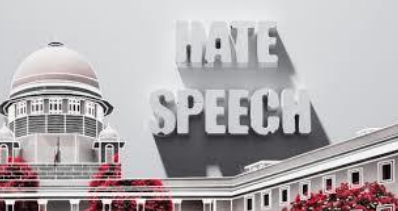
Core Summary of Judicial Observations • Universal vs. Sectional Protection: The Supreme Court emphasized that the fight against hate speech must be a collective effort on behalf of all citizens, rather than being limited to seeking protection for one\'s own specific community. • Emphasis on Fraternity: Justice B.V. Nagarathna observed that the elimination of hate speech is intrinsically linked to the constitutional value of \'Fraternity\'; once society internalizes mutual respect, hate speech will naturally dissipate. • Critique of Selective Victimhood: The Court questioned the trend of individual communities approaching the bench for exclusive protection, suggesting that the legal stand should be a categorical \'no one should indulge in hate speech\' regardless of the target. • The Concept of \'Brahmophobia\': The petitioner sought to criminalize \'Brahmophobia\' as a form of caste-based discrimination; however, the Court maintained that legal interventions should not be community-specific but rather based on general societal standards of tolerance. • Social Resilience and Ignoring Hate: The Bench advised that reacting to every instance of hate speech often triggers a chain reaction; instead, developing the intellectual capacity to ignore certain provocations can lead to such elements fading away naturally. • Role of Education and Development: The Court highlighted that the prevalence of hate speech is a reflection of a society\'s level of education, intellectual development, and patience, rather than just a failure of legal machinery. Key Definitions • Hate Speech: While not explicitly defined in the Indian Penal Code (IPC), it is generally understood as any communication that vilifies, humiliates, or incites hatred against a group based on attributes such as religion, caste, or ethnicity. • Fraternity: A foundational principle in the Preamble of the Indian Constitution that aims to promote a sense of common brotherhood among all Indians, transcending narrow communal or caste identities. • Jurisprudence: The theory or philosophy of law; in this context, it refers to the evolving legal principles the Supreme Court uses to balance free speech with the prevention of communal disharmony. Constitutional & Legal Provisions • Article 19(1)(a) & 19(2): While citizens have the right to freedom of speech, the State can impose \'reasonable restrictions\' in the interests of public order, decency, or morality. • Article 51A(e): A Fundamental Duty of every citizen to promote harmony and the spirit of common brotherhood amongst all the people of India transcending religious, linguistic, and regional or sectional diversities. • Sections 153A, 153B, and 505 of the IPC: These sections penalize acts that promote enmity between different groups on grounds of religion, race, place of birth, residence, language, etc., and acts prejudicial to maintenance of harmony. • The Preamble: Explicitly mentions \'Fraternity assuring the dignity of the individual and the unity and integrity of the Nation.\' Additional Important Keypoints • Pravasi Bhalai Sangathan Case (2014): A landmark judgment where the SC asked the Law Commission to define hate speech and suggest ways to curb it, noting that it marginalizes individuals from mainstream society. • Tehseen Poonawalla Case (2018): The Court laid down guidelines against mob lynching and hate speech, emphasizing the \'sacrosanct duty\' of the state to protect secular ethos. • The Tolerance Threshold: The recent observation suggests a shift toward building \'societal resilience,\' where the judiciary encourages citizens to not be easily influenced by inflammatory rhetoric to prevent the \'reaction-trigger\' cycle. Conclusion The Supreme Court’s refusal to entertain community-specific petitions against hate speech reinforces a \'Universalist\' legal doctrine. By pivoting the argument toward \'Fraternity\' and \'Societal Education,\' the Court is signaling that while laws exist to punish offenders, the ultimate cure for hate speech lies in the moral and intellectual evolution of the citizenry. This approach discourages the fragmentation of the legal system into various \'identity-based\' protections and upholds the constitutional vision of a unified, tolerant India. UPSC Relevance • General Studies II: Indian Constitution- historical underpinnings, evolution, features, and significant provisions; Role of Judiciary; Fundamental Rights and Duties. • General Studies IV (Ethics): Human Values; Role of family, society and educational institutions in inculcating values; Tolerance and compassion towards the weaker-sections.


Address : 506, 3rd EYE THREE (III), Opp. Induben Khakhrawala, Girish Cold Drink Cross Road, CG Road, Navrangpura, Ahmedabad, 380009.
Mobile : 8469231587 / 9586028957
Telephone : 079-40098991
E-mail: dics.upsc@gmail.com
Address: A-306, The Landmark, Urjanagar-1, Opp. Spicy Street, Kudasan – Por Road, Kudasan, Gandhinagar – 382421
Mobile : 9723832444 / 9723932444
E-mail: dics.gnagar@gmail.com
Address: 2nd Floor, 9 Shivali Society, L&T Circle, opp. Ratri Bazar, Karelibaugh, Vadodara, 390018
Mobile : 9725692037 / 9725692054
E-mail: dics.vadodara@gmail.com
Address: 403, Raj Victoria, Opp. Pal Walkway, Near Galaxy Circle, Pal, Surat-394510
Mobile : 8401031583 / 8401031587
E-mail: dics.surat@gmail.com
Address: 303,305 K 158 Complex Above Magson, Sindhubhavan Road Ahmedabad-380059
Mobile : 9974751177 / 8469231587
E-mail: dicssbr@gmail.com
Address: 57/17, 2nd Floor, Old Rajinder Nagar Market, Bada Bazaar Marg, Delhi-60
Mobile : 9104830862 / 9104830865
E-mail: dics.newdelhi@gmail.com