






Ahmedabad
(Head Office)Address : 506, 3rd EYE THREE (III), Opp. Induben Khakhrawala, Girish Cold Drink Cross Road, CG Road, Navrangpura, Ahmedabad, 380009.
Mobile : 8469231587 / 9586028957
Telephone : 079-40098991
E-mail: dics.upsc@gmail.com

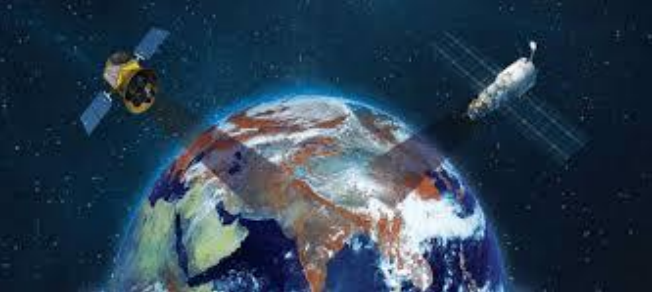
• Growth of Private Space Ecosystem: Since the 2020 privatization of the space sector, Indian startups like Pixxel, Digantara, and GalaxEye have pioneered advanced surveillance technologies, including high-resolution imagery, satellite mapping, and ground-station analytics. • Revenue and Market Potential: Satellite surveillance and communications represent the most significant commercial segments of India’s space economy, projected to contribute nearly 20% of its annual revenue with a target of $8 billion by 2033. • Evolution from ISRO to Commercial Models: While ISRO’s Cartosat and EOS series provide critical 3D data for domestic defense, their utility is restricted to sovereign use; private firms fill the gap by retailing high-cadence data to global markets. • Geopolitical Significance in Modern Warfare: The shift toward unmanned warfare, ballistic missiles, and AI-integrated drone strikes has turned space-based intelligence into a decisive military asset, particularly in volatile regions like West Asia. • Regulatory Obstacles and Data Localization: Current Indian frameworks mandate data localization at domestic ground stations, but the upcoming draft space law will be the final arbiter on the complexities of exporting sensitive geospatial intelligence. • Global Shutter Control and US Dominance: Indian firms face \'geospatial shutter control\' risks where US regulations can restrict who they sell data to, forcing a strategic choice between lucrative US government contracts and emerging West Asian markets. Key Definitions • Space-Based Surveillance: The use of satellite constellations to monitor terrestrial activities, track orbital assets, and provide real-time geospatial intelligence (GEOINT). • Geospatial Shutter Control: A regulatory mechanism, primarily used by the US, that allows the government to restrict the dissemination of commercial satellite imagery of specific areas during times of conflict or for national security reasons. • Data Localization: The requirement that data collected or processed within a certain jurisdiction be stored on physical servers located within that country\'s borders. Constitutional and Legal Provisions • Space Policy 2023: Encourages end-to-end participation of Non-Government Entities (NGEs) in the space sector, moving ISRO toward R&D while startups handle commercial operations. • Article 51 of the Constitution: Under Directive Principles of State Policy (DPSP), India strives to promote international peace and security; however, the commercialization of surveillance data must balance this with sovereign interests. • Geospatial Data Guidelines (2021): Liberalized the acquisition and production of geospatial data and maps, removing the requirement for prior approvals for Indian entities, though exports remain subject to security vetting. • IN-SPACe (Indian National Space Promotion and Authorization Centre): The single-window nodal agency responsible for authorizing and regulating the space activities of private players in India. Additional Key Points • Dual-Use Technology: Space surveillance is inherently \'dual-use,\' meaning it serves both civilian (disaster management, agriculture) and military (troop movement, missile guidance) purposes. • Strategic Autonomy: By developing a robust private surveillance sector, India reduces its reliance on foreign constellations (like Maxar or Starlink) for critical intelligence. • The \'West Asia\' Opportunity: The demand for tactical intelligence in the Middle East offers a testing ground for Indian startups to compete with global incumbents. Conclusion India stands at a pivotal junction where technological capability meets commercial opportunity. While the privatization of 2020 has birthed a competitive startup ecosystem, the lack of a finalized, comprehensive Space Act remains a hurdle. To capture the projected $8 billion market, India must navigate the delicate balance between domestic security regulations and the restrictive global laws imposed by dominant space powers like the US. UPSC Relevance • GS Paper II: Effect of policies and politics of developed and developing countries on India’s interests (US Shutter Control and West Asia conflict). • GS Paper III: Science and Technology—developments and their applications and effects in everyday life; Indigenization of technology; Awareness in the field of Space. • Prelims: ISRO missions (Cartosat, EOS), IN-SPACe, Space Policy 2023, and international treaties regarding outer space.


Address : 506, 3rd EYE THREE (III), Opp. Induben Khakhrawala, Girish Cold Drink Cross Road, CG Road, Navrangpura, Ahmedabad, 380009.
Mobile : 8469231587 / 9586028957
Telephone : 079-40098991
E-mail: dics.upsc@gmail.com
Address: A-306, The Landmark, Urjanagar-1, Opp. Spicy Street, Kudasan – Por Road, Kudasan, Gandhinagar – 382421
Mobile : 9723832444 / 9723932444
E-mail: dics.gnagar@gmail.com
Address: 2nd Floor, 9 Shivali Society, L&T Circle, opp. Ratri Bazar, Karelibaugh, Vadodara, 390018
Mobile : 9725692037 / 9725692054
E-mail: dics.vadodara@gmail.com
Address: 403, Raj Victoria, Opp. Pal Walkway, Near Galaxy Circle, Pal, Surat-394510
Mobile : 8401031583 / 8401031587
E-mail: dics.surat@gmail.com
Address: 303,305 K 158 Complex Above Magson, Sindhubhavan Road Ahmedabad-380059
Mobile : 9974751177 / 8469231587
E-mail: dicssbr@gmail.com
Address: 57/17, 2nd Floor, Old Rajinder Nagar Market, Bada Bazaar Marg, Delhi-60
Mobile : 9104830862 / 9104830865
E-mail: dics.newdelhi@gmail.com