






Ahmedabad
(Head Office)Address : 506, 3rd EYE THREE (III), Opp. Induben Khakhrawala, Girish Cold Drink Cross Road, CG Road, Navrangpura, Ahmedabad, 380009.
Mobile : 8469231587 / 9586028957
Telephone : 079-40098991
E-mail: dics.upsc@gmail.com

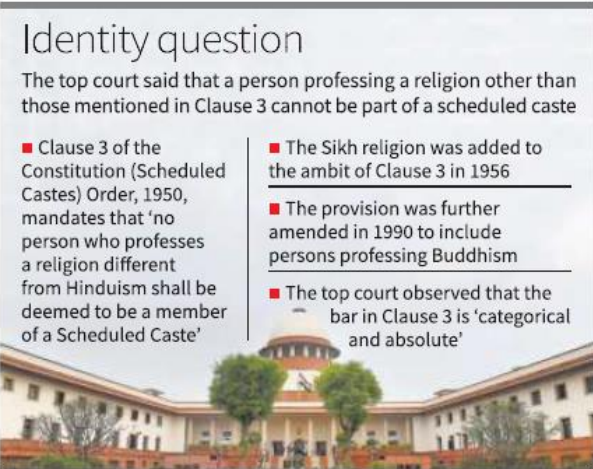
• The Supreme Court has reaffirmed that Scheduled Caste (SC) status is fundamentally linked to religious identity as defined under the Constitution (Scheduled Castes) Order, 1950. • Conversion to any religion other than Hinduism, Sikhism, or Buddhism results in an immediate and complete loss of SC status, effective from the moment of conversion, regardless of the individual’s birth or heritage. • The Court characterized Clause 3 of the 1950 Order as \'categorical and absolute,\' asserting that the bar against members of other religions being deemed SC is a settled legal provision. • Protection under the Scheduled Castes and Scheduled Tribes (Prevention of Atrocities) Act, 1989, is contingent upon the complainant maintaining their SC status; once a person converts to Christianity or Islam, they can no longer invoke this specific legislation. • The ruling was delivered in the case of Chinthada Anand, where the court upheld an Andhra Pradesh High Court decision quashing criminal proceedings because the complainant had served as a Christian pastor for a decade. • The judiciary maintains that since the caste system is not theoretically recognized in Christianity or Islam, the socio-legal disabilities associated with \'untouchability\' (the basis for SC status) are legally deemed to have ceased upon conversion. Key Definitions and Terminology Clause 3 of the 1950 Order: A specific provision in the Constitution (Scheduled Castes) Order stating that no person professing a religion different from Hinduism, Sikhism, or Buddhism shall be deemed a member of a Scheduled Caste. Profession of Religion: The outward manifestation or public declaration of faith; the Court views becoming a pastor or active practitioner of a non-Indic faith as definitive proof of \'professing\' that religion. Scheduled Castes (SC): Those castes, races, or tribes specified by the President under Article 341 of the Constitution who have historically faced social disabilities like untouchability within the fold of Hindu society. Constitutional and Legal Framework Article 341: Empowers the President to specify the castes, races, or tribes which shall be deemed to be Scheduled Castes in relation to a State or Union Territory. The Constitution (Scheduled Castes) Order, 1950: The foundational executive order identifying SCs. Initially restricted to Hindus, it was amended in 1956 to include Sikhs and in 1990 to include Buddhists. SC/ST (Prevention of Atrocities) Act, 1989: A special law enacted to prevent crimes and social disabilities against members of SCs and STs. Its applicability is strictly limited to individuals currently holding a valid caste certificate as recognized by the 1950 Order. Strategic Analysis and Key Points • Historical Evolution: The 1956 and 1990 amendments recognized that Sikhism and Buddhism are branches of the Indic religious tradition where caste-like social structures persisted, unlike the Abrahamic faiths. • Burden of Proof: In cases involving the 1989 Act, the prosecution must prove that the victim belongs to a Scheduled Caste. If evidence of conversion is presented, the legal protection lapses immediately. • Judicial Consistency: This judgment aligns with previous precedents like Soosai v. Union of India (1985), where the SC held that to be eligible for SC status, a person must show they suffer from the same disabilities even after conversion. Conclusion The Supreme Court\'s stance reinforces the strictly religious criteria for SC eligibility, maintaining a clear distinction between Indic faiths and others. While the social reality of \'Dalit Christians\' or \'Dalit Muslims\' remains a subject of intense socio-political debate and pending litigation before larger benches, the current legal position remains that conversion entails a forfeiture of all reservation benefits and statutory protections tied to SC status. UPSC Relevance GS Paper II: Functions and responsibilities of the Union and the States, Welfare schemes for vulnerable sections, and Laws, institutions, and Bodies constituted for the protection and betterment of these vulnerable sections. GS Paper IV: Ethics and Social Justice regarding the intersection of religious freedom and affirmative action. Prelims: Article 341, the 1950 Order amendments (1956 & 1990), and the scope of the SC/ST Act, 1989.


Address : 506, 3rd EYE THREE (III), Opp. Induben Khakhrawala, Girish Cold Drink Cross Road, CG Road, Navrangpura, Ahmedabad, 380009.
Mobile : 8469231587 / 9586028957
Telephone : 079-40098991
E-mail: dics.upsc@gmail.com
Address: A-306, The Landmark, Urjanagar-1, Opp. Spicy Street, Kudasan – Por Road, Kudasan, Gandhinagar – 382421
Mobile : 9723832444 / 9723932444
E-mail: dics.gnagar@gmail.com
Address: 2nd Floor, 9 Shivali Society, L&T Circle, opp. Ratri Bazar, Karelibaugh, Vadodara, 390018
Mobile : 9725692037 / 9725692054
E-mail: dics.vadodara@gmail.com
Address: 403, Raj Victoria, Opp. Pal Walkway, Near Galaxy Circle, Pal, Surat-394510
Mobile : 8401031583 / 8401031587
E-mail: dics.surat@gmail.com
Address: 303,305 K 158 Complex Above Magson, Sindhubhavan Road Ahmedabad-380059
Mobile : 9974751177 / 8469231587
E-mail: dicssbr@gmail.com
Address: 57/17, 2nd Floor, Old Rajinder Nagar Market, Bada Bazaar Marg, Delhi-60
Mobile : 9104830862 / 9104830865
E-mail: dics.newdelhi@gmail.com