






Ahmedabad
(Head Office)Address : 506, 3rd EYE THREE (III), Opp. Induben Khakhrawala, Girish Cold Drink Cross Road, CG Road, Navrangpura, Ahmedabad, 380009.
Mobile : 8469231587 / 9586028957
Telephone : 079-40098991
E-mail: dics.upsc@gmail.com

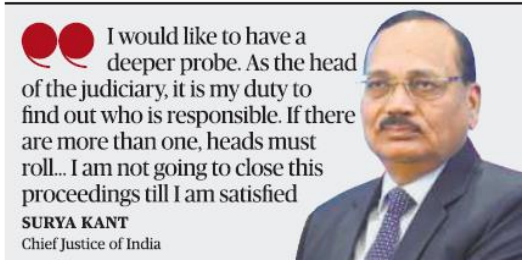
The Supreme Court of India recently took a stringent stance against the inclusion of content in a Class 8 NCERT textbook that portrayed the judiciary as a \'corrupt\' institution. Terming it a \'deep-rooted conspiracy\' to bias young minds, the Court initiated suo motu contempt proceedings and ordered an immediate nationwide seizure of all copies. Key Highlights and Summary • Judicial Crackdown on Biased Content: The Supreme Court ordered a \'blanket and complete\' ban on a Class 8 Social Science textbook published by NCERT (February 2026 edition) due to a section portraying the judiciary as venal and corrupt. • Suo Motu Contempt Action: A three-judge Bench led by CJI Surya Kant initiated contempt of court proceedings, describing the textual depiction as \'reckless, irresponsible, and motivated\' conduct intended to instil systemic bias. • Protection of Impressionable Minds: The Court emphasized that such \'calculated moves\' target students to alienate future generations from the judicial system, thereby threatening the foundational trust in the Rule of Law. • Immediate Executive Mandate: The Bench ordered the immediate seizure and sealing of every physical and digital copy of the book, directing that \'heads must roll\' to ensure accountability within the Ministry of Education and NCERT. • Government Stance: Representing the Centre, the Solicitor General offered an unconditional apology; however, the Court refused to close the proceedings, seeking a deeper probe into the authorship and vetting process. Constitutional and Legal Provisions • Article 129 & 215: Grants the Supreme Court and High Courts the power to punish for contempt of themselves to maintain the dignity and authority of the justice system. • Contempt of Courts Act, 1971: Defines \'Criminal Contempt\' as the publication of any matter which \'scandalises or tends to scandalise\' or lowers the authority of any court. • Article 141: Law declared by the Supreme Court is binding on all courts and authorities within the territory of India, including educational bodies like NCERT. • Section 13 of Contempt of Courts Act: Stipulates that the court may not impose a sentence unless it is satisfied that the contempt is of such a nature that it substantially interferes with the due course of justice. Key Definitions • Suo Motu: A Latin term meaning \'on its own motion.\' It refers to a situation where a court takes up a case on its own, without any formal complaint or petition being filed by a party. • Venal: Used in the judicial context to describe an institution or individual showing or motivated by susceptibility to bribery; being corrupt. • Criminal Contempt: Any act that lowers the authority of the court, prejudices judicial proceedings, or obstructs the administration of justice. Additional Critical Analysis: The vetting process of NCERT is under scrutiny here. As an autonomous body under the Ministry of Education, NCERT is tasked with providing a balanced view of Indian Democracy. The Court’s observation of a \'well-orchestrated conspiracy\' suggests a potential lapse in the Internal Review Committees and National Syllabus Framework (NSF) oversight, which is supposed to filter sensitive or defamatory content before it reaches the public. Conclusion: The Supreme Court’s intervention underscores the delicate balance between freedom of expression in academic discourse and the protection of constitutional institutions from unsubstantiated vilification. While criticism of judicial delays or pendency is common, labeling the entire institution as \'corrupt\' in primary education materials is viewed by the Court as a direct assault on the separation of powers and public order. UPSC Relevance • GS Paper II: Judiciary (Structure, Organization, and Functioning), Contempt of Court, Role of Statutory/Autonomous Bodies (NCERT), and Issues relating to Education. • GS Paper IV: Ethics and Integrity (Foundational values of the Constitution and the ethics of portraying public institutions). • Prelims: Powers of SC under Art. 129, Contempt of Courts Act provisions, and the administrative hierarchy of the Ministry of Education.


Address : 506, 3rd EYE THREE (III), Opp. Induben Khakhrawala, Girish Cold Drink Cross Road, CG Road, Navrangpura, Ahmedabad, 380009.
Mobile : 8469231587 / 9586028957
Telephone : 079-40098991
E-mail: dics.upsc@gmail.com
Address: A-306, The Landmark, Urjanagar-1, Opp. Spicy Street, Kudasan – Por Road, Kudasan, Gandhinagar – 382421
Mobile : 9723832444 / 9723932444
E-mail: dics.gnagar@gmail.com
Address: 2nd Floor, 9 Shivali Society, L&T Circle, opp. Ratri Bazar, Karelibaugh, Vadodara, 390018
Mobile : 9725692037 / 9725692054
E-mail: dics.vadodara@gmail.com
Address: 403, Raj Victoria, Opp. Pal Walkway, Near Galaxy Circle, Pal, Surat-394510
Mobile : 8401031583 / 8401031587
E-mail: dics.surat@gmail.com
Address: 303,305 K 158 Complex Above Magson, Sindhubhavan Road Ahmedabad-380059
Mobile : 9974751177 / 8469231587
E-mail: dicssbr@gmail.com
Address: 57/17, 2nd Floor, Old Rajinder Nagar Market, Bada Bazaar Marg, Delhi-60
Mobile : 9104830862 / 9104830865
E-mail: dics.newdelhi@gmail.com