



Ahmedabad
(Head Office)Address : 506, 3rd EYE THREE (III), Opp. Induben Khakhrawala, Girish Cold Drink Cross Road, CG Road, Navrangpura, Ahmedabad, 380009.
Mobile : 8469231587 / 9586028957
Telephone : 079-40098991
E-mail: dics.upsc@gmail.com

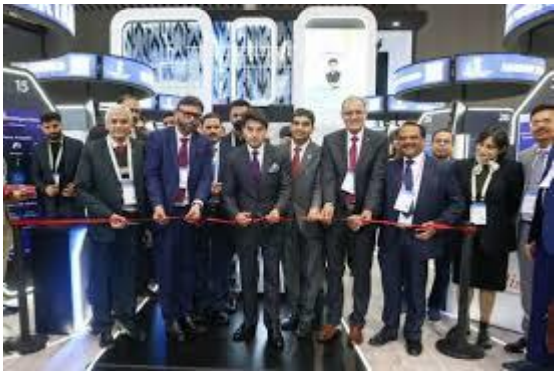
• Affordability and Universal Connectivity: India advocated for \'Breaking the Cost Barrier,\' emphasizing that the 3.1 billion people globally excluded from the digital economy require affordable devices and services to bridge the \'usage gap.\' • Intelligent Infrastructure: Under the theme \'Built for What’s Next,\' India transitioned its focus from mere access to intelligent, autonomous, and AI-driven networks that are human-centric and resilient. • Indigenous Manufacturing Hub: The \'Bharat Pavilion\' featured 40 Indian firms showcasing homegrown solutions in 5G/6G, satellite communication, and semiconductors, signaling India\'s rise as a design-led manufacturing powerhouse. • Technological Milestones: Key launches included the TJ1600-D3 Hyper-scalable DCI Platform (Tejas Networks) and demonstrations of 6G data calls on cmWave, highlighting India\'s readiness for next-gen optical and wireless standards. • Global Strategic Collaborations: High-level engagements with the ITU, Nokia, Ericsson, and Qualcomm focused on building trusted technology ecosystems and aligning global 6G standards with India’s specific requirements. • Institutional Momentum: The unveiling of the India Mobile Congress (IMC) 2026 curtain raiser (scheduled for October 2026) aims to solidify India’s position as a global nerve center for telecom innovation and AI integration. Key Definitions • Usage Gap: The gap representing people who live within the footprint of a mobile broadband network but do not use mobile internet services, often due to high costs of devices or lack of digital skills. • Data Centre Interconnect (DCI): Technology that connects two or more data centers together over short, medium, or long distances using high-speed packet-optical connectivity. • cmWave (Centimetric Wave): Frequency bands between 3 GHz and 30 GHz, considered crucial for 6G to provide a balance between wide coverage and high capacity. Constitutional & Legal Provisions • Article 19(1)(a): The Supreme Court has increasingly linked the \'Right to Internet\' as a medium to exercise the fundamental right to freedom of speech and expression. • Telecommunications Act, 2023: Replaced the archaic Indian Telegraph Act, 1885; it provides a modern legal framework for spectrum management, right of way, and national security in telecom. • Digital Personal Data Protection (DPDP) Act, 2023: Ensures that the expansion of \'Intelligent Connectivity\' and AI-driven networks adheres to stringent data privacy norms for Indian citizens.• National Digital Communications Policy (NDCP): Aims to provide \'Broadband for All\' and create 4 million additional jobs in the digital communications sector. Additional Key Points • The IQ Era: The official theme of MWC 2026, highlighting the convergence of AI and connectivity to create \'smarter\' business and societal outcomes. • TEPC’s Role: The Telecom Equipment and Services Export Promotion Council (TEPC) is the nodal agency under the Foreign Trade Policy facilitating the global outreach of Indian telecom exporters. • 6G Vision Document: India’s proactive stance aims to secure a significant share of global IPR (Intellectual Property Rights) in the upcoming 6G standards. Conclusion India’s leadership at MWC 2026 underscores a shift from being a consumer of technology to a provider of secure, affordable, and indigenous digital solutions. By balancing cost-effective innovation with cutting-edge AI and 6G research, India is positioning itself as the \'Trusted Partner\' in the global digital supply chain, ensuring that the \'IQ Era\' remains inclusive for the Global South. UPSC Relevance • GS Paper II: Bilateral, regional, and global groupings involving India; Effect of policies of developed/developing countries on India’s interests. • GS Paper III: Science and Technology—developments and their applications and effects in everyday life; Indigenization of technology; Infrastructure (Telecom); IT and Computers. • Prelims: Terms like 6G, cmWave, DCI, and roles of international bodies like ITU and GSMA.


Address : 506, 3rd EYE THREE (III), Opp. Induben Khakhrawala, Girish Cold Drink Cross Road, CG Road, Navrangpura, Ahmedabad, 380009.
Mobile : 8469231587 / 9586028957
Telephone : 079-40098991
E-mail: dics.upsc@gmail.com
Address: A-306, The Landmark, Urjanagar-1, Opp. Spicy Street, Kudasan – Por Road, Kudasan, Gandhinagar – 382421
Mobile : 9723832444 / 9723932444
E-mail: dics.gnagar@gmail.com
Address: 2nd Floor, 9 Shivali Society, L&T Circle, opp. Ratri Bazar, Karelibaugh, Vadodara, 390018
Mobile : 9725692037 / 9725692054
E-mail: dics.vadodara@gmail.com
Address: 403, Raj Victoria, Opp. Pal Walkway, Near Galaxy Circle, Pal, Surat-394510
Mobile : 8401031583 / 8401031587
E-mail: dics.surat@gmail.com
Address: 303,305 K 158 Complex Above Magson, Sindhubhavan Road Ahmedabad-380059
Mobile : 9974751177 / 8469231587
E-mail: dicssbr@gmail.com
Address: 57/17, 2nd Floor, Old Rajinder Nagar Market, Bada Bazaar Marg, Delhi-60
Mobile : 9104830862 / 9104830865
E-mail: dics.newdelhi@gmail.com