




Ahmedabad
(Head Office)Address : 506, 3rd EYE THREE (III), Opp. Induben Khakhrawala, Girish Cold Drink Cross Road, CG Road, Navrangpura, Ahmedabad, 380009.
Mobile : 8469231587 / 9586028957
Telephone : 079-40098991
E-mail: dics.upsc@gmail.com

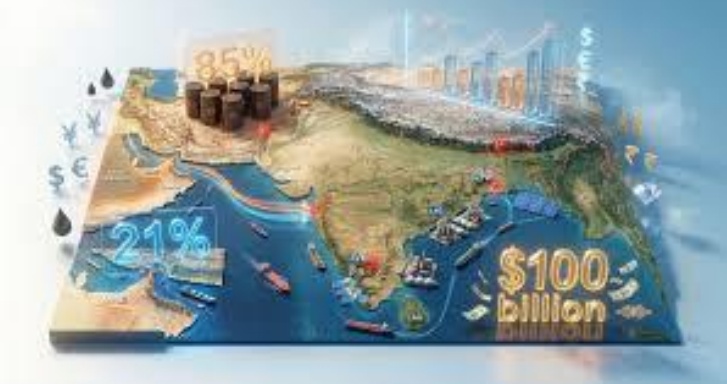
The recent conflict in West Asia, beginning February 28, has severely disrupted the global energy landscape, particularly the liquefied natural gas (LNG) supply chain. With the blockade of the Strait of Hormuz and targeted attacks on Qatar’s Ras Laffan industrial complex, India faces an acute energy squeeze. The following points summarize the critical dimensions of this crisis for the Indian economy and energy security. • Supply Chain Paralysis: Approximately 20% of global LNG traverses the Strait of Hormuz. The blockade, coupled with a 17% reduction in Qatar’s export capacity due to infrastructure damage at Ras Laffan, has forced QatarEnergy to declare force majeure, directly halting a significant portion of India\'s contracted supplies. • Price Volatility and Economic Strain: Natural gas prices have surged globally, with Asian spot prices (JKM) doubling from $10 to $22 per MMBtu. This price shock increases India’s import bill, worsens the current account deficit (CAD), and exerts inflationary pressure on downstream sectors. • Domestic Rationing and Prioritization: In response to the crunch, the Indian government has diverted supplies to prioritize \'City Gas Distribution\' (cooking and mobility). Consequently, the fertilizer sector is receiving only 70% of its average requirements, while other industries like tea and steel face 20% supply cuts. • Infrastructure and Recovery Timeline: The damage to Qatari production facilities is estimated at $20 billion, with a recovery period of up to five years. This suggests that the \'gas squeeze\' is not a shortterm glitch but a medium-term structural challenge for Indian energy procurement. • Strategic Diversification: India is aggressively seeking to pivot its import basket toward Australia, the USA, and Algeria. Concurrently, there is a renewed focus on tapping India’s domestic reserves, estimated at 1.3 trillion cubic metres of natural gas and 4.5 billion barrels of oil. • Sectoral Vulnerability: While India produces nearly 50% of its gas needs domestically, this is almost entirely consumed by the residential and transport sectors. This leaves the industrial core—fertilizers, power, and manufacturing—entirely vulnerable to international market fluctuations and geopolitical blockades. Key Definitions and Terminology • Liquefied Natural Gas (LNG): Natural gas (predominantly methane) that has been cooled to liquid form (approximately -162°C) for ease and safety of non-pressurized storage or transport. • Force Majeure: A common clause in contracts which essentially frees both parties from liability or obligation when an extraordinary event or circumstance beyond their control (e.g., war, strike, riot) occurs. • Strait of Hormuz: A strategic chokepoint between the Persian Gulf and the Gulf of Oman; it is the world\'s most important oil and gas transit terminal. Constitutional and Legal Framework • Entry 53, List I (Union List): Under the Seventh Schedule of the Constitution of India, the regulation and development of oilfields and mineral oil resources, petroleum, and petroleum products fall under the exclusive jurisdiction of the Union Government. • Oilfields (Regulation and Development) Act, 1948: Provides the basic legal framework for the regulation of oilfields and the development of mineral oil resources. • Petroleum and Natural Gas Regulatory Board (PNGRB) Act, 2006: Established the PNGRB to regulate the refining, processing, storage, transportation, distribution, marketing, and sale of petroleum, petroleum products, and natural gas. Strategic Key Points for Examination • Import Dependency: India imported 27 million tonnes of LNG in FY2025, costing $14.9 billion. Over 40% of this originates from West Asia, highlighting a significant geographical over-concentration risk. • Energy Transition: The crisis threatens India’s goal of increasing the share of natural gas in its primary energy mix from 6% to 15% by 2030, as high prices may force industries back to coal. • Fertilizer Subsidy: Reduced gas supply and higher import costs will likely spike the government’s fertilizer subsidy bill, as natural gas is the primary feedstock for urea production. Conclusion and UPSC Relevance The current LNG crisis underscores the fragility of India’s energy security when tethered to a single volatile region. For the UPSC Civil Services Exam, this topic is highly relevant under GS Paper II (International Relations - Effect of politics of developed and developing countries on India\'s interests) and GS Paper III (Energy, Infrastructure, and Economic Development). The situation demands a dual strategy: \'Strategic Autonomy\' through diversified global partnerships (like the US and Australia) and \'Atmanirbharta\' by accelerating domestic exploration and the transition to renewable alternatives. The ability of India to navigate this \'energy trilemma\' of security, equity, and sustainability will define its economic resilience in the coming decade.


Address : 506, 3rd EYE THREE (III), Opp. Induben Khakhrawala, Girish Cold Drink Cross Road, CG Road, Navrangpura, Ahmedabad, 380009.
Mobile : 8469231587 / 9586028957
Telephone : 079-40098991
E-mail: dics.upsc@gmail.com
Address: A-306, The Landmark, Urjanagar-1, Opp. Spicy Street, Kudasan – Por Road, Kudasan, Gandhinagar – 382421
Mobile : 9723832444 / 9723932444
E-mail: dics.gnagar@gmail.com
Address: 2nd Floor, 9 Shivali Society, L&T Circle, opp. Ratri Bazar, Karelibaugh, Vadodara, 390018
Mobile : 9725692037 / 9725692054
E-mail: dics.vadodara@gmail.com
Address: 403, Raj Victoria, Opp. Pal Walkway, Near Galaxy Circle, Pal, Surat-394510
Mobile : 8401031583 / 8401031587
E-mail: dics.surat@gmail.com
Address: 303,305 K 158 Complex Above Magson, Sindhubhavan Road Ahmedabad-380059
Mobile : 9974751177 / 8469231587
E-mail: dicssbr@gmail.com
Address: 57/17, 2nd Floor, Old Rajinder Nagar Market, Bada Bazaar Marg, Delhi-60
Mobile : 9104830862 / 9104830865
E-mail: dics.newdelhi@gmail.com