


Ahmedabad
(Head Office)Address : 506, 3rd EYE THREE (III), Opp. Induben Khakhrawala, Girish Cold Drink Cross Road, CG Road, Navrangpura, Ahmedabad, 380009.
Mobile : 8469231587 / 9586028957
Telephone : 079-40098991
E-mail: dics.upsc@gmail.com

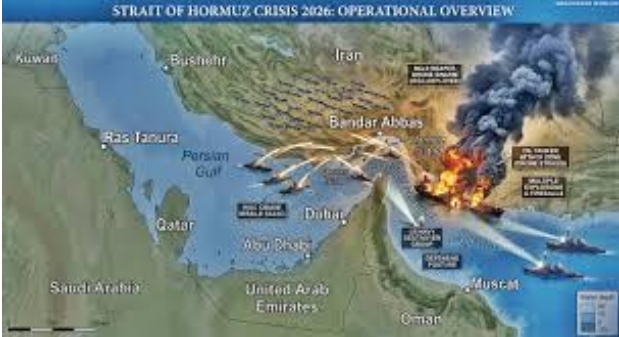
The ongoing conflict in West Asia has entered a critical phase following U.S. President Donald Trump’s latest ultimatum to the Iranian administration. The following points summarize the most significant developments for the examination: • Targeting Civilian Infrastructure: The U.S. has threatened to strike Iran’s essential \'dual-use\' infrastructure—specifically Electric Generating Plants, Oil Wells, and Desalinization Plants— marking a shift from purely military targets to those that sustain the Iranian economy and civilian life. • The Strait of Hormuz Deadlock: A central demand of the U.S. is the immediate reopening of the Strait of Hormuz for global business. Iran has utilized its geographical advantage to disrupt maritime traffic, leading to a \'de facto\' blockade that has surged global Brent crude prices to approximately $115 per barrel. • Strategic Ultimatum (April 6 Deadline): Following a series of tactical delays, the U.S. administration has set a final deadline of April 6, 2026, for Iran to agree to a 15-point deal. This timeline underscores a policy of \'coercive diplomacy\' aimed at securing a ceasefire and reopening vital energy corridors. • Kharg Island Significance: For the first time, Kharg Island—Iran’s primary maritime oil terminal which handles over 90% of its crude exports—has been explicitly named as a target. Its destruction would effectively terminate Iran’s ability to export oil, crippling the regime\'s primary revenue source. • Diplomatic Disconnect: While the U.S. claims \'serious discussions\' with a \'more reasonable regime\' in Tehran, official Iranian spokespersons have dismissed these claims as \'unrealistic and irrational.\' This discrepancy suggests either back-channel negotiations (possibly via Oman or Pakistan) or a strategic use of misinformation by both sides. • Regional Spillover: The conflict is no longer confined to U.S.-Iran tensions; it involves active exchanges between the Israel Defence Forces (IDF) and the Islamic Revolutionary Guard Corps (IRGC), alongside threats to American bases and energy assets in neighboring Gulf nations like Kuwait and the UAE. Key Definitions • Strait of Hormuz: A narrow waterway connecting the Persian Gulf and the Gulf of Oman. It is the world’s most important energy chokepoint, through which roughly 1/5th of global oil and 1/3rd of global LNG passes. • Force Majeure: A legal clause in contracts that allows a party to skip its obligations due to extraordinary events beyond its control (e.g., war). Several Gulf nations have declared this for energy exports. • Strategic Petroleum Reserves (SPR): Emergency fuel stores maintained by countries to tide over supply disruptions. India’s SPR currently covers roughly 9.5 days of its crude requirements. Constitutional and Legal Provisions • Article 51 (Directive Principles of State Policy): Mandates that India shall endeavor to promote international peace and security and maintain just and honorable relations between nations. This guides India’s current \'strategic silence\' and calls for de-escalation. • Essential Commodities Act, 1955: Leveraged by the Indian government to regulate the supply and pricing of LPG and fertilizers, which have been severely affected by the West Asian supply chain disruption. • UNCLOS (UN Convention on the Law of the Sea): The legal framework governing \'Transit Passage\' through international straits. Any permanent closure of the Strait of Hormuz by Iran is considered a violation of international maritime law. Conclusion The current standoff represents a \'maximum pressure\' tactic by the U.S. to force a structural change in Iranian foreign policy. For the global economy, the stakes involve a potential energy catastrophe, while for Iran, the threat to its desalinization and power plants poses an existential domestic crisis. The success of the April 6 deadline will determine whether the region moves toward a fragile ceasefire or an all-out conventional war. UPSC Relevance • GS Paper II (International Relations): Impact of West Asian instability on India’s \'Link West\' policy, the role of major powers (U.S., China), and the challenge of maintaining strategic autonomy. • GS Paper III (Economy & Security): Energy security, \'Imported Inflation,\' and the vulnerability of India\'s maritime trade routes. The crisis highlights the need for expanding India\'s Strategic Petroleum Reserves (SPR) and diversifying energy sources. • Prelims: Mapping of the Persian Gulf, Kharg Island, and the Strait of Hormuz; understanding the mechanics of global oil pricing and the role of the IRGC.


Address : 506, 3rd EYE THREE (III), Opp. Induben Khakhrawala, Girish Cold Drink Cross Road, CG Road, Navrangpura, Ahmedabad, 380009.
Mobile : 8469231587 / 9586028957
Telephone : 079-40098991
E-mail: dics.upsc@gmail.com
Address: A-306, The Landmark, Urjanagar-1, Opp. Spicy Street, Kudasan – Por Road, Kudasan, Gandhinagar – 382421
Mobile : 9723832444 / 9723932444
E-mail: dics.gnagar@gmail.com
Address: 2nd Floor, 9 Shivali Society, L&T Circle, opp. Ratri Bazar, Karelibaugh, Vadodara, 390018
Mobile : 9725692037 / 9725692054
E-mail: dics.vadodara@gmail.com
Address: 403, Raj Victoria, Opp. Pal Walkway, Near Galaxy Circle, Pal, Surat-394510
Mobile : 8401031583 / 8401031587
E-mail: dics.surat@gmail.com
Address: 303,305 K 158 Complex Above Magson, Sindhubhavan Road Ahmedabad-380059
Mobile : 9974751177 / 8469231587
E-mail: dicssbr@gmail.com
Address: 57/17, 2nd Floor, Old Rajinder Nagar Market, Bada Bazaar Marg, Delhi-60
Mobile : 9104830862 / 9104830865
E-mail: dics.newdelhi@gmail.com