






Ahmedabad
(Head Office)Address : 506, 3rd EYE THREE (III), Opp. Induben Khakhrawala, Girish Cold Drink Cross Road, CG Road, Navrangpura, Ahmedabad, 380009.
Mobile : 8469231587 / 9586028957
Telephone : 079-40098991
E-mail: dics.upsc@gmail.com

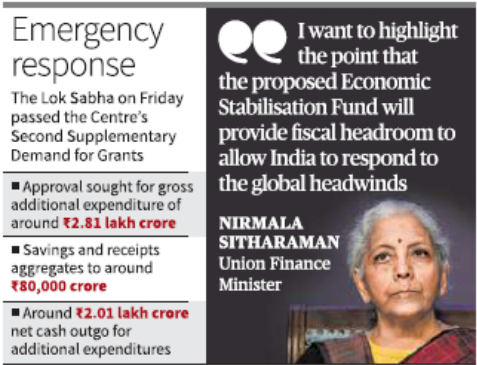
• Strategic Fiscal Buffer: The Union Government has allocated ₹57,381 crore toward a newly designated \'Economic Stabilisation Fund\' to counter \'global headwinds,\' specifically addressing volatility in oil prices (near $100/barrel) and supply chain disruptions from the West Asia conflict. • Supplementary Expenditure: The Lok Sabha approved the Second Supplementary Demand for Grants involving a gross additional spending of ₹2.81 lakh crore, with a net cash outgo of ₹2.01 lakh crore after accounting for ₹80,000 crore in additional receipts. • Fiscal Deficit Commitment: Despite the increased spending, the Finance Ministry maintains that the fiscal deficit target for the 2025-26 period remains on track, signaling a commitment to the fiscal consolidation roadmap. • Macroeconomic Resilience: The fund is designed as a proactive \'fiscal headroom\' to protect subsectors of the Indian economy from unanticipated external shocks and to ensure the post-COVID-19 recovery remains uninterrupted. • Legislative Approval: The appropriation of these funds followed a mandatory parliamentary debate, emphasizing the constitutional requirement for executive accountability over the Consolidated Fund of India. • Focus on Energy Security: A significant driver for this allocation is the \'oil shock\' and potential energy shortages, ensuring that domestic prices and industrial inputs remain insulated from global geopolitical instability. Key Definitions & Concepts • Supplementary Demand for Grants: A request presented to Parliament when the amount authorized by the Appropriation Act for a particular service is found to be insufficient for the current financial year. • Fiscal Headroom: The flexibility in a government\'s budget that allows it to provide resources for a desired purpose without jeopardizing the sustainability of its financial position or the stability of the economy. • Global Headwinds: External economic conditions (e.g., wars, pandemics, global inflation) that threaten to slow down domestic economic growth. • Net Cash Outgo: The actual additional expenditure that requires fresh funds from the Consolidated Fund of India, excluding the amounts met through savings or enhanced receipts. Constitutional & Legal Provisions • Article 115: Governs Supplementary, additional, or excess grants. It stipulates that if the amount authorized for a service is insufficient, the President shall cause to be laid before Parliament another statement showing the estimated amount of that expenditure. • Article 114: Pertains to the Appropriation Bill, ensuring no money is withdrawn from the Consolidated Fund of India except under appropriation made by law. • FRBM Act, 2003: The Fiscal Responsibility and Budget Management Act provides the legal framework for the government’s fiscal consolidation roadmap, which the Finance Minister referenced regarding the deficit targets. Additional Key Points for Examination • Counter-Cyclical Fiscal Policy: The creation of an Economic Stabilisation Fund is a classic example of a counter-cyclical measure, where the government builds buffers to use during periods of economic downturn or external volatility. • Resource Mobilization: The government highlighted ₹80,000 crore in additional receipts, likely stemming from higher-than-expected tax buoyancy or non-tax revenues, which mitigates the impact of the extra spending on the deficit. Conclusion The establishment of the Economic Stabilisation Fund represents a shift toward \'pre-emptive fiscalism.\' By securing parliamentary approval for a multi-thousand-crore buffer, the government aims to balance the need for aggressive growth with the reality of an increasingly volatile global geopolitical landscape. The move reinforces India’s strategy of maintaining domestic stability even when global energy and supply chains are under duress. UPSC Relevance • GS Paper II: Parliament and State Legislatures—structure, functioning, conduct of business, powers & privileges (Budgetary process, Articles 112-117). • GS Paper III: Indian Economy and issues relating to planning, mobilization of resources, growth, development, and employment; Government Budgeting; Fiscal Policy. • Prelims Link: Constitutional Articles related to Grants (115, 116); Difference between Supplementary, Additional, and Excess Grants; Fiscal Deficit vs. Primary Deficit.


Address : 506, 3rd EYE THREE (III), Opp. Induben Khakhrawala, Girish Cold Drink Cross Road, CG Road, Navrangpura, Ahmedabad, 380009.
Mobile : 8469231587 / 9586028957
Telephone : 079-40098991
E-mail: dics.upsc@gmail.com
Address: A-306, The Landmark, Urjanagar-1, Opp. Spicy Street, Kudasan – Por Road, Kudasan, Gandhinagar – 382421
Mobile : 9723832444 / 9723932444
E-mail: dics.gnagar@gmail.com
Address: 2nd Floor, 9 Shivali Society, L&T Circle, opp. Ratri Bazar, Karelibaugh, Vadodara, 390018
Mobile : 9725692037 / 9725692054
E-mail: dics.vadodara@gmail.com
Address: 403, Raj Victoria, Opp. Pal Walkway, Near Galaxy Circle, Pal, Surat-394510
Mobile : 8401031583 / 8401031587
E-mail: dics.surat@gmail.com
Address: 303,305 K 158 Complex Above Magson, Sindhubhavan Road Ahmedabad-380059
Mobile : 9974751177 / 8469231587
E-mail: dicssbr@gmail.com
Address: 57/17, 2nd Floor, Old Rajinder Nagar Market, Bada Bazaar Marg, Delhi-60
Mobile : 9104830862 / 9104830865
E-mail: dics.newdelhi@gmail.com