




Ahmedabad
(Head Office)Address : 506, 3rd EYE THREE (III), Opp. Induben Khakhrawala, Girish Cold Drink Cross Road, CG Road, Navrangpura, Ahmedabad, 380009.
Mobile : 8469231587 / 9586028957
E-mail: dics.upsc@gmail.com

Core Summary
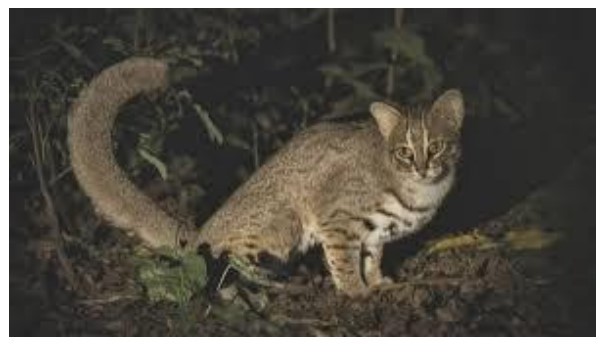
• Rare Sighting: The Rusty-spotted cat (Prionailurus rubiginosus), one of the world smallest wildcat species, was recently sighted and photographed breeding in the Aravalli scrublands near Delhi-NCR (specifically Faridabad and Gurgaon).
• Evidence of Breeding: This is the first recorded instance of the species breeding in this landscape, with photographic evidence of a mother and kitten in Kot village, indicating a resident and reproducing population.
• Conservation Status: Classified as Near Threatened on the IUCN Red List, the species is native to India, Sri Lanka, and Nepal, surviving in virgin forests and undisturbed scrublands.
• Habitat Under Threat: Approximately 75% of its habitat is currently threatened by land-use changes, including intensive agriculture and rapid urban expansion in the Delhi-NCR region.
• Ecological Indicator: The presence of this elusive and sensitive species serves as a proof of health for the Aravalli ecosystem, highlighting the need to protect these scrublands from further fragmentation.
• Research Milestone: The findings, documented by researchers from Indira Gandhi University and published in the journal Zoo Print, transition the species status in the region from sporadic visitor to resident wildlife.
Key Definitions
• Scrubland: An area of land that is uncultivated and covered with sparse, stunted trees and bushes; a critical but often ignored ecosystem for small carnivores.
• Near Threatened (IUCN): A conservation category assigned to species that may be considered threatened with extinction in the near future, although they do not currently qualify for the threatened status.
• Elusive Species: Animals that are naturally secretive, have low population densities, or are well-camouflaged, making them extremely difficult to observe or document in the wild.
Constitutional & Legal Provisions
• Wildlife (Protection) Act, 1972: The Rustyspotted cat is protected under Schedule I of this Act, providing it the highest level of legal protection in India, equivalent to that of the Tiger or Asiatic Lion.
• Article 48A (DPSP): Mandates that the State shall endeavor to protect and improve the environment and to safeguard the forests and wildlife of the country.
• Article 51A(g) (Fundamental Duties): It is the duty of every citizen of India to protect and improve the natural environment including forests, lakes, rivers, and wildlife.
• Forest (Conservation) Act, 1980: Relevant for the Aravalli region to prevent the diversion of forest land (including deemed forests or scrublands) for non-forest purposes like mining or real estate.
Additional Key Insights
• Physical Characteristics: Measuring only 35-48 cm in length (about half of which is tail), it is often referred to as the hummingbird of the cat family. Its fur is reddish-grey with distinctive rusty spots.
• Aravalli Conservation: The sighting reinforces the demand for a Green Wall or a protected corridor in the Aravallis to prevent the desertification of the Indo-Gangetic plain and preserve regional biodiversity.
• Technological Role: The shift from rare camera-trap recordings to live sightings indicates either a growing population or improved ecological monitoring techniques in the Haryana-Delhi border areas.
Conclusion
The discovery of a breeding population of Rusty-spotted cats at the doorstep of Delhi is a major conservation win. It challenges the perception of the Aravalli scrublands as wastelands and underscores their role as a vital biodiversity repository. Ensuring the survival of this Schedule I species will require strict enforcement of land-use regulations and the recognition of these scrublands as critical wildlife habitats rather than mere buffer zones for urban sprawl.
UPSC Relevance
• GS Paper III: Conservation, environmental pollution and degradation, environmental impact assessment; Biodiversity and Wildlife protection.
• Prelims Factor: Species-specific details (Scientific name, IUCN status, Wildlife Protection Act Schedule, and typical habitat) are frequent targets for Preliminary examination questions.
• Geography (Mapping): Significance of the Aravalli Range as a climate regulator and biodiversity corridor in Northern India.


Address : 506, 3rd EYE THREE (III), Opp. Induben Khakhrawala, Girish Cold Drink Cross Road, CG Road, Navrangpura, Ahmedabad, 380009.
Mobile : 8469231587 / 9586028957
E-mail: dics.upsc@gmail.com
Address: A-306, The Landmark, Urjanagar-1, Opp. Spicy Street, Kudasan – Por Road, Kudasan, Gandhinagar – 382421
Mobile : 9723832444 / 9723932444
E-mail: dics.gnagar@gmail.com
Address: 2nd Floor, 9 Shivali Society, L&T Circle, opp. Ratri Bazar, Karelibaugh, Vadodara, 390018
Mobile : 9725692037 / 9725692054
E-mail: dics.vadodara@gmail.com
Address: 403, Raj Victoria, Opp. Pal Walkway, Near Galaxy Circle, Pal, Surat-394510
Mobile : 8401031583 / 8401031587
E-mail: dics.surat@gmail.com
Address: 303,305 K 158 Complex Above Magson, Sindhubhavan Road Ahmedabad-380059
Mobile : 9974751177 / 8469231587
E-mail: dicssbr@gmail.com
Address: 57/17, 2nd Floor, Old Rajinder Nagar Market, Bada Bazaar Marg, Delhi-60
Mobile : 9104830862 / 9104830865
E-mail: dics.newdelhi@gmail.com