



Ahmedabad
(Head Office)Address : 506, 3rd EYE THREE (III), Opp. Induben Khakhrawala, Girish Cold Drink Cross Road, CG Road, Navrangpura, Ahmedabad, 380009.
Mobile : 8469231587 / 9586028957
E-mail: dics.upsc@gmail.com

Core Summary
• Legislative Overhaul: The transition from the Mahatma Gandhi National Rural Employment Guarantee Act (MGNREGA) to the Viksit Bharat-Guarantee for Rozgar and Ajeevika Mission (Gramin) Bill, 2025, alongside the implementation of new Labour Codes, marks a significant shift in rural and informal labor policy.
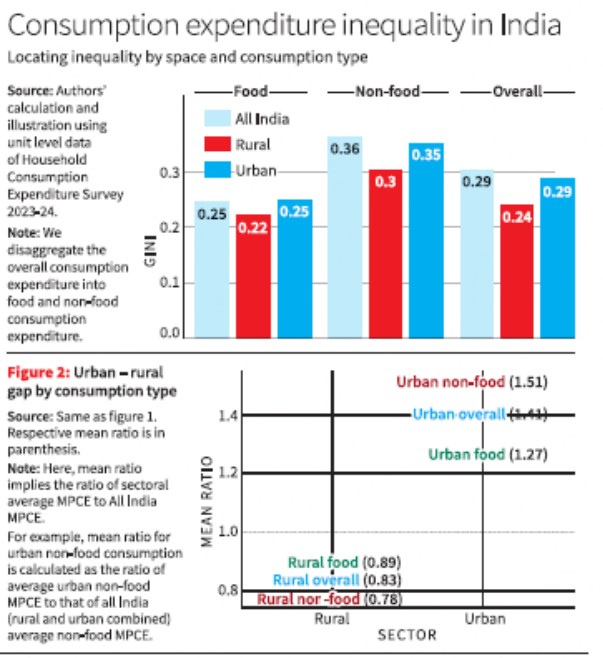
• The Consumption Gap: Analysis of the HCES 2023-24 data reveals a Gini index of 0.29 for consumption expenditure, which is notably higher than earlier World Bank estimates (0.25), indicating deeper structural disparities.
• Urban-Rural Divergence: Inequality is predominantly driven by non-food expenditure, where the urban sector exhibits higher disparity than rural areas; the mean urban non-food spending is 1.5 times the national average.
• Concentration of Spending: Wealth concentration is evident in urban centers, where the top 10% of the population accounts for 27% of total non-food expenditure, and the richest decile mean spending is nine times that of the rural poorest decile.
• Underestimation of the Super-Rich: Current NSSO surveys primarily capture consumption rather than the massive wealth of the super-rich, leading to a gross underestimation of actual economic inequality in national statistics.
• Class-Based Lag: While urban professionals and managers have gained disproportionately since the 1980s, urban informal workers and rural agricultural laborers have lagged, worsening between-class inequality despite various welfare interventions.
Key Definitions
• Gini Index: A statistical measure representing income or expenditure distribution of a nation\'s residents; a score of 0 represents perfect equality, while 1 represents perfect inequality.
• MPCE (Monthly Per Capita Expenditure): The average amount spent by an individual in a household per month on goods and services for consumption.
• Decile Groups: A method of dividing a population into ten equal parts based on a specific variable (like income or spending) to analyze distribution patterns.
• Viksit Bharat-GRAAM Bill, 2025: The proposed successor to MGNREGA, aimed at restructuring rural employment and livelihood guarantees under the Viksit Bharat framework.
Constitutional & Legal Provisions
• Article 38: A Directive Principle of State Policy (DPSP) mandating the State to secure a social order for the promotion of the welfare of the people and to minimize inequalities in income, status, and opportunities.
• Article 39: Directs the State to ensure that the ownership and control of material resources are distributed to subserve the common good and to prevent the concentration of wealth.
• Article 41: Right to work, to education, and to public assistance in certain cases, which provides the constitutional basis for employment guarantee schemes like MGNREGA and its successor.
• The Labour Codes (2020-2025): Consolidation of 29 central labor laws into four codes (Wages, Social Security, Industrial Relations, and Occupational Safety) aimed at formalizing the economy but raising concerns regarding the social safety net for informal workers.
Additional Key Insights
• The Invisible Wealth: The fact that 13% of the richest decile still hold BPL cards indicates significant leakages or data inaccuracies in the identification of beneficiaries for welfare schemes like PMGKY.
• Debt-Led Consumption: A substantial portion of the Indian middle and lower classes relies on credit to sustain consumption, masking the true extent of income stagnation among lower deciles.
• Structural Distress: Persistent agricultural distress and urban-centric growth models are the primary drivers behind the widening mean ratio disparity between rural and urban sectors.
Conclusion
The transition to the Viksit Bharat-GRAAM Bill, 2025, occurs at a juncture where statistical inequality appears lower due to methodological shifts, yet ground-level class disparity remains acute. Policy formulation based on the assumption of declining inequality risks marginalizing the urban informal workforce and rural laborers who have not shared proportionally in the non-food consumption boom. For genuine Viksit Bharat (Developed India), the growth-class-inequality nexus must be addressed by ensuring that livelihood missions provide more than just subsistence.
UPSC Relevance
• GS Paper II: Government policies and interventions for development in various sectors; Issues arising out of their design and implementation; Welfare schemes for vulnerable sections.
• GS Paper III: Indian Economy and issues relating to planning, mobilization of resources, growth, development, and employment; Inclusive growth and issues arising from it.
• Key Concept (Social Justice): The debate between Growth vs. Redistribution and the effectiveness of the \'Trickle-down theory\' in the Indian context.


Address : 506, 3rd EYE THREE (III), Opp. Induben Khakhrawala, Girish Cold Drink Cross Road, CG Road, Navrangpura, Ahmedabad, 380009.
Mobile : 8469231587 / 9586028957
E-mail: dics.upsc@gmail.com
Address: A-306, The Landmark, Urjanagar-1, Opp. Spicy Street, Kudasan – Por Road, Kudasan, Gandhinagar – 382421
Mobile : 9723832444 / 9723932444
E-mail: dics.gnagar@gmail.com
Address: 2nd Floor, 9 Shivali Society, L&T Circle, opp. Ratri Bazar, Karelibaugh, Vadodara, 390018
Mobile : 9725692037 / 9725692054
E-mail: dics.vadodara@gmail.com
Address: 403, Raj Victoria, Opp. Pal Walkway, Near Galaxy Circle, Pal, Surat-394510
Mobile : 8401031583 / 8401031587
E-mail: dics.surat@gmail.com
Address: 303,305 K 158 Complex Above Magson, Sindhubhavan Road Ahmedabad-380059
Mobile : 9974751177 / 8469231587
E-mail: dicssbr@gmail.com
Address: 57/17, 2nd Floor, Old Rajinder Nagar Market, Bada Bazaar Marg, Delhi-60
Mobile : 9104830862 / 9104830865
E-mail: dics.newdelhi@gmail.com