




Ahmedabad
(Head Office)Address : 506, 3rd EYE THREE (III), Opp. Induben Khakhrawala, Girish Cold Drink Cross Road, CG Road, Navrangpura, Ahmedabad, 380009.
Mobile : 8469231587 / 9586028957
E-mail: dics.upsc@gmail.com

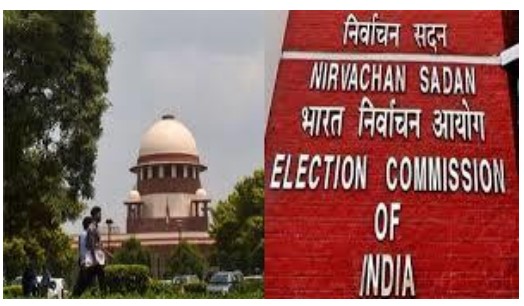
• Supreme Court Questioning Executive Dominance: The Supreme Court of India is currently hearing a challenge to the 2023 law regarding the appointment of Election Commissioners (ECs). The court questioned the inclusion of a Union Cabinet Minister in the three-member selection panel instead of a neutral or independent person, such as the Chief Justice of India (CJI).
• Structural Imbalance in the Selection Panel: The bench noted that the current composition—consisting of the Prime Minister, a Cabinet Minister (nominated by the PM), and the Leader of Opposition—creates an inherent 2:1 majority in favor of the executive. This leads to concerns that the executive could exercise total control over the appointment process.
• Comparison with CBI Director Selection: Justice Dipankar Datta highlighted an inconsistency in legislative standards, noting that the Chief Justice is included in the panel to select the CBI Director to ensure the rule of law. The court wondered why a similar standard for an independent member is not applied to the selection of ECs, which is vital for maintaining democracy.
• Independence and Public Perception: The court stated that the Election Commission of India (ECI) must not only be independent but also appear to be so. A selection process perceived as being under executive control could undermine public confidence in the purity and fairness of the electoral process.
• Constitutional Role of the Judiciary: The bench emphasized that the maintenance of a pure election is essential for a healthy democracy. The hearing explores whether the 2023 Act aligns with the spirit of the Constitution, which envisions an autonomous body to conduct free and fair elections.
• Ongoing Legal Challenge: The Supreme Court is examining whether the removal of the CJI from the selection process (which was previously mandated by a SC judgment before the new law was enacted) violates the basic structure of the Constitution or the principle of institutional integrity.
Key Definitions
• Election Commission of India (ECI): A permanent and independent constitutional body established under Article 324 to ensure free and fair elections in India.
• Executive Control: A situation where the branch of government responsible for implementing laws (the Cabinet/Ministry) has the dominant power to make key institutional appointments.
• Rule of Law: The principle that all people and institutions are subject to and accountable to law that is fairly applied and enforced; a fundamental pillar of the Indian Constitution.
• Basic Structure Doctrine: A judicial principle that certain fundamental features of the Constitution of India cannot be altered or destroyed by amendments by the Parliament.
Constitutional and Legal Provisions
• Article 324: Grants the power of superintendence, direction, and control of elections to the Election Commission. It also specifies that the appointment of the CEC and other ECs shall be made by the President, subject to any law made by Parliament.
• The Chief Election Commissioner and other Election Commissioners (Appointment, Conditions of Service and Term of Office) Act, 2023: The legislation that replaced the previous process and established the current selection committee comprising the PM, a Cabinet Minister, and the Leader of Opposition.
• Anoop Baranwal v. Union of India (2023): The landmark Supreme Court judgment which originally ruled that the selection committee should include the PM, the Leader of the Opposition, and the CJI until Parliament enacted a specific law.
• Article 141: The law declared by the Supreme Court is binding on all courts within the territory of India, raising questions about how the 2023 Act interacts with previous judicial directives.
Conclusion
The debate surrounding the appointment of Election Commissioners highlights the delicate balance between legislative prerogative and judicial oversight. While the Parliament has the authority to frame laws for appointments, the Supreme Court scrutiny ensures that such laws do not compromise the institutional autonomy of the ECI. Ensuring a neutral selection process is not just a matter of legal technicality but a fundamental requirement for the credibility of Indian democracy.
UPSC Relevance
This topic is of critical importance for General Studies Paper II (Governance, Constitution, and Polity). It directly relates to Appointment to various Constitutional posts, powers, functions and responsibilities of various Constitutional Bodies. For the Preliminary Exam, candidates should focus on the composition of the selection committee and the provisions of Article 324. For the Main Exam, the focus should be on the tension between the Executive and Judiciary, the Basic Structure implications of institutional independence, and the recommendations of various committees (like the Dinesh Goswami Committee) on electoral reforms. Understanding the shift from the Anoop Baranwal judgment to the 2023 Act is essential for answering analytical questions on constitutional morality.


Address : 506, 3rd EYE THREE (III), Opp. Induben Khakhrawala, Girish Cold Drink Cross Road, CG Road, Navrangpura, Ahmedabad, 380009.
Mobile : 8469231587 / 9586028957
E-mail: dics.upsc@gmail.com
Address: A-306, The Landmark, Urjanagar-1, Opp. Spicy Street, Kudasan – Por Road, Kudasan, Gandhinagar – 382421
Mobile : 9723832444 / 9723932444
E-mail: dics.gnagar@gmail.com
Address: 2nd Floor, 9 Shivali Society, L&T Circle, opp. Ratri Bazar, Karelibaugh, Vadodara, 390018
Mobile : 9725692037 / 9725692054
E-mail: dics.vadodara@gmail.com
Address: 403, Raj Victoria, Opp. Pal Walkway, Near Galaxy Circle, Pal, Surat-394510
Mobile : 8401031583 / 8401031587
E-mail: dics.surat@gmail.com
Address: 303,305 K 158 Complex Above Magson, Sindhubhavan Road Ahmedabad-380059
Mobile : 9974751177 / 8469231587
E-mail: dicssbr@gmail.com
Address: 57/17, 2nd Floor, Old Rajinder Nagar Market, Bada Bazaar Marg, Delhi-60
Mobile : 9104830862 / 9104830865
E-mail: dics.newdelhi@gmail.com