




Ahmedabad
(Head Office)Address : 506, 3rd EYE THREE (III), Opp. Induben Khakhrawala, Girish Cold Drink Cross Road, CG Road, Navrangpura, Ahmedabad, 380009.
Mobile : 8469231587 / 9586028957
E-mail: dics.upsc@gmail.com

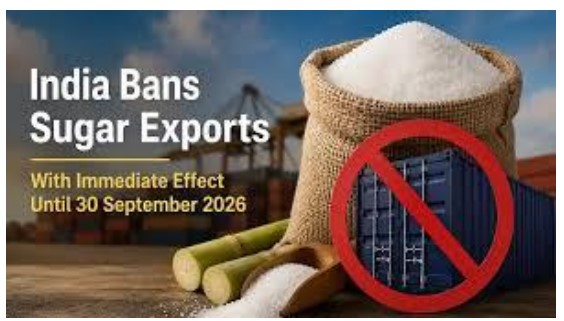
• Regulatory Shift in Export Regime: The Government of India has moved sugar exports from the restricted category to the prohibited category until September 30, 2026. This mandate by the Directorate General of Foreign Trade (DGFT) effectively halts the export of raw, white, and refined sugar to prioritize domestic food security.
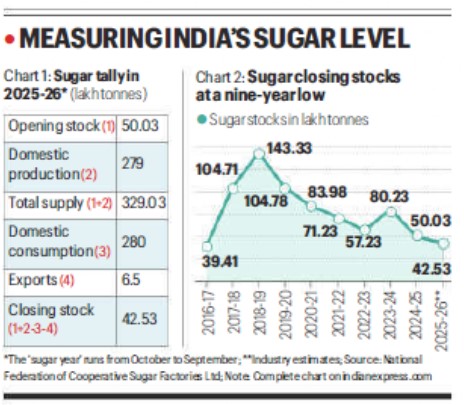
• Domestic Production and Supply Concerns: With annual consumption estimated at 28 million tonnes (mt), current production for the 2025-26 season is projected to barely meet this requirement at approximately 28 mt. The early closure of mills—with only five operational by late April compared to 19 the previous year—indicates a significant tightening of the supply side.
• Inflationary Pressures and Festive Demand: The primary trigger for the ban is the rising trend in wholesale sugar prices. By curbing exports, the government aims to prevent a retail price spike ahead of the high-consumption festive season, thereby managing overall food inflation.
• Climatic Risks and El Niño Factor: Policymakers are wary of the impact of El Niño on sugarcane yields. Potential water stress in key producing states like Maharashtra and Karnataka could lead to a second consecutive year of suboptimal production, necessitating the conservation of current stocks.
• Linkage with Biofuel Goals: The ban ensures that sugarcane byproducts remain available for the Ethanol Blended Petrol (EBP) Programme. Maintaining a steady supply of feedstock for ethanol is crucial for meeting India green energy targets and reducing the crude oil import bill.
• Global Market and Trade Reliability: As the world second-largest sugar producer, India exit from the export market has led to an immediate rise in international prices. While this benefits competitors like Brazil and Thailand, it raises concerns regarding India policy predictability and its reputation as a reliable global food supplier.
Key Definitions
• Prohibited Category: A trade classification under the Foreign Trade Policy where goods cannot be exported at all, except under specific permissions or bilateral agreements.
• El Niño: A climate pattern characterized by the unusual warming of surface waters in the eastern tropical Pacific Ocean, often leading to suppressed monsoon rainfall in India.
• Ethanol Blending: The process of mixing ethyl alcohol (derived from sugarcane molasses or grains) with petrol to reduce vehicular emissions and fuel imports.
• Food Inflation: A persistent rise in the price levels of food products, measured in India primarily through the Consumer Price Index (CPI).
Constitutional and Legal Provisions
• Foreign Trade (Development and Regulation) Act, 1992: The principal legislation that empowers the Central Government to notify the Export and Import (EXIM) Policy and prohibit or restrict trade in specific goods.
• Essential Commodities Act, 1955: This Act allows the government to regulate the production, supply, and distribution of a whole range of commodities (including sugar) to ensure availability at fair prices.
• Article 39(b): A Directive Principle of State Policy (DPSP) which dictates that the State shall direct its policy towards ensuring that the ownership and control of the material resources of the community are so distributed as best to subserve the common good.
• Seventh Schedule (Union List): Entry 41 (Trade and commerce with foreign countries) and Entry 83 (Duties of customs including export duties) provide the constitutional basis for the Union\'s exclusive control over export bans.
Conclusion
The abrupt ban on sugar exports underscores the government India-first approach to food security and inflation management. While the move protects domestic consumers and the ethanol program, it creates a challenging environment for sugar mills and international trade relations. Balancing the interests of farmers, who benefit from high export prices, with the urban consumer\'s need for affordable staples remains a complex task for fiscal and agricultural planners.
UPSC Relevance
This topic is highly relevant for General Studies Paper III (Economy & Agriculture), particularly under the heads of Major Crops/Cropping Patterns, Food Security, and Inflation. It also links to General Studies Paper II (Governance) regarding the use of executive power in trade regulation. For the Preliminary Exam, candidates should focus on the role of the DGFT and the impact of El Niño on Indian monsoons. For the Main Exam, the focus should be on the tension between Exportled Growth and Domestic Price Stability, as well as the implications of frequent policy shifts on India standing in global trade forums like the WTO.


Address : 506, 3rd EYE THREE (III), Opp. Induben Khakhrawala, Girish Cold Drink Cross Road, CG Road, Navrangpura, Ahmedabad, 380009.
Mobile : 8469231587 / 9586028957
E-mail: dics.upsc@gmail.com
Address: A-306, The Landmark, Urjanagar-1, Opp. Spicy Street, Kudasan – Por Road, Kudasan, Gandhinagar – 382421
Mobile : 9723832444 / 9723932444
E-mail: dics.gnagar@gmail.com
Address: 2nd Floor, 9 Shivali Society, L&T Circle, opp. Ratri Bazar, Karelibaugh, Vadodara, 390018
Mobile : 9725692037 / 9725692054
E-mail: dics.vadodara@gmail.com
Address: 403, Raj Victoria, Opp. Pal Walkway, Near Galaxy Circle, Pal, Surat-394510
Mobile : 8401031583 / 8401031587
E-mail: dics.surat@gmail.com
Address: 303,305 K 158 Complex Above Magson, Sindhubhavan Road Ahmedabad-380059
Mobile : 9974751177 / 8469231587
E-mail: dicssbr@gmail.com
Address: 57/17, 2nd Floor, Old Rajinder Nagar Market, Bada Bazaar Marg, Delhi-60
Mobile : 9104830862 / 9104830865
E-mail: dics.newdelhi@gmail.com