





Ahmedabad
(Head Office)Address : 506, 3rd EYE THREE (III), Opp. Induben Khakhrawala, Girish Cold Drink Cross Road, CG Road, Navrangpura, Ahmedabad, 380009.
Mobile : 8469231587 / 9586028957
E-mail: dics.upsc@gmail.com

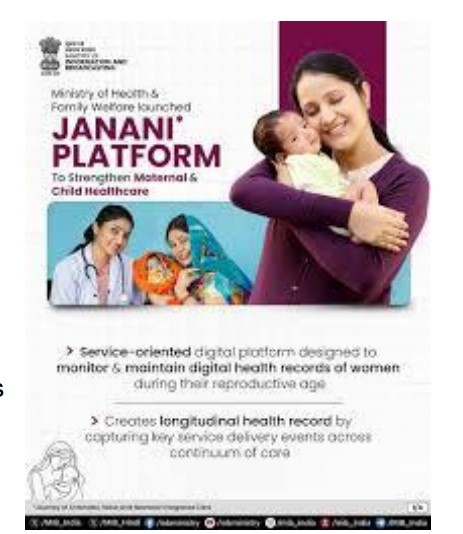
The Union Ministry of Health and Family Welfare has introduced the JANANI (Journey of Antenatal, Natal and Neonatal Integrated Care) platform to revolutionize maternal and child health (MCH) tracking. Launched during the National Summit on Innovation and Inclusivity, this service-oriented digital ecosystem serves as an advanced upgrade to the existing Reproductive and Child Health (RCH) portal. It aims to institutionalize longitudinal digital health records, ensuring that every stage of the reproductive and neonatal journey is monitored with precision to reduce maternal and infant mortality rates.
Key Highlights of the JANANI Platform
• Continuum of Care: The platform provides comprehensive tracking from antenatal care and delivery preparedness to postnatal and newborn care, including home-based young child care and family planning.
• Longitudinal Health Records: Unlike fragmented data systems, JANANI creates a continuous health history for women of reproductive age by capturing all key service delivery events in a single digital file.
• QR-Enabled Portability: The introduction of QRenabled digital MCH cards ensures that health records are portable and easily accessible across different healthcare facilities nationwide.
• Advanced Monitoring Tools: The system incorporates automated alerts for high-risk pregnancies, real-time supervisory dashboards, and due-list generation to ensure timely medical interventions.
• Interoperability and Convergence: JANANI is designed to sync with other national platforms like U-WIN (immunization) and POSHAN (nutrition), facilitating seamless data exchange across sectors.
• Robust Verification: The platform utilizes unique identifiers such as ABHA and biometric/OTP-based Aadhaar authentication to prevent record duplication and assist migratory populations.
Definitions of Key Terms
• Antenatal Care (ANC): The systemic medical supervision and care provided to pregnant women to ensure the best health conditions for both mother and fetus.
• Longitudinal Record: A permanent, digital health thread that tracks a patient medical history over time rather than a single clinical encounter.
• ABHA (Ayushman Bharat Health Account): A unique 14-digit identification number used to link all health records of a person across different healthcare providers.
• U-WIN: A national digital platform specifically designed to digitize India’s Universal Immunization Programme (UIP).
Constitutional and Legal Provisions
• Article 21: The Right to Life includes the right to health; JANANI facilitates this by ensuring maternal and neonatal safety.
• Article 42 (DPSP): Directs the State to make provisions for securing just and humane conditions of work and for maternity relief.
• Article 47 (DPSP): Mandates the State to raise the level of nutrition and the standard of living and to improve public health.
• Digital Personal Data Protection (DPDP) Act, 2023: Governs the ethical handling and privacy of the digital health data collected through platforms like JANANI.
Additional Important Key Points
• Current Progress: The platform has already achieved 1.34 crore beneficiary registrations and over 30 lakh MCH card generations.
• Self-Registration: Beneficiaries can actively engage in their healthcare journey through webbased and mobile self-registration facilities.
• High-Risk Management: By automating alerts for complications, the platform directly targets the reduction of the Maternal Mortality Ratio (MMR) and Neonatal Mortality Rate (NMR).
• Migratory Continuity: The pan-India search functionality ensures that pregnant women who migrate for work or family reasons do not lose access to their health history or scheduled visits.
Conclusion The JANANI platform marks a significant structural reform in India public health administration. By shifting from manual registries to a real-time, interoperable digital ecosystem, the government is not only improving service delivery but also enhancing accountability. This integration of technology with grassroots healthcare is a vital step toward achieving Sustainable Development Goal (SDG) 3.1 and 3.2, which aim to reduce global maternal and neonatal mortality.
UPSC Relevance
• GS Paper II: Issues relating to the development and management of Social Sector/Services relating to Health; Government policies and interventions for development in various sectors.
• GS Paper III: E-governance- applications, models, successes, limitations, and potential; Science and Technology- developments and their applications in everyday life.
• Social Issues: Empowerment of women through health literacy and digital inclusion.


Address : 506, 3rd EYE THREE (III), Opp. Induben Khakhrawala, Girish Cold Drink Cross Road, CG Road, Navrangpura, Ahmedabad, 380009.
Mobile : 8469231587 / 9586028957
E-mail: dics.upsc@gmail.com
Address: A-306, The Landmark, Urjanagar-1, Opp. Spicy Street, Kudasan – Por Road, Kudasan, Gandhinagar – 382421
Mobile : 9723832444 / 9723932444
E-mail: dics.gnagar@gmail.com
Address: 2nd Floor, 9 Shivali Society, L&T Circle, opp. Ratri Bazar, Karelibaugh, Vadodara, 390018
Mobile : 9725692037 / 9725692054
E-mail: dics.vadodara@gmail.com
Address: 403, Raj Victoria, Opp. Pal Walkway, Near Galaxy Circle, Pal, Surat-394510
Mobile : 8401031583 / 8401031587
E-mail: dics.surat@gmail.com
Address: 303,305 K 158 Complex Above Magson, Sindhubhavan Road Ahmedabad-380059
Mobile : 9974751177 / 8469231587
E-mail: dicssbr@gmail.com
Address: 57/17, 2nd Floor, Old Rajinder Nagar Market, Bada Bazaar Marg, Delhi-60
Mobile : 9104830862 / 9104830865
E-mail: dics.newdelhi@gmail.com