

Ahmedabad
(Head Office)Address : 506, 3rd EYE THREE (III), Opp. Induben Khakhrawala, Girish Cold Drink Cross Road, CG Road, Navrangpura, Ahmedabad, 380009.
Mobile : 8469231587 / 9586028957
E-mail: dics.upsc@gmail.com

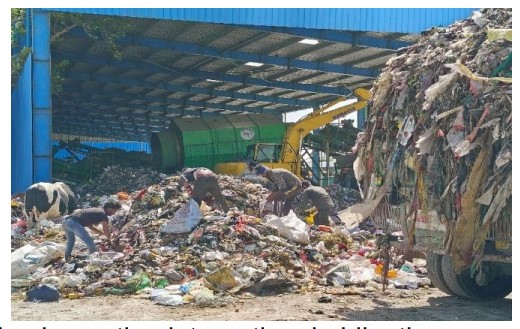
The Solid Waste Management Rules, 2026, which came into effect on April 1, 2026, supersede the 2016 regulations to address India escalating waste crisis. While the rules aim for a circular economy and digital monitoring, they have sparked a debate regarding the over-centralization of a function that is inherently local and ecologically diverse.
Core Summary of the 2026 Waste Framework
• National Ecological Emergency: The rules address compounding extremes such as landfill methane fires, plastic-clogged drains, and the scarring of rural landscapes by e-waste and pesticide containers.
• Expanded Scope and Objectives: The 2026 framework seeks to improve source segregation, remediate legacy dumpsites, regulate bulk waste generators, and promote scientific processing.
• Rural-Urban Extension: For the first time, these rules extend a complex Material Recovery Facility (MRF)-linked architecture to rural local bodies, treating gram panchayats as miniature municipalities.
• The Subsidiarity Challenge: Critics argue the rules reverse the principle of subsidiarity, presuming central competence while reducing state and local bodies to mere implementing instruments.
• Technocratic and Digital Focus: The rules mandate a centralized online portal for reporting to the Central Pollution Control Board (CPCB), raising concerns that compliance may become reporting upward rather than governing outward.
Key Definitions & Concepts
• Subsidiarity: The principle that social and political issues should be dealt with at the most immediate or local level that is consistent with their resolution.
• Legacy Dumpsites: Large accumulations of historical waste in landfills that require scientific remediation to prevent leachate and toxic gas emissions.
• Material Recovery Facility (MRF): A specialized plant that receives, separates, and prepares recyclable materials for marketing to end-user manufacturers.
• Continuing Mandamus: A judicial remedy where a court retains jurisdiction over a case to ensure its orders are implemented over a period of time.
Constitutional & Legal Provisions
• Article 253: Empowers Parliament to make laws for implementing international obligations (e.g., the 1972 Stockholm Declaration), providing the basis for the Environment (Protection) Act, 1986.
• Seventh Schedule: Solid waste management intersects with Public Health and Sanitation (State List) and Environment (effectively under Union/Concurrent jurisdiction via the 1986 Act).
• Article 243G & 243W: These articles pertain to the powers and responsibilities of Panchayats and Municipalities, respectively, emphasizing their role in local governance.
Additional Strategic Keypoints
• The Knowledge Problem: As noted by F.A. Hayek, effective waste decisions depend on dispersed, contextual knowledge of specific locations, which cannot be easily transmitted to a central authority in New Delhi.
• Capacity Building vs. Conferral: Capacity is built through decision-making and feedback (learning by doing), not by following top-down instructions that may cause local expertise to atrophy.
• Fiscal Gap: The 2026 Rules expand obligations without a formula-based financial backup, risking underfunded mandates and quiet evasion by local bodies.
Conclusion
While the 2026 Rules possess a sound environmental intent, their administrative design leans heavily toward centralization. To truly solve the waste crisis, the framework must evolve from a rigid, technocratic operational blueprint into a federal design that treats States as policy laboratories. A decentralized approach—tailored to the specific needs of Himalayan towns, coastal panchayats, and megacities—is essential to prevent mountains of waste from becoming monuments to local neglect.
UPSC Relevance
• GS Paper II: Federal structure and challenges; Devolution of powers and finances to local levels; Important aspects of governance (Transparency & Accountability).
• GS Paper III: Environmental pollution and degradation; Conservation; Disaster management (Urban flooding and landfill fires).
• Prelims: Environment (Protection) Act, 1986; CPCB functions; Articles 243 and 253; Basics of the 1972 Stockholm Declaration.


Address : 506, 3rd EYE THREE (III), Opp. Induben Khakhrawala, Girish Cold Drink Cross Road, CG Road, Navrangpura, Ahmedabad, 380009.
Mobile : 8469231587 / 9586028957
E-mail: dics.upsc@gmail.com
Address: A-306, The Landmark, Urjanagar-1, Opp. Spicy Street, Kudasan – Por Road, Kudasan, Gandhinagar – 382421
Mobile : 9723832444 / 9723932444
E-mail: dics.gnagar@gmail.com
Address: 2nd Floor, 9 Shivali Society, L&T Circle, opp. Ratri Bazar, Karelibaugh, Vadodara, 390018
Mobile : 9725692037 / 9725692054
E-mail: dics.vadodara@gmail.com
Address: 403, Raj Victoria, Opp. Pal Walkway, Near Galaxy Circle, Pal, Surat-394510
Mobile : 8401031583 / 8401031587
E-mail: dics.surat@gmail.com
Address: 303,305 K 158 Complex Above Magson, Sindhubhavan Road Ahmedabad-380059
Mobile : 9974751177 / 8469231587
E-mail: dicssbr@gmail.com
Address: 57/17, 2nd Floor, Old Rajinder Nagar Market, Bada Bazaar Marg, Delhi-60
Mobile : 9104830862 / 9104830865
E-mail: dics.newdelhi@gmail.com