




Ahmedabad
(Head Office)Address : 506, 3rd EYE THREE (III), Opp. Induben Khakhrawala, Girish Cold Drink Cross Road, CG Road, Navrangpura, Ahmedabad, 380009.
Mobile : 8469231587 / 9586028957
E-mail: dics.upsc@gmail.com

The Indian summer of 2026 is characterized by a complex interplay of meteorological phenomena that are significantly impacting regional weather patterns.
Core Summary of Key Climate Drivers
• Impact of Western Disturbances: These extra-tropical cyclones originate from the Mediterranean region and travel eastward, bringing unseasonal rainfall and influencing weather over Northern India, particularly between December and March.
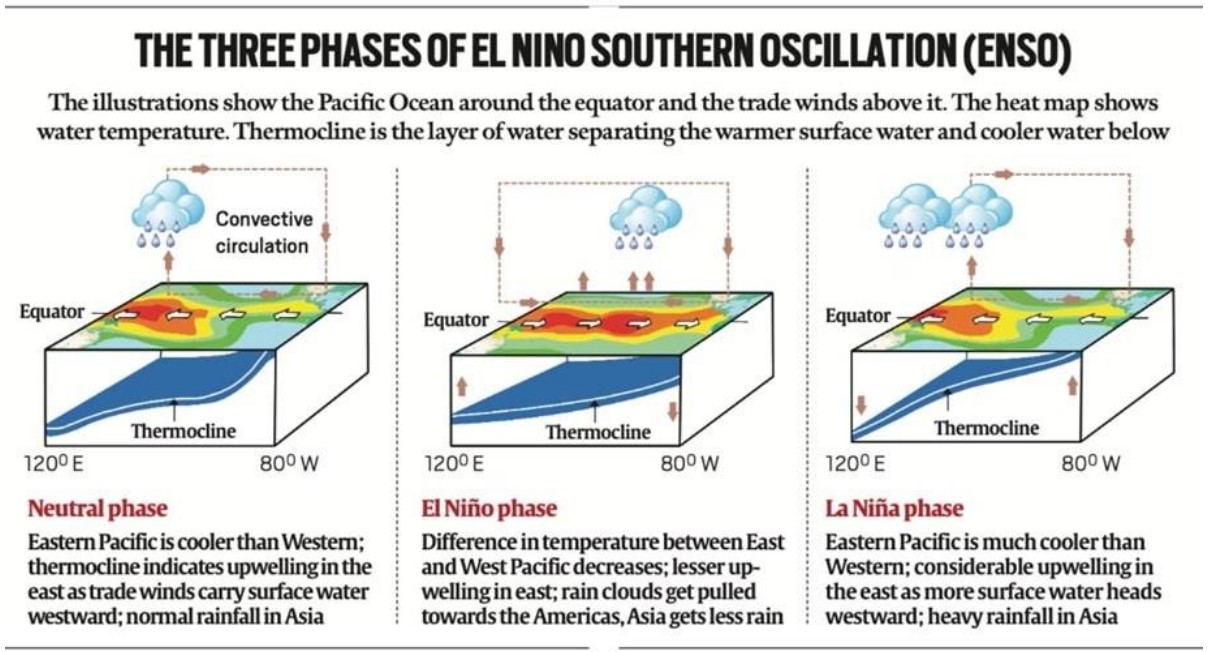
• The El Niño Threat: As a warm phase of the El Niño Southern Oscillation (ENSO), El Niño causes unusual warming of surface waters in the eastern Pacific Ocean, which typically results in a weakened or delayed Indian monsoon and intensified heatwaves.
• ENSO Phases and Indian Monsoon: While El Niño is associated with dry spells and weak monsoons in India, its counterpart, La Niña, involves the cooling of eastern Pacific waters and generally provides a boost to the southwest monsoon, sometimes leading to floods.
• Heatwave Criteria by IMD: The India Meteorological Department (IMD) classifies a heatwave when temperatures in the plains reach 40°C or 30°C in hilly regions, further categorized based on a departure of 4.5°C to 6.4°C from the normal temperature.
• The Critical Wet Bulb Temperature: This metric measures the lowest temperature achievable through evaporative cooling; according to the IPCC, sustained exposure to wet bulb temperatures exceeding 35°C can be fatal to humans due to the body inability to regulate heat through sweat.
• Apparent vs. Actual Temperature: The Feels Like temperature accounts for humidity and wind conditions, explaining why a 40°C day in a humid region like Palakkad feels much hotter and more stressful than the same temperature in a dry region like Delhi.
Key Definitions & Concepts
• Subtropical Westerly Jet Stream: A high-altitude, fast-moving air current flowing from west to east, within which Western Disturbances are embedded as they move over the Himalayan and Tibetan highlands.
• Thermocline: An oceanographic layer that separates the warmer surface water from the much cooler water below, playing a vital role in ENSO phase transitions.
• Wet Bulb Temperature: The temperature typically measured by a thermometer covered in a water-soaked cloth (measuring moisture), representing the maximum cooling capacity of the human body via evaporation.
Constitutional & Legal Provisions
• Article 48A (DPSP): Mandates that the State shall endeavor to protect and improve the environment, which includes monitoring and adapting to extreme climate events like heatwaves.
• Article 51A(g): Establishes a fundamental duty for every citizen to protect and improve the natural environment, essential for community participation in climate conservation efforts.
• Disaster Management Act, 2005: Provides the legal framework for both the Centre and States to manage Heatwaves as disasters, ensuring the implementation of Heat Action Plans (HAPs) at the district level.
Additional Strategic Keypoints
• Agricultural Vulnerability: The link between El Niño and weak monsoons directly impacts India food security and agricultural GDP, necessitating robust irrigation and crop diversification strategies.
• Urban Heat Island Effect: Intensified heatwaves in cities like Delhi are exacerbated by concrete infrastructure, requiring urban planning interventions like cool roofs and increased green cover.
• Health Hazards: Sustained exposure to high wet bulb temperatures is a rising public health crisis, as high humidity prevents the body from dispelling heat through sweat evaporation.
Conclusion
India current climate scenario is a convergence of diverse atmospheric and oceanic phenomena. While Western Disturbances have brought unseasonal relief, the overarching threat of El Niño poses a significant risk to the 2026 monsoon and agricultural stability. Understanding metrics like the wet bulb temperature is no longer just a scientific exercise but a critical necessity for public safety and disaster preparedness in an era of global climate change.
UPSC Relevance
• GS Paper I: Geographical features and their location- changes in critical geographical features (including water-bodies and ice-caps) and in flora and fauna and the effects of such changes.
• GS Paper III: Disaster and disaster management (Heatwaves); Environmental pollution and degradation; Impact of climate change on agriculture.
• Prelims: Conceptual questions on ENSO phases (El Niño, La Niña, Neutral), Jet Streams, and the mechanism of Western Disturbances.


Address : 506, 3rd EYE THREE (III), Opp. Induben Khakhrawala, Girish Cold Drink Cross Road, CG Road, Navrangpura, Ahmedabad, 380009.
Mobile : 8469231587 / 9586028957
E-mail: dics.upsc@gmail.com
Address: A-306, The Landmark, Urjanagar-1, Opp. Spicy Street, Kudasan – Por Road, Kudasan, Gandhinagar – 382421
Mobile : 9723832444 / 9723932444
E-mail: dics.gnagar@gmail.com
Address: 2nd Floor, 9 Shivali Society, L&T Circle, opp. Ratri Bazar, Karelibaugh, Vadodara, 390018
Mobile : 9725692037 / 9725692054
E-mail: dics.vadodara@gmail.com
Address: 403, Raj Victoria, Opp. Pal Walkway, Near Galaxy Circle, Pal, Surat-394510
Mobile : 8401031583 / 8401031587
E-mail: dics.surat@gmail.com
Address: 303,305 K 158 Complex Above Magson, Sindhubhavan Road Ahmedabad-380059
Mobile : 9974751177 / 8469231587
E-mail: dicssbr@gmail.com
Address: 57/17, 2nd Floor, Old Rajinder Nagar Market, Bada Bazaar Marg, Delhi-60
Mobile : 9104830862 / 9104830865
E-mail: dics.newdelhi@gmail.com