

Ahmedabad
(Head Office)Address : 506, 3rd EYE THREE (III), Opp. Induben Khakhrawala, Girish Cold Drink Cross Road, CG Road, Navrangpura, Ahmedabad, 380009.
Mobile : 8469231587 / 9586028957
E-mail: dics.upsc@gmail.com

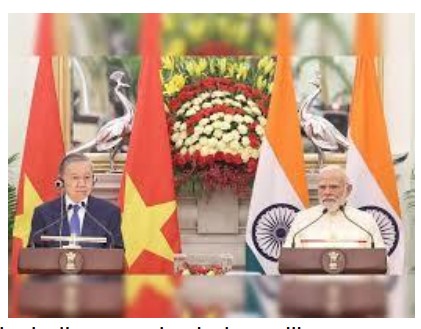
The state visit of Vietnamese President Tô Lâm to India (May 5-7, 2026) marks a paradigm shift in bilateral relations, elevating the bond to an Enhanced Comprehensive Strategic Partnership. Against the backdrop of a volatile Indo-Pacific, this visit transitions the relationship from symbolic camaraderie to a robust, security-oriented alliance. The convergence of India Act East Policy and Vietnam strategic hedging has created a durable framework for maritime security, economic resilience, and technological collaboration.
Core Summary of the State Visit & Bilateral Shift
• Strategic Elevation: The relationship has been upgraded to an Enhanced Comprehensive Strategic Partnership, signifying a move beyond incremental progress toward a deep, multifaceted strategic alignment.
• Defence as the Backbone: Shifting from capacitybuilding to capability enhancement, discussions now involve high-end hardware like BrahMos supersonic cruise missiles, following the successful 2023 transfer of INS Kirpan.
• Maritime Convergence: Both nations have reaffirmed a rules-based maritime order in the South China Sea, explicitly countering unilateralism and maritime coercion through joint strategic autonomy.
• Economic Ambition: With a trade target of $25 billion by 2030, the focus has shifted to next-generation sectors including supply chain resilience, rare earth minerals, and digital payment integration (UPI-NAPAS).
• ASEAN Centrality: Vietnam remains the linchpin of India engagement with Southeast Asia, serving as a vital manufacturing partner for India strategy to diversify supply chains away from China.
Key Definitions & Concepts
• Enhanced Comprehensive Strategic Partnership: The highest tier of diplomatic engagement involving deep institutionalized cooperation in defense, critical technology, and geopolitics.
• Strategic Hedging: A foreign policy of diversification used by middle powers (like Vietnam) to avoid taking sides in great power competition while protecting national interests.
• Act East Policy: India diplomatic initiative to promote economic, strategic, and cultural relations with the vast Asia-Pacific region at different levels.
Constitutional & Legal Provisions
• Article 51 (DPSP): The Indian Constitution mandates the State to promote international peace and security and maintain just and honorable relations between nations, providing the foundational logic for the Act East Policy.
• UNCLOS (1982): Both India and Vietnam emphasize the United Nations Convention on the Law of the Sea as the legal framework for resolving disputes in the South China Sea and maintaining freedom of navigation.
• India-ASEAN FTA: The legal basis for trade relations, currently under review to address trade deficits and simplify rules of origin to benefit manufacturing hubs like Vietnam and India.
Additional Strategic Keypoints
• Supply Chain Resilience: Collaboration in critical minerals (rare earths) is essential for India semiconductor and green energy missions, where Vietnam holds significant untapped reserves.
• Minilateralism: India and Vietnam contribute to vibrant networks (alongside Quad members) that balance regional power dynamics without being part of formal military alliances.
• Implementation Gaps: Challenges remain in translating strategic intent into operational reality, particularly regarding logistics, defense industrial joint ventures, and private sector participation.
Conclusion
The visit of President Tô Lâm signifies that India and Vietnam are no longer just civilizational friends but indispensable strategic partners. By weaving together defense deterrence, economic security, and maritime law, the partnership offers a blueprint for middle-power cooperation in a multipolar world. The success of this Enhanced phase will depend on overcoming bureaucratic hurdles to realize high-value defense exports and integrated digital economies.
UPSC Relevance
• GS Paper II: India and its neighborhood-relations; Bilateral, regional and global groupings and agreements involving India and/or affecting India’s interests (Act East Policy and Indo-Pacific).
• GS Paper III: Security challenges and their management in border areas; Linkages of organized crime with terrorism (Maritime security and supply chain vulnerabilities).
• Prelims: Locations in the South China Sea (Paracel/Spratly Islands), details of INS Kirpan, BrahMos missile specifications, and ASEAN-India summits.


Address : 506, 3rd EYE THREE (III), Opp. Induben Khakhrawala, Girish Cold Drink Cross Road, CG Road, Navrangpura, Ahmedabad, 380009.
Mobile : 8469231587 / 9586028957
E-mail: dics.upsc@gmail.com
Address: A-306, The Landmark, Urjanagar-1, Opp. Spicy Street, Kudasan – Por Road, Kudasan, Gandhinagar – 382421
Mobile : 9723832444 / 9723932444
E-mail: dics.gnagar@gmail.com
Address: 2nd Floor, 9 Shivali Society, L&T Circle, opp. Ratri Bazar, Karelibaugh, Vadodara, 390018
Mobile : 9725692037 / 9725692054
E-mail: dics.vadodara@gmail.com
Address: 403, Raj Victoria, Opp. Pal Walkway, Near Galaxy Circle, Pal, Surat-394510
Mobile : 8401031583 / 8401031587
E-mail: dics.surat@gmail.com
Address: 303,305 K 158 Complex Above Magson, Sindhubhavan Road Ahmedabad-380059
Mobile : 9974751177 / 8469231587
E-mail: dicssbr@gmail.com
Address: 57/17, 2nd Floor, Old Rajinder Nagar Market, Bada Bazaar Marg, Delhi-60
Mobile : 9104830862 / 9104830865
E-mail: dics.newdelhi@gmail.com