




Ahmedabad
(Head Office)Address : 506, 3rd EYE THREE (III), Opp. Induben Khakhrawala, Girish Cold Drink Cross Road, CG Road, Navrangpura, Ahmedabad, 380009.
Mobile : 8469231587 / 9586028957
E-mail: dics.upsc@gmail.com


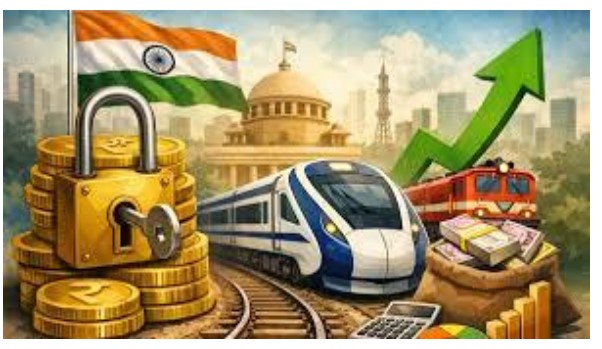
The Union Budget for the 2026-27 financial year addresses the \'triple threat\' of food, fuel, and fertilizer security while navigating a volatile global trade landscape. By integrating advanced technology like AI and securing critical mineral supply chains, the budget seeks to insulate Indian industry from the \'weaponization\' of global finance and technology. Core Summary of the Development • Security Triplets: The budget reinforces \'Food, Fuel, and Fertilizer\' security with a massive ₹2.27 trillion allocation for food subsidies, ensuring free grains for 81.35 crore people under PMGKAY. • Countering Global Headwinds: To protect businesses from rising U.S. tariffs (now averaging 18%), the government has allowed SEZ units to sell in the Domestic Tariff Area (DTA) at concessional duties, helping utilize idle capacity. • Technology as a Multiplier: A dedicated ₹1,000 crore has been earmarked for the India AI Mission to bolster national computing capacity and domestic data storage, shielding Indian youth from AI-led job disruptions. • Critical Mineral Resilience: To combat the \'weaponization of resources,\' the budget exempts customs duty on capital goods used for processing critical minerals (like Lithium and Cobalt) and extends tax waivers for nuclear power projects until 2035. • Agricultural Value Addition: Beyond subsidies, ₹4,064 crore is allocated to the Food Processing Ministry to reduce post-harvest losses and improve farmer realizations, maintaining food inflation below 2%. • Fiscal Preparedness: The Finance Minister emphasized that the government maintains adequate fiscal buffers to manage unanticipated global shocks and the strategic use of finance as a geopolitical tool. Key Definitions • Domestic Tariff Area (DTA): An area within India that is outside the Special Economic Zones (SEZs). Sales from SEZs to DTA are typically treated as imports and subjected to full customs duties. • Critical Minerals: Metallic or non-metallic elements (e.g., Lithium, Graphite, Rare Earths) that are essential for modern technology and have a high risk of supply chain disruption. • Force Multiplier: In an economic sense, an input or policy (like Capital Expenditure or AI) that results in a disproportionately large increase in output or efficiency. Constitutional and Legal Context • Article 112: Mandates the presentation of the \'Annual Financial Statement\' (Budget), detailing estimated receipts and expenditure of the Government of India for the financial year. • Article 266: Deals with the Consolidated Fund of India, from which all subsidies (Food, Fertilizer, Fuel) are appropriated following parliamentary approval. • Special Economic Zones Act, 2005: The legal framework governing SEZ units; recent budget proposals modify these rules to allow greater flexibility in domestic sales to counter external trade barriers. Additional Key Points • Data Sovereignty: By incentivizing domestic cloud and data centers, the government aims to prevent \'data colonization,\' ensuring Indian user data remains a domestic resource for indigenous AI development. • The \'Bali Clause\' Reversal: The FM highlighted the reversal of previous WTO-related decisions on public stockholding, prioritizing the sovereign right to maintain food buffers for national food security. • Strategic Energy Shift: The exemption on capital goods for nuclear and critical mineral processing signifies a shift toward Baseload Green Power and reducing dependency on the \'petrodollar\' and foreign supply chains. ConclusionThe FY27 Budget is a blueprint for \'Resilient India\' (Atmanirbhar Bharat), balancing immediate social welfare with long-term industrial modernization. By addressing high-tech sectors like AI and Biopharma while simultaneously shielding labor-intensive textiles and SEZs from global tariff wars, the government is attempting a delicate \'dual-track\' growth strategy. The focus on \'domesticating\' supply chains for critical minerals and data reflects a sophisticated understanding of modern geopolitical vulnerabilities. UPSC Relevance • GS Paper II: Government policies and interventions for development; Issues relating to poverty and hunger (Food Security). • GS Paper III: Indian Economy and issues relating to planning, mobilization of resources, growth, and employment; Effects of liberalization on the economy. • Mains Perspective: Discuss how the \'weaponization of technology and finance\' impacts India\'s strategic autonomy and the role of budgetary policy in building economic resilience.


Address : 506, 3rd EYE THREE (III), Opp. Induben Khakhrawala, Girish Cold Drink Cross Road, CG Road, Navrangpura, Ahmedabad, 380009.
Mobile : 8469231587 / 9586028957
E-mail: dics.upsc@gmail.com
Address: A-306, The Landmark, Urjanagar-1, Opp. Spicy Street, Kudasan – Por Road, Kudasan, Gandhinagar – 382421
Mobile : 9723832444 / 9723932444
E-mail: dics.gnagar@gmail.com
Address: 2nd Floor, 9 Shivali Society, L&T Circle, opp. Ratri Bazar, Karelibaugh, Vadodara, 390018
Mobile : 9725692037 / 9725692054
E-mail: dics.vadodara@gmail.com
Address: 403, Raj Victoria, Opp. Pal Walkway, Near Galaxy Circle, Pal, Surat-394510
Mobile : 8401031583 / 8401031587
E-mail: dics.surat@gmail.com
Address: 303,305 K 158 Complex Above Magson, Sindhubhavan Road Ahmedabad-380059
Mobile : 9974751177 / 8469231587
E-mail: dicssbr@gmail.com
Address: 57/17, 2nd Floor, Old Rajinder Nagar Market, Bada Bazaar Marg, Delhi-60
Mobile : 9104830862 / 9104830865
E-mail: dics.newdelhi@gmail.com