Ahmedabad
(Head Office)Address : 506, 3rd EYE THREE (III), Opp. Induben Khakhrawala, Girish Cold Drink Cross Road, CG Road, Navrangpura, Ahmedabad, 380009.
Mobile : 8469231587 / 9586028957
E-mail: dics.upsc@gmail.com

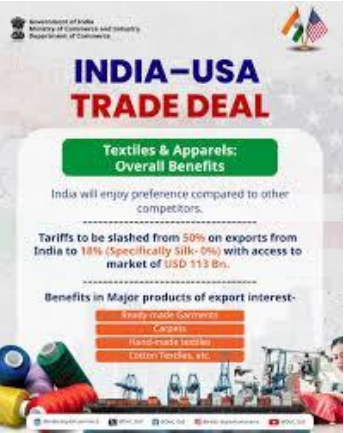
The Union Minister of Commerce and Industry, Piyush Goyal, recently clarified that India is set to receive zero reciprocal tariff benefits on textile exports to the United States. This provision aims to place Indian exporters on a level playing field with competitors like Bangladesh, ensuring that the domestic textile industry remains globally competitive. Key Highlights of the Proposed Agreement • Parity with Bangladesh: India will receive the same trade concessions as Bangladesh, specifically a 0% tariff on textile and apparel exports, provided certain conditions regarding raw material sourcing are met. • Conditionality of Zero Tariff: To avail of the duty-free benefit, garments must be manufactured using raw materials (such as cotton or man-made fibres) sourced from the U.S., processed in India, and then exported back to the U.S. • Interim Tariff Structure: Under the broader framework, the U.S. has already agreed to reduce baseline tariffs on Indian goods to 18% (down from as high as 50%), giving India a marginal edge over Bangladesh’s general rate of 19%. • Protection of Sensitive Sectors: The Minister emphasized that 90- 95% of India’s agricultural produce, including dairy, poultry, wheat, and rice, remains outside the scope of the deal to protect the interests of Indian farmers. • Strategic \'Fine Print\': While the current framework establishes the 18% rate, the specific \'cotton-for-zero-tariff\' clause is expected to be detailed in the final interim agreement scheduled for signing in mid-March 2026. • Market Significance: The U.S. is the largest destination for Indian textiles, accounting for approximately 30% of total exports (valued at nearly $7.5 billion annually); this deal is projected to help double textile exports to $60 billion. Constitutional & Legal Provisions • Article 253: Grants Parliament the exclusive power to make any law for implementing international treaties, agreements, or conventions with other countries. • Article 73: Specifies that the Executive power of the Union extends to matters where Parliament has the power to make laws, allowing the Union Cabinet to negotiate and sign trade deals. • Seventh Schedule (Union List): \'Foreign affairs\' (Entry 10) and \'Entering into treaties and agreements with foreign countries\' (Entry 14) fall under the exclusive jurisdiction of the Central Government. • Collection of Statistics Act, 2008: Used for gathering industrial and trade data that informs the negotiation of such bilateral trade agreements.Definitions of Key Terms • Reciprocal Tariff: A trade policy where a country applies the same tariff rates on imports from a partner country that the partner country applies to its own exports. • Interim Trade Agreement: A preliminary deal that covers a limited set of goods and services, often serving as a precursor to a Comprehensive Economic Partnership Agreement (CEPA) or a full Free Trade Agreement (FTA). • Rules of Origin: The criteria used to determine the national source of a product. In this deal, the \'origin\' of the raw material (U.S. cotton) is the deciding factor for the zero-duty benefit. • Fine Print: A term referring to the specific, detailed terms and conditions of an agreement that may not be apparent in the initial summary or framework. Conclusion The \'zero-tariff\' assurance for Indian textiles manufactured with U.S. cotton is a strategic move to neutralize the competitive advantage recently gained by Bangladesh. By securing this \'reciprocal\' arrangement, India not only protects its massive labor-intensive textile sector but also deepens its economic integration with the U.S. without compromising sensitive agricultural segments. UPSC Relevance • Prelims: Understanding concepts like Reciprocal Tariffs, Rules of Origin, and the role of MoC&I in trade negotiations. • Mains (GS Paper II & III): International Relations (Bilateral groupings & agreements involving India); Indian Economy (Effects of liberalization on the textile sector, export-led growth, and balancing farmer interests with global trade).


Address : 506, 3rd EYE THREE (III), Opp. Induben Khakhrawala, Girish Cold Drink Cross Road, CG Road, Navrangpura, Ahmedabad, 380009.
Mobile : 8469231587 / 9586028957
E-mail: dics.upsc@gmail.com
Address: A-306, The Landmark, Urjanagar-1, Opp. Spicy Street, Kudasan – Por Road, Kudasan, Gandhinagar – 382421
Mobile : 9723832444 / 9723932444
E-mail: dics.gnagar@gmail.com
Address: 2nd Floor, 9 Shivali Society, L&T Circle, opp. Ratri Bazar, Karelibaugh, Vadodara, 390018
Mobile : 9725692037 / 9725692054
E-mail: dics.vadodara@gmail.com
Address: 403, Raj Victoria, Opp. Pal Walkway, Near Galaxy Circle, Pal, Surat-394510
Mobile : 8401031583 / 8401031587
E-mail: dics.surat@gmail.com
Address: 303,305 K 158 Complex Above Magson, Sindhubhavan Road Ahmedabad-380059
Mobile : 9974751177 / 8469231587
E-mail: dicssbr@gmail.com
Address: 57/17, 2nd Floor, Old Rajinder Nagar Market, Bada Bazaar Marg, Delhi-60
Mobile : 9104830862 / 9104830865
E-mail: dics.newdelhi@gmail.com