




Ahmedabad
(Head Office)Address : 506, 3rd EYE THREE (III), Opp. Induben Khakhrawala, Girish Cold Drink Cross Road, CG Road, Navrangpura, Ahmedabad, 380009.
Mobile : 8469231587 / 9586028957
E-mail: dics.upsc@gmail.com

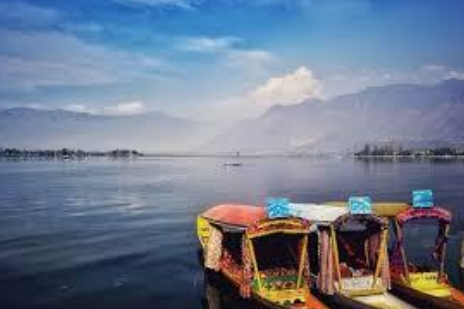
The Jammu and Kashmir government has recently shelved the ambitious ₹416.72-crore Dal Lake restoration project, which originally proposed the relocation of nearly 9,000 families. Shifting away from the 2009 \'Rakhe-Arth\' resettlement model, the new policy adopts an in-situ conservation approach, recognizing lake dwellers as integral stakeholders in the ecosystem. This shift marks a significant change in urban environmental governance, prioritizing socio-ecological integration over mass displacement. Key Summary Points for UPSC • Strategic Policy Reversal: The 17-year-old relocation plan was scrapped after achieving only 27% progress, failing primarily due to poor infrastructure at resettlement sites and the ecological unsuitability of the marshy Bemina area. • Anthropogenic Pressures: Dal Lake faces severe degradation from \'point and non-point\' sewage sources, encroachment, and nutrient enrichment, leading to a massive shrinkage in water spread and the rise of invasive weeds. • In-Situ Conservation Model: The new plan proposes transforming 58 internal hamlets into \'eco-hamlets,\' installing modular Sewage Treatment Plants (STPs), and dredging interior channels to restore water circulation. • Ecosystem Stakeholders: Under the new High-Level Committee recommendations, lake dwellers are categorized as an \'integral part\' of the ecosystem rather than a threat, emphasizing community-led conservation. • Hydrological Revitalization: Key technical focus has shifted to widening interior water channels to improve navigation and water movement, addressing the \'stagnation\' that fuels eutrophication. • Financial Re-allocation: A fresh Detailed Project Report (DPR) by IIT Roorkee, worth ₹212.38 crore under the PM’s Development Package, is now the primary vehicle for the \'Integrated Management of Dal-Nigeen Lake Ecosystem.\' Constitutional & Legal Provisions • Article 48A (DPSP): Mandates that the State shall endeavor to protect and improve the environment and safeguard the forests and wildlife of the country. • Article 51A(g) (Fundamental Duties): Explicitly states it is the duty of every citizen to protect and improve the natural environment including forests, lakes, rivers, and wildlife. • Ramsar Convention Principles: Although Dal Lake is not yet a designated Ramsar site, its management follows international standards for the \'wise use\' of wetlands, emphasizing the integration of local livelihoods with conservation. • The Environment (Protection) Act, 1986: Provides the overarching legal framework under which the J&K Lake Conservation and Management Authority (LCMA) operates to regulate activities within the eco-sensitive zone. Definitions of Key Terms • In-situ Conservation: The preservation of components of biological diversity or ecosystems in their natural habitats; in this context, it refers to protecting the lake while allowing human settlement within managed zones.• Eutrophication: A process where a water body becomes overly enriched with nutrients (nitrates and phosphates), leading to excessive plant growth (algae/weeds) and depletion of dissolved oxygen. • Anthropogenic Pressure: Environmental stress or degradation caused by human activities, such as untreated sewage discharge and deforestation. • Rakh-e-Arth: A resettlement colony in Srinagar\'s Bemina area established for displaced Dal dwellers, which faced criticism for being built on \'low-lying silt/clay\' prone to liquefaction. Comparison: Relocation vs. In-Situ Model
Conclusion The decision to shelve the mass relocation of Dal dwellers signals a pragmatic acceptance of the socioeconomic realities of Srinagar. By pivoting to an in-situ model, the J&K government aims to balance the \'liquid heart\' of Kashmir\'s tourism with the rights of its traditional inhabitants. The success of this transition now hinges on the timely execution of modular STPs and scientific dredging to ensure that \'living on the lake\' does not translate into the \'death of the lake.\' UPSC Relevance • Prelims: Geography of J&K (Dal Lake, Jhelum River system, floating gardens or \'Raad\'); National Plan for Conservation of Aquatic Ecosystems (NPCA). • Mains (GS Paper III): Environmental Impact Assessment (EIA); Conservation, environmental pollution, and degradation; Sustainable Urbanization. • Mains (GS Paper II): Welfare schemes for vulnerable sections; Challenges of resettlement and rehabilitation (R&R) in ecologically sensitive zones.


Address : 506, 3rd EYE THREE (III), Opp. Induben Khakhrawala, Girish Cold Drink Cross Road, CG Road, Navrangpura, Ahmedabad, 380009.
Mobile : 8469231587 / 9586028957
E-mail: dics.upsc@gmail.com
Address: A-306, The Landmark, Urjanagar-1, Opp. Spicy Street, Kudasan – Por Road, Kudasan, Gandhinagar – 382421
Mobile : 9723832444 / 9723932444
E-mail: dics.gnagar@gmail.com
Address: Tithi Commercial Complex, 401/402 Productivity Road, Opp. Productivity House, Alkapuri, Vadodara, Gujarat – 390007
Mobile : 9725692037 / 9725692054
E-mail: dics.vadodara@gmail.com
Address: 403, Raj Victoria, Opp. Pal Walkway, Near Galaxy Circle, Pal, Surat-394510
Mobile : 8401031583 / 8401031587
E-mail: dics.surat@gmail.com
Address: 303,305 K 158 Complex Above Magson, Sindhubhavan Road Ahmedabad-380059
Mobile : 9974751177 / 8469231587
E-mail: dicssbr@gmail.com
Address: 57/17, 2nd Floor, Old Rajinder Nagar Market, Bada Bazaar Marg, Delhi-60
Mobile : 9104830862 / 9104830865
E-mail: dics.newdelhi@gmail.com